Proof of grade:
Week 1
zaterdag 4 januari 2020
11:40
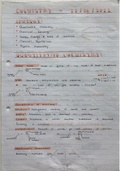
1. Types of variables
A variable can be seen as a label name of a characteristic of, say a subject which characteristic
depends from subject to subject (subject specific)
A variable is a recorded piece of information or a characteristic about a person, a case or unit in a
study. -- some characteristic info that is recorded for each person but it varies or changes from
person to person.
E.g.:
The label -- hair color may be a variable with possible characteristics varying from brown, blond, and
red -- categories
The subjects are sub-divided in different categories depending on the hair color.
The number of categories is determined naturally or chosen by the researcher or data collector.
There are different types of variables:
1. Qualitative variables: nominal, ordinal
2. Quantitative variables: interval, ratio
Qualitative variables are also called 'categorical' or 'discrete' variables. Although there are also
quantitative discrete variables, in applied statistics qualitative variables are often associated with
discrete variables. Qualitative variables place people into groups or categories.
All qualitative variables are discrete, but not all quantitative variables are.
Discrete variables can only take on a finite number of values, only integer.
Examples: volume of milk bought at a store, number of defective parts
Qualitative variables are often summarized using proportions and percentages.
The opposite of discrete is continuous, for example the volume of milk produced by a cow, the depth
at which a drilling team strikes oil.
These are measured on a continuous scale, not integer only.
Continuous can be divided into ratio (meaningful 0, meaningful ratio) and interval (non-meaningful
or arbitrary 0)
Nominal (qualitative) variables
Variables for which the scores are only intended to distinguish between different categories. The
scores itself don't have any meaning.
So no ordering based on magnitude or size.
Quantitative are often summarized by mean or average or the median.
Example
Hair color with categories brown, blond or red can be scored as 1, 2, 3 but also as 3, 1, 2.
, • The categories are not ordered
• The space between the scores does not have any meaning
• One cannot also say that, e.g. The score 2 is twice as much worth as the score 1.
Ordinal variables
Nominal variables for which the categories are ordered.
Ordering based on magnitude or size, there is a rank or an order in the categories.
Example
Social economic class is a variable with e.g. Categories low, middle and high. They can be scored as 1,
2 and 3 or 3, 2 and 1, as long as the ordering is preserved.
The underlying structure must not be invalidated. The space between the categories still doesn't
have any meaning and it can't be said that score 2 is twice as worth as score 1.
Quantitative variables, as opposed to qualitative variables, are often called 'continuous' or 'numeric'
variables or treated as continuous -- the variable can take any number within an interval of scores.
Quantitative variables are recorded numeric quantities, for each person or each case.
Quantitative variables can be converted into qualitative variables e.g. Age -> child/adult/senior
Interval variable
Contain the same information as nominal and ordinal variables, only now the differences between
scores can be meaningfully interpreted.
However, it doesn't make sense to say that 20 deg. C is twice as warm as 10. The reason for this is
because 'zero' is arbitrary and chosen as the freezing point of water.
Example
IQ is continuous, can take values between 0 and 200, and any value between these end points is
basically possible. IQ is an interval variable, because it contains all properties of an ordinal (and also
nominal) variable, but now the difference between scores do have some objective meaning. IQ
scores can be compared.
Also temperature on the Celsius scale. An increase of 10 from 10 to 20 is the same increase as from
25 to 35. In both cases we can say it's getting warmer by 10 degrees. Though subjectively, an
increase from 10 to 20 may be experienced differently than an increase from 25 to 35.
Ratio variable
Do contain the information that 20 can be interpreted as twice of 10.
Example
Age, the number of brothers
We can compare different scores of a ratio variable, because there exists a fixed zero value.
Strictly speaking the variable 'number of brothers' is discrete and not continuous. In applied
statistics, however, such ratio variables are often indicated as continuous variables.
The type of variable determines which statistical technique can be used in a proper way.
So also:
,
, 2. Histogram, bar chart
It's important to summarize data meaningfully.
Suppose that a data set about the scores of the final test is collected and that we want to describe
and summarize the most important characteristics of the observed measurements.
-Frequency distribution/table
A way to summarize the scores of the students is to create a so called frequency table. It consists of
rows and columns:
Vertically, there are 5 columns. In the 1st column, the scores are presented. In the second column,
the frequencies. In the last and 5th column, the cumulative percentages are presented.
Week 1
zaterdag 4 januari 2020
11:40
1. Types of variables
A variable can be seen as a label name of a characteristic of, say a subject which characteristic
depends from subject to subject (subject specific)
A variable is a recorded piece of information or a characteristic about a person, a case or unit in a
study. -- some characteristic info that is recorded for each person but it varies or changes from
person to person.
E.g.:
The label -- hair color may be a variable with possible characteristics varying from brown, blond, and
red -- categories
The subjects are sub-divided in different categories depending on the hair color.
The number of categories is determined naturally or chosen by the researcher or data collector.
There are different types of variables:
1. Qualitative variables: nominal, ordinal
2. Quantitative variables: interval, ratio
Qualitative variables are also called 'categorical' or 'discrete' variables. Although there are also
quantitative discrete variables, in applied statistics qualitative variables are often associated with
discrete variables. Qualitative variables place people into groups or categories.
All qualitative variables are discrete, but not all quantitative variables are.
Discrete variables can only take on a finite number of values, only integer.
Examples: volume of milk bought at a store, number of defective parts
Qualitative variables are often summarized using proportions and percentages.
The opposite of discrete is continuous, for example the volume of milk produced by a cow, the depth
at which a drilling team strikes oil.
These are measured on a continuous scale, not integer only.
Continuous can be divided into ratio (meaningful 0, meaningful ratio) and interval (non-meaningful
or arbitrary 0)
Nominal (qualitative) variables
Variables for which the scores are only intended to distinguish between different categories. The
scores itself don't have any meaning.
So no ordering based on magnitude or size.
Quantitative are often summarized by mean or average or the median.
Example
Hair color with categories brown, blond or red can be scored as 1, 2, 3 but also as 3, 1, 2.
, • The categories are not ordered
• The space between the scores does not have any meaning
• One cannot also say that, e.g. The score 2 is twice as much worth as the score 1.
Ordinal variables
Nominal variables for which the categories are ordered.
Ordering based on magnitude or size, there is a rank or an order in the categories.
Example
Social economic class is a variable with e.g. Categories low, middle and high. They can be scored as 1,
2 and 3 or 3, 2 and 1, as long as the ordering is preserved.
The underlying structure must not be invalidated. The space between the categories still doesn't
have any meaning and it can't be said that score 2 is twice as worth as score 1.
Quantitative variables, as opposed to qualitative variables, are often called 'continuous' or 'numeric'
variables or treated as continuous -- the variable can take any number within an interval of scores.
Quantitative variables are recorded numeric quantities, for each person or each case.
Quantitative variables can be converted into qualitative variables e.g. Age -> child/adult/senior
Interval variable
Contain the same information as nominal and ordinal variables, only now the differences between
scores can be meaningfully interpreted.
However, it doesn't make sense to say that 20 deg. C is twice as warm as 10. The reason for this is
because 'zero' is arbitrary and chosen as the freezing point of water.
Example
IQ is continuous, can take values between 0 and 200, and any value between these end points is
basically possible. IQ is an interval variable, because it contains all properties of an ordinal (and also
nominal) variable, but now the difference between scores do have some objective meaning. IQ
scores can be compared.
Also temperature on the Celsius scale. An increase of 10 from 10 to 20 is the same increase as from
25 to 35. In both cases we can say it's getting warmer by 10 degrees. Though subjectively, an
increase from 10 to 20 may be experienced differently than an increase from 25 to 35.
Ratio variable
Do contain the information that 20 can be interpreted as twice of 10.
Example
Age, the number of brothers
We can compare different scores of a ratio variable, because there exists a fixed zero value.
Strictly speaking the variable 'number of brothers' is discrete and not continuous. In applied
statistics, however, such ratio variables are often indicated as continuous variables.
The type of variable determines which statistical technique can be used in a proper way.
So also:
,
, 2. Histogram, bar chart
It's important to summarize data meaningfully.
Suppose that a data set about the scores of the final test is collected and that we want to describe
and summarize the most important characteristics of the observed measurements.
-Frequency distribution/table
A way to summarize the scores of the students is to create a so called frequency table. It consists of
rows and columns:
Vertically, there are 5 columns. In the 1st column, the scores are presented. In the second column,
the frequencies. In the last and 5th column, the cumulative percentages are presented.