PART III: SYSTEM ANALYSIS AND DESIGN EVALUATION
Chapter 4: Alternatives and Models in Decision Making
EBW2409: SYSTEMS APPROACH TO ENVIRONMENTAL MANAGEMENT
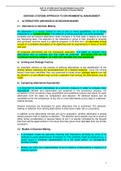
4 ALTERNATIVES AND MODELS IN DECISION MAKING
4.1 Alternatives in Decision Making
An alternative is a choice limited to one of two or more possibilities, as of things,
propositions, or courses of action, the selection of which precludes any other possibility. A
complete and all-inclusive alternative rarely emerges in its final state. It begins as a hazy
but interesting idea. The attention of the individual or group is then directed to analysis
and synthesis, and the result is a definite proposal. In its final form, an alternative should
consist of a complete description of its objectives and its requirements in terms of benefit
and cost.
All proposed alternatives are not necessarily attainable. It is better to consider many
alternatives than to overlook one that might be preferred. Alternatives that are not
considered cannot be adopted, no matter how desirable they may actually be.
a) Limiting and Strategic Factors
An important element of the process of defining alternatives is the identification of the
limiting factors restricting the accomplishment of a desired objective. Once the limiting
factors have been identified, they are examined to locate those strategic factors that can
be altered in a cost-efficient way so that a selection from among the alternatives may be
made.
b) Comparing Alternatives Equivalently
It is important to convert alternatives to a common measure in order to compare them
equivalently. Models and optimization are essential in the conversion process. On
completion of the conversion step, quantitative and qualitative outputs and inputs for each
alternative form the basis for comparison and decision. All identical factors can be
cancelled out for the comparison of any two or more alternatives at any step of a decision-
making process.
Several outcomes are evaluated for each alternative that is examined. The decision-
making or selection from among alternatives is often done under risk or uncertainty.
In addition to the alternatives formally set up for evaluation, another alternative is almost
always present–that of making no decision. The decision not to decide may be a result of
either active consideration or passive failure to act; it is usually motivated by the thought
that there will be opportunities in the future that may prove more desirable than any known
at present.
4.2 Models in Decision Making
A simulation model (X) assumes meaning and importance primarily by virtue of its
similarity to some phenomenon of interest (Y). The similarity might be physical (e.g., a
model plane–a miniature representation of a full sized plane), or conceptual–a
likeness of ideas.
Models can either be a representation of set of relations (mathematical or logical) or of
physical system.
1
, PART III: SYSTEM ANALYSIS AND DESIGN EVALUATION
Chapter 4: Alternatives and Models in Decision Making
4.2.1 Need for alternatives and models in decision-making
Models and their manipulation (or simulation) are useful tools in systems analysis.
They simplify the complexity facing the decision maker to help in the understanding of
the decision-making process.
Models are also required in decision making in order to utilize efficiently the limited
resources for various activities.
A model may be used as a representation of a system to be brought into being, or to
analyse a system already in being.
Experimental investigation using a model yields design or operational decisions in less
time and at less cost than direct manipulation of the system itself.
Simulation provides a means of deriving answers that would not be available if we
relied on more commonplace methods of data acquisition and analysis.
At times there is need to study systems to try to gain some insight into the
relationships among various components, or predict performance under some new
conditions being considered. Figure 4.1 presents different ways in which a system
might be studied.
Figure 4.1: Ways to study a system.
Experimenting with the actual system is usually costly and disruptive, hence the need
for experimenting with a model of the system.
4.2.2 Models and simulation terminologies
Physical models are geometric equivalents, either as miniatures, enlargements, or
duplicates made to the same scale. A wind tunnel is a physical model that engineers
build and use to simulate atmospheric conditions and air currents.
Mathematical models represent a system in terms of logical and quantitative
relationships that are then manipulated and changed to see how the model reacts, and
thus how the system would react, if the mathematical model is a valid one.
Once a mathematical model has been built, it must be examined to establish how it
can be used to answer the questions of interest about the system it is supposed to
represent. If the model is simple enough, it may be possible to work with its
relationships and quantities to get an exact analytical solution.
2
, PART III: SYSTEM ANALYSIS AND DESIGN EVALUATION
Chapter 4: Alternatives and Models in Decision Making
However, many systems are highly complex, so that valid mathematical models of
them are themselves complex, precluding any possibility of an analytical solution.
Therefore, the model must be studied by means of simulation (i.e., numerically
exercising the model for inputs in question to see how they affect the output measures
of performance).
A static simulation model is a representation of a system at a particular time, or one
that may be used to represent a system in which time simply plays no role.
Conversely, a dynamic simulation model represents a system as it evolves over time,
such as a conveyor system in a factory.
Deterministic vs stochastic simulation models. If a simulation model does not contain
any probabilistic (i.e., random) components, then it is deterministic; otherwise it is
stochastic (as in most models that simulate queuing and inventory systems).
Discrete models deal primarily with the study of waiting lines, with the objective of
determining such measures as the average waiting time and the length of the queue.
They are systems in which the changes are discontinuous. Each change in the state of
the system is called an event. For example, arrival or departure of a customer in a
queue is an event. Likewise, sale of an item from the stock or arrival of an order to
replenish the stock is an event in an inventory system. Therefore, the simulation of a
discrete system is often referred to as discrete-event simulation.
Continuous simulation models deal with systems whose behaviour changes
continuously with time. These models usually use differential equations to describe the
interactions among the different elements of the system. A typical example deals with
the study of world population dynamics.
Note that a discrete model is not always used to model a discrete system, and vice versa.
The decision on which model to use depends on the specific objectives of the study. For
example, traffic flow on a highway may be modelled as either discrete (if the
characteristics and movement of individual cars are important) or continuous (if the cars
are treated ‘in the aggregate’’).
4.2.3 Elements of computer simulation
The elements of computer simulation include: (1) assumptions upon which the simulation
is built, (2) parameters, or fixed values, (3) inputs, or independent variables,
(4) algorithms, or process decision rules, and (5) outputs. Ideally, theoretical principles
provide the underlying assumptions and algorithms.
Assumptions–research hypotheses are used as assumptions in computer simulation.
These are expressed as both null hypothesis that no relationship exists between the
independent and dependent variable, and an alternative hypothesis that there is a
linkage between the independent and dependent variable. Simulation differs from
observational and other types of empirical research in that additional assumptions,
which reflect the particular nature of the phenomenon being modelled, also are
identified. Assumptions also serve as a guide for decision processes incorporated into
simulation, and must therefore be compatible with those decision processes.
Parameters–models contain parameters, such as the birth and death rates of gorillas,
the rate of arrival of cars at a toll-booth, the likelihood of a car-driver to possess the
correct change for an automatic toll-booth, etc. In order for the models to be realistic,
these parameters must be chosen to correspond as closely as possible to reality, and
typically this means that before a model can be simulated, the real-life process must
be observed, and so sampled that parameter estimates can be obtained. In the case
of modelling forests, the forests must first of all be surveyed to assess the extent of
fungal infection. In the case of a doctor's waiting room, variables such as consultation
times and inter-arrival times must be observed. With epidemics, one needs reports of
3
Chapter 4: Alternatives and Models in Decision Making
EBW2409: SYSTEMS APPROACH TO ENVIRONMENTAL MANAGEMENT
4 ALTERNATIVES AND MODELS IN DECISION MAKING
4.1 Alternatives in Decision Making
An alternative is a choice limited to one of two or more possibilities, as of things,
propositions, or courses of action, the selection of which precludes any other possibility. A
complete and all-inclusive alternative rarely emerges in its final state. It begins as a hazy
but interesting idea. The attention of the individual or group is then directed to analysis
and synthesis, and the result is a definite proposal. In its final form, an alternative should
consist of a complete description of its objectives and its requirements in terms of benefit
and cost.
All proposed alternatives are not necessarily attainable. It is better to consider many
alternatives than to overlook one that might be preferred. Alternatives that are not
considered cannot be adopted, no matter how desirable they may actually be.
a) Limiting and Strategic Factors
An important element of the process of defining alternatives is the identification of the
limiting factors restricting the accomplishment of a desired objective. Once the limiting
factors have been identified, they are examined to locate those strategic factors that can
be altered in a cost-efficient way so that a selection from among the alternatives may be
made.
b) Comparing Alternatives Equivalently
It is important to convert alternatives to a common measure in order to compare them
equivalently. Models and optimization are essential in the conversion process. On
completion of the conversion step, quantitative and qualitative outputs and inputs for each
alternative form the basis for comparison and decision. All identical factors can be
cancelled out for the comparison of any two or more alternatives at any step of a decision-
making process.
Several outcomes are evaluated for each alternative that is examined. The decision-
making or selection from among alternatives is often done under risk or uncertainty.
In addition to the alternatives formally set up for evaluation, another alternative is almost
always present–that of making no decision. The decision not to decide may be a result of
either active consideration or passive failure to act; it is usually motivated by the thought
that there will be opportunities in the future that may prove more desirable than any known
at present.
4.2 Models in Decision Making
A simulation model (X) assumes meaning and importance primarily by virtue of its
similarity to some phenomenon of interest (Y). The similarity might be physical (e.g., a
model plane–a miniature representation of a full sized plane), or conceptual–a
likeness of ideas.
Models can either be a representation of set of relations (mathematical or logical) or of
physical system.
1
, PART III: SYSTEM ANALYSIS AND DESIGN EVALUATION
Chapter 4: Alternatives and Models in Decision Making
4.2.1 Need for alternatives and models in decision-making
Models and their manipulation (or simulation) are useful tools in systems analysis.
They simplify the complexity facing the decision maker to help in the understanding of
the decision-making process.
Models are also required in decision making in order to utilize efficiently the limited
resources for various activities.
A model may be used as a representation of a system to be brought into being, or to
analyse a system already in being.
Experimental investigation using a model yields design or operational decisions in less
time and at less cost than direct manipulation of the system itself.
Simulation provides a means of deriving answers that would not be available if we
relied on more commonplace methods of data acquisition and analysis.
At times there is need to study systems to try to gain some insight into the
relationships among various components, or predict performance under some new
conditions being considered. Figure 4.1 presents different ways in which a system
might be studied.
Figure 4.1: Ways to study a system.
Experimenting with the actual system is usually costly and disruptive, hence the need
for experimenting with a model of the system.
4.2.2 Models and simulation terminologies
Physical models are geometric equivalents, either as miniatures, enlargements, or
duplicates made to the same scale. A wind tunnel is a physical model that engineers
build and use to simulate atmospheric conditions and air currents.
Mathematical models represent a system in terms of logical and quantitative
relationships that are then manipulated and changed to see how the model reacts, and
thus how the system would react, if the mathematical model is a valid one.
Once a mathematical model has been built, it must be examined to establish how it
can be used to answer the questions of interest about the system it is supposed to
represent. If the model is simple enough, it may be possible to work with its
relationships and quantities to get an exact analytical solution.
2
, PART III: SYSTEM ANALYSIS AND DESIGN EVALUATION
Chapter 4: Alternatives and Models in Decision Making
However, many systems are highly complex, so that valid mathematical models of
them are themselves complex, precluding any possibility of an analytical solution.
Therefore, the model must be studied by means of simulation (i.e., numerically
exercising the model for inputs in question to see how they affect the output measures
of performance).
A static simulation model is a representation of a system at a particular time, or one
that may be used to represent a system in which time simply plays no role.
Conversely, a dynamic simulation model represents a system as it evolves over time,
such as a conveyor system in a factory.
Deterministic vs stochastic simulation models. If a simulation model does not contain
any probabilistic (i.e., random) components, then it is deterministic; otherwise it is
stochastic (as in most models that simulate queuing and inventory systems).
Discrete models deal primarily with the study of waiting lines, with the objective of
determining such measures as the average waiting time and the length of the queue.
They are systems in which the changes are discontinuous. Each change in the state of
the system is called an event. For example, arrival or departure of a customer in a
queue is an event. Likewise, sale of an item from the stock or arrival of an order to
replenish the stock is an event in an inventory system. Therefore, the simulation of a
discrete system is often referred to as discrete-event simulation.
Continuous simulation models deal with systems whose behaviour changes
continuously with time. These models usually use differential equations to describe the
interactions among the different elements of the system. A typical example deals with
the study of world population dynamics.
Note that a discrete model is not always used to model a discrete system, and vice versa.
The decision on which model to use depends on the specific objectives of the study. For
example, traffic flow on a highway may be modelled as either discrete (if the
characteristics and movement of individual cars are important) or continuous (if the cars
are treated ‘in the aggregate’’).
4.2.3 Elements of computer simulation
The elements of computer simulation include: (1) assumptions upon which the simulation
is built, (2) parameters, or fixed values, (3) inputs, or independent variables,
(4) algorithms, or process decision rules, and (5) outputs. Ideally, theoretical principles
provide the underlying assumptions and algorithms.
Assumptions–research hypotheses are used as assumptions in computer simulation.
These are expressed as both null hypothesis that no relationship exists between the
independent and dependent variable, and an alternative hypothesis that there is a
linkage between the independent and dependent variable. Simulation differs from
observational and other types of empirical research in that additional assumptions,
which reflect the particular nature of the phenomenon being modelled, also are
identified. Assumptions also serve as a guide for decision processes incorporated into
simulation, and must therefore be compatible with those decision processes.
Parameters–models contain parameters, such as the birth and death rates of gorillas,
the rate of arrival of cars at a toll-booth, the likelihood of a car-driver to possess the
correct change for an automatic toll-booth, etc. In order for the models to be realistic,
these parameters must be chosen to correspond as closely as possible to reality, and
typically this means that before a model can be simulated, the real-life process must
be observed, and so sampled that parameter estimates can be obtained. In the case
of modelling forests, the forests must first of all be surveyed to assess the extent of
fungal infection. In the case of a doctor's waiting room, variables such as consultation
times and inter-arrival times must be observed. With epidemics, one needs reports of
3