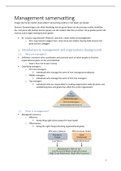
Management samenvatting
Vragen die hij kan stellen staan altijd in de learning outline in het begin van de ppt
Examen: Examenvragen zijn altijd tweeledig, ken de grote lijnen van de principes achter modellen
(bv. niet perse alle puntjes kunnen geven van elk model)->dan ben je erdoor. Als je goede punten wil
moet je ook je eigen mening kunnen geven.
• Bv. Is taylor nog relevant? Waarom, wanneer, onder welke omstandigheden.
o Dit is nog relevant volgens hem, maar als je een andere mening hebt moet je het
goed kunnen uitleggen
1. Introduction to management and organizations (background)
1.1. Who are managers?
• Definition: someone who coordinates and oversees work of other people so that the
organizational goals can be accomplished
o Goal is thus not to earn money
• Classifying managers:
o First line managers
Individuals who manage the work of non-managerial employees
o Middle managers
Individuals who manage the work of first-line managers
o Top managers
Individuals who are responsible for making organization wide decisions and
establishing plans and goals that affect the entire organization
1.2. What is management?
• Managerial concerns:
o Efficiency
Doing thing right (most output for least input)
o Effectiveness
Doing the right things (attaining organisational goals)
1
,1.3. What do managers do?
• Functional approach
o Planning
Defining goals, establishing strategies to achieve goals, developing plans to
integrate and coordinate activities
o Organizing
Arranging and structuring work to accomplish organizational goals
o Leading
Working with and through people to accomplish goals
o Controlling
Monitoring, comparing and correcting work
Planning, organizing, leading and controlling lead to achieving the goals of the
organization
• Management roles approach
o Interpersonal roles
Figurehead, leader, liaison
o Informational roles
Monitor, disseminator (versprijder), spokesperson
o Decisional roles
Disturbance handler, resource allocator, negotiator
• What managers actually do (Mintzberg)
o Interaction
With others, the organization and external context of the organization
o Reflection
Thoughtful thinking
o Action
Practical doing
Mintzberg found out that managers are 80% of their time busy with minor problems
• Skills approach
o Technical skills
Knowledge and proficiency in a specific field
o Human skills
The ability to work well with other people
o Conceptual skills
The ability to think and conceptualize about abstract and complex situations
concerning the organisation
• How the manager’s job is changing
o Increasing importance of customers
Customers are the reason that the organisation exists
2
, • Managing customer relationships is the responsibility of all managers
and employees
• Consistent high quality customer service is essential for survival
o Innovation
Doing things differently, exploring new territory and taking risks
• Managers should encourage employees to be aware of and act on
opportunities for innovation
1.4. What is an organization?
Definition: A deliberate arrangement of people to accomplish some specific purpose (that individuals
independently could not accomplish alone)
• Common characteristics of organisations
o Have a distinct purpose (goal)
o Composed of people
o Deliberate structure
1.5. Why study management?
• Universality of management
o There is a universal need for management:
All sizes of organisations (small – large)
All types of organisation (profit - non-profit)
All organisational levels (bottom – top)
All organizational areas (manufacturing, marketing, HR, accounting, …)
3
, 2. Management yesterday and today
Heel belangrijk hoofdstuk, altijd examenvraag over één van de historical schools: wat houdt die
school? Kijk er kritisch naar, in welke mate is dit nog relevant op de dag van vandaag? -> ja, ze zijn
allemaal nog relevant want we komen ze op de dag van vandaag allemaal nog tegen.
Hoofdlijnen weten, waarom zeggen die mensen dat en wat heeft dit van effect op de effectiviteit en
efficientie als manager?
2.1. Historical background of management
• Ancient management
o Egypt (pyramids) & China (great wall)
o Venetians (floating warships assembly lines)
• Adam smith
o The wealth of nations (1776)
Advocate the division of labor (job specialization) to increase the productivity
of workers
• Industrial revolution
o Substituted machine power for human labor
o Created large organisations in need for management
2.2. Scientific management
• Fredrick Winslow Taylor
o Father of scientific management
o Published principles of scientific management (1911)
o The theory of scientific management:
Using scientific methods to define ‘one best way’ for a job to be done
• Putting the right person on the job with the correct tools and
equipment
• Having a standardized method of doing the job
• Providing an economic incentive to the worker
o Taylor’s 4 principles of management
Develop a science for each element of an individual’s work
• This replaces the old rule-of-thumb method
Scientifically select and then train, teach and develop the worker
Cooperate with the workers to ensure that all work is done in accordance
with the principles of the science that has been developed
4
Vragen die hij kan stellen staan altijd in de learning outline in het begin van de ppt
Examen: Examenvragen zijn altijd tweeledig, ken de grote lijnen van de principes achter modellen
(bv. niet perse alle puntjes kunnen geven van elk model)->dan ben je erdoor. Als je goede punten wil
moet je ook je eigen mening kunnen geven.
• Bv. Is taylor nog relevant? Waarom, wanneer, onder welke omstandigheden.
o Dit is nog relevant volgens hem, maar als je een andere mening hebt moet je het
goed kunnen uitleggen
1. Introduction to management and organizations (background)
1.1. Who are managers?
• Definition: someone who coordinates and oversees work of other people so that the
organizational goals can be accomplished
o Goal is thus not to earn money
• Classifying managers:
o First line managers
Individuals who manage the work of non-managerial employees
o Middle managers
Individuals who manage the work of first-line managers
o Top managers
Individuals who are responsible for making organization wide decisions and
establishing plans and goals that affect the entire organization
1.2. What is management?
• Managerial concerns:
o Efficiency
Doing thing right (most output for least input)
o Effectiveness
Doing the right things (attaining organisational goals)
1
,1.3. What do managers do?
• Functional approach
o Planning
Defining goals, establishing strategies to achieve goals, developing plans to
integrate and coordinate activities
o Organizing
Arranging and structuring work to accomplish organizational goals
o Leading
Working with and through people to accomplish goals
o Controlling
Monitoring, comparing and correcting work
Planning, organizing, leading and controlling lead to achieving the goals of the
organization
• Management roles approach
o Interpersonal roles
Figurehead, leader, liaison
o Informational roles
Monitor, disseminator (versprijder), spokesperson
o Decisional roles
Disturbance handler, resource allocator, negotiator
• What managers actually do (Mintzberg)
o Interaction
With others, the organization and external context of the organization
o Reflection
Thoughtful thinking
o Action
Practical doing
Mintzberg found out that managers are 80% of their time busy with minor problems
• Skills approach
o Technical skills
Knowledge and proficiency in a specific field
o Human skills
The ability to work well with other people
o Conceptual skills
The ability to think and conceptualize about abstract and complex situations
concerning the organisation
• How the manager’s job is changing
o Increasing importance of customers
Customers are the reason that the organisation exists
2
, • Managing customer relationships is the responsibility of all managers
and employees
• Consistent high quality customer service is essential for survival
o Innovation
Doing things differently, exploring new territory and taking risks
• Managers should encourage employees to be aware of and act on
opportunities for innovation
1.4. What is an organization?
Definition: A deliberate arrangement of people to accomplish some specific purpose (that individuals
independently could not accomplish alone)
• Common characteristics of organisations
o Have a distinct purpose (goal)
o Composed of people
o Deliberate structure
1.5. Why study management?
• Universality of management
o There is a universal need for management:
All sizes of organisations (small – large)
All types of organisation (profit - non-profit)
All organisational levels (bottom – top)
All organizational areas (manufacturing, marketing, HR, accounting, …)
3
, 2. Management yesterday and today
Heel belangrijk hoofdstuk, altijd examenvraag over één van de historical schools: wat houdt die
school? Kijk er kritisch naar, in welke mate is dit nog relevant op de dag van vandaag? -> ja, ze zijn
allemaal nog relevant want we komen ze op de dag van vandaag allemaal nog tegen.
Hoofdlijnen weten, waarom zeggen die mensen dat en wat heeft dit van effect op de effectiviteit en
efficientie als manager?
2.1. Historical background of management
• Ancient management
o Egypt (pyramids) & China (great wall)
o Venetians (floating warships assembly lines)
• Adam smith
o The wealth of nations (1776)
Advocate the division of labor (job specialization) to increase the productivity
of workers
• Industrial revolution
o Substituted machine power for human labor
o Created large organisations in need for management
2.2. Scientific management
• Fredrick Winslow Taylor
o Father of scientific management
o Published principles of scientific management (1911)
o The theory of scientific management:
Using scientific methods to define ‘one best way’ for a job to be done
• Putting the right person on the job with the correct tools and
equipment
• Having a standardized method of doing the job
• Providing an economic incentive to the worker
o Taylor’s 4 principles of management
Develop a science for each element of an individual’s work
• This replaces the old rule-of-thumb method
Scientifically select and then train, teach and develop the worker
Cooperate with the workers to ensure that all work is done in accordance
with the principles of the science that has been developed
4