BIOD 151/A & P 1
Final Exam Study Guide
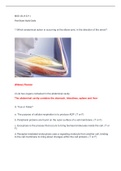
1.Which anatomical action is occurring at the elbow joint, in the direction of the arrow? (Elbow) Flexion
2.List two organs contained in the abdominal cavity.
The abdominal cavity contains the stomach, intestines, spleen and liver
3. True or False?
a. The purpose of cellular respiration is to produce ADP. (T or F) b. Peripheral proteins are found on the outer surface of a cell membrane. (T or F) c. Exocytosis is the process that occurs to bring biomacromolecules inside the cell. (T or
F) d. Receptor-mediated endocytosis uses a signaling molecule from another cell, binding to the cell membrane to bring about changes within the cell proteins. (T or F) e. Endocytosis is a passive process. It does not require cellular energy expenditure.(T or F) a. False- (ATP is produced, not ADP)
b. True
c. False- (This process is called endocytosis)
d. True
e. False- (Endocytosis is an active process and requires cellular energy)
4. Describe the position of the epigastric region relative to the umbilical region in anatomical position terms. Use a full sentence for your description.
The epigastric region is superior to the umbilical region.
(OR) The umbilical region is inferior to the epigastric region.
5. Look at the figure below. The right femur is moved in the direction of the arrow. What anatomical action term best describes this movement? Adduction (The femur is moving towards midline) 6. Note: Essay answers must clearly be in your own words.
In your own words, discuss Tay-Sachs disease. What organelle within the cell is impacted? What are the symptoms of the disease and why do they occur?
(1)Lysosomes
(2) buildup of toxic lipids inside the cell (biomacromolecules)
(3) disability and death
In the genetic disease known as Tay-Sachs, one of the normally present digestive
enzymes inside lysosomes is lacking. Thus, a toxic lipid in the brain cells cannot be broken down. The resulting buildup of lipids in these cells can cause intellectual disability and death.
7. Note: Essay answers must clearly be in your own words.
You are observing two cells under the microscope. They are the same type of eukaryotic cell but one appears much larger. Based on appearance alone, which one would you expect to be carrying out respiration at a more active rate, the larger or smaller cell? Explain why.
The smaller cell. Cells need to remain relatively small because as a cell expands the amount of surface area relative to the volume of the cell decreases. The smaller cell is more active because relative to its volume, its surface area is larger
than a bigger cell. With a larger surface area (relative to its volume) this allows the metabolic processes to occur faster.
8. Using the letters given, match the cell with the type of solution it has been placed in:
Correct!
A cell beginning to shrink Correct!
A red blood cell placed in distilled (purified) water Correct!
A cell neither shrinking or swelling hypertonic
hypotonic
isotonic
Final Exam Study Guide
1.Which anatomical action is occurring at the elbow joint, in the direction of the arrow? (Elbow) Flexion
2.List two organs contained in the abdominal cavity.
The abdominal cavity contains the stomach, intestines, spleen and liver
3. True or False?
a. The purpose of cellular respiration is to produce ADP. (T or F) b. Peripheral proteins are found on the outer surface of a cell membrane. (T or F) c. Exocytosis is the process that occurs to bring biomacromolecules inside the cell. (T or
F) d. Receptor-mediated endocytosis uses a signaling molecule from another cell, binding to the cell membrane to bring about changes within the cell proteins. (T or F) e. Endocytosis is a passive process. It does not require cellular energy expenditure.(T or F) a. False- (ATP is produced, not ADP)
b. True
c. False- (This process is called endocytosis)
d. True
e. False- (Endocytosis is an active process and requires cellular energy)
4. Describe the position of the epigastric region relative to the umbilical region in anatomical position terms. Use a full sentence for your description.
The epigastric region is superior to the umbilical region.
(OR) The umbilical region is inferior to the epigastric region.
5. Look at the figure below. The right femur is moved in the direction of the arrow. What anatomical action term best describes this movement? Adduction (The femur is moving towards midline) 6. Note: Essay answers must clearly be in your own words.
In your own words, discuss Tay-Sachs disease. What organelle within the cell is impacted? What are the symptoms of the disease and why do they occur?
(1)Lysosomes
(2) buildup of toxic lipids inside the cell (biomacromolecules)
(3) disability and death
In the genetic disease known as Tay-Sachs, one of the normally present digestive
enzymes inside lysosomes is lacking. Thus, a toxic lipid in the brain cells cannot be broken down. The resulting buildup of lipids in these cells can cause intellectual disability and death.
7. Note: Essay answers must clearly be in your own words.
You are observing two cells under the microscope. They are the same type of eukaryotic cell but one appears much larger. Based on appearance alone, which one would you expect to be carrying out respiration at a more active rate, the larger or smaller cell? Explain why.
The smaller cell. Cells need to remain relatively small because as a cell expands the amount of surface area relative to the volume of the cell decreases. The smaller cell is more active because relative to its volume, its surface area is larger
than a bigger cell. With a larger surface area (relative to its volume) this allows the metabolic processes to occur faster.
8. Using the letters given, match the cell with the type of solution it has been placed in:
Correct!
A cell beginning to shrink Correct!
A red blood cell placed in distilled (purified) water Correct!
A cell neither shrinking or swelling hypertonic
hypotonic
isotonic