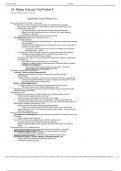
ACIDS ( H20 + At →
)
A }o+ H20 not included
in Kalkb expressions !
→
Proton donors
→
Ionize to form Ht ions
H20 always in equation !
→
*
Ionization = .
covalent bonds
produce new ions
-
strong acids
0 ionize completely →
every acid molecule will donate it is proton ! ( reason for high Ka value [ P] > &] )
acid molecules left at equilibrium
=
no
'
- :
High concern . H30 ions (hydronium)
low pH
-
-
good electrical conductors
-
large Ka value .
* Produce weak
conjugate base →
won't accept protons to form original acid .
=
reaction n reversible
weak acids
•
ionize partially :[ PK [ R]
:
low content . H30
t
Higher pH than SA
-
weak electrical conductors
-
-
small Ka value .
☒ Produce strong conjugate base =
remains of acid after →
will accept protons to form original acid
: reaction is reversible . a Ht is donated
, BASES H20 ④ not included
in Kalkb expressions !
→
Proton acceptors
( Hydroxide )
-
→
Dissociate to form OH
water never shown !
equation
→
in
☒
Dissociation = .
ionic bonds
existing ions
•
.
Strong bases
→
Dissociate completely =
every base will accept a proton ( [ P] > ④ large Kb )
-
→
high content .
OH
→
weak conjugate acid = will not donate protons to form original base .
: Not reversible
High pH
→
→
Good electrical conductors
→
Large Kb value
weak bases
Dissociate
partially
→
.
-
→
Low content .
OH
strong conjugate acid
→ =
readily donate protons to form original base .
: Reversible
pH
→
ower than SB
→
Weak electrical conductors
→
small Kb value .
)
A }o+ H20 not included
in Kalkb expressions !
→
Proton donors
→
Ionize to form Ht ions
H20 always in equation !
→
*
Ionization = .
covalent bonds
produce new ions
-
strong acids
0 ionize completely →
every acid molecule will donate it is proton ! ( reason for high Ka value [ P] > &] )
acid molecules left at equilibrium
=
no
'
- :
High concern . H30 ions (hydronium)
low pH
-
-
good electrical conductors
-
large Ka value .
* Produce weak
conjugate base →
won't accept protons to form original acid .
=
reaction n reversible
weak acids
•
ionize partially :[ PK [ R]
:
low content . H30
t
Higher pH than SA
-
weak electrical conductors
-
-
small Ka value .
☒ Produce strong conjugate base =
remains of acid after →
will accept protons to form original acid
: reaction is reversible . a Ht is donated
, BASES H20 ④ not included
in Kalkb expressions !
→
Proton acceptors
( Hydroxide )
-
→
Dissociate to form OH
water never shown !
equation
→
in
☒
Dissociation = .
ionic bonds
existing ions
•
.
Strong bases
→
Dissociate completely =
every base will accept a proton ( [ P] > ④ large Kb )
-
→
high content .
OH
→
weak conjugate acid = will not donate protons to form original base .
: Not reversible
High pH
→
→
Good electrical conductors
→
Large Kb value
weak bases
Dissociate
partially
→
.
-
→
Low content .
OH
strong conjugate acid
→ =
readily donate protons to form original base .
: Reversible
pH
→
ower than SB
→
Weak electrical conductors
→
small Kb value .