

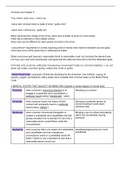
Criminal Law Chapter 3
True crime= actus reus + mens rea
-mens rea= criminal intent or state of mind, “guilty mind”
-actus reus= criminal act, “guilty act”
Mens rea drives the charge of the crime, actus reus is easier to prove (in most cases)
mens rea is irrelevant in strict liability crimes
Actus reus can be different for each person involved in the crime
-concurrence= requirement in crimes requiring proof of mental intent that the forbidden act and guilty
mind must occur at the same time or otherwise be linked
State must prove guilt beyond a reasonable doubt (a reasonable could not conclude the element was
not true), jury must vote unanimously and agree that the state has done this to find the defendant guilty
Criminal acts must be volitional (involuntary movement holds no criminal liability) → an act
does not make a person guilty unless the mind is guilty
-Model Penal Code= proposed criminal law developed by the American Law Institute, a group of
lawyers, judges, and teachers. Many states have modeled their criminal codes on the Model Penal
Code. *
4 MENTAL STATES THAT QUALIFY AS MENS REA (highest to lowest degree of mental fault)
Purposely when a person’s conscious objective is to Shooting up a school
engage in a particular act to accomplish a
particular result (acting “intentionally” ~plan)
Knowingly when a person knows the nature of their Shooting a particular person at
conduct will necessarily lead to a particular school knowing it could injure
result (acting “willfully”) someone else
Recklessly when a person consciously disregards or Bringing a gun to school and playing
creates a substantial and unjustifiable risk that with it and accidentally injuring
grossly deviates from a standard of care that a someone
reasonable person would follow under the
circumstances
Negligently when a person fails to be aware of a substantial Anesthesiologist giving too much
and unjustifiable risk that a dangerous anesthesia
circumstance exists or a prohibited result will
follow. Failure to use a standard of care that a
reasonable person would use.
True crime= actus reus + mens rea
-mens rea= criminal intent or state of mind, “guilty mind”
-actus reus= criminal act, “guilty act”
Mens rea drives the charge of the crime, actus reus is easier to prove (in most cases)
mens rea is irrelevant in strict liability crimes
Actus reus can be different for each person involved in the crime
-concurrence= requirement in crimes requiring proof of mental intent that the forbidden act and guilty
mind must occur at the same time or otherwise be linked
State must prove guilt beyond a reasonable doubt (a reasonable could not conclude the element was
not true), jury must vote unanimously and agree that the state has done this to find the defendant guilty
Criminal acts must be volitional (involuntary movement holds no criminal liability) → an act
does not make a person guilty unless the mind is guilty
-Model Penal Code= proposed criminal law developed by the American Law Institute, a group of
lawyers, judges, and teachers. Many states have modeled their criminal codes on the Model Penal
Code. *
4 MENTAL STATES THAT QUALIFY AS MENS REA (highest to lowest degree of mental fault)
Purposely when a person’s conscious objective is to Shooting up a school
engage in a particular act to accomplish a
particular result (acting “intentionally” ~plan)
Knowingly when a person knows the nature of their Shooting a particular person at
conduct will necessarily lead to a particular school knowing it could injure
result (acting “willfully”) someone else
Recklessly when a person consciously disregards or Bringing a gun to school and playing
creates a substantial and unjustifiable risk that with it and accidentally injuring
grossly deviates from a standard of care that a someone
reasonable person would follow under the
circumstances
Negligently when a person fails to be aware of a substantial Anesthesiologist giving too much
and unjustifiable risk that a dangerous anesthesia
circumstance exists or a prohibited result will
follow. Failure to use a standard of care that a
reasonable person would use.


