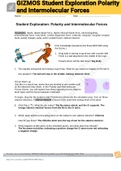
GIZMOS Student Exploration Polarity
and Intermolecular Forces
Name: Date:
Student Exploration: Polarity and Intermolecular Forces
Vocabulary: dipole, dipole-dipole force, dipole-induced dipole force, electronegativity,
intermolecular force, ionic bond, London dispersion force, molecule, nonpolar, nonpolar covalent
bond, partial charges, polar, polar covalent bond, valence electron
Prior Knowledge Questions (Do these BEFORE using
the Gizmo.)
1. A big bully is having a tug-of-war with a small child.
There is a ball attached to the middle of the rope.
m
er as
Toward whom will the ball move? Big Bully
co
eH w
2. Two equally strong kids are having a tug-of-war. What do you expect to happen to the ball in
o.
rs e
this situation? The ball will stay in the middle, halfway between them
ou urc
Gizmo Warm-up
Just like in a tug-of-war, atoms that are bonded to one another pull
o
on the electrons they share. In the Polarity and Intermolecular
aC s
Forces Gizmo, you will explore how these opposing forces relate to
vi y re
bond types and the forces between molecules.
To begin, drag the Na (sodium) and Cl (chlorine) atoms into the simulation area. Turn on Show
valence electrons. A valence electron is found in the outermost energy level of the atom.
ed d
ar stu
1. Click Play ( ). What do you notice? The Na atoms shrink, and the Ci expands. The
orange valence electron moves from the Na to the Ci atom.
is
2. Which atom seems to be pulling more on the sodium’s one valence electron? Chlorine
Th
How do you know? The chlorine atom won the tug of war for the valence electron.
3. What happens to the colors of the simulated atoms, and what does this indicate?
sh
The Na atoms turn blue, indicating a positive charge the Ci atom turns red indicating
a negative charge.
This study source was downloaded by 100000828331062 from CourseHero.com on 08-08-2021 07:53:17 GMT -05:00
2019
https://www.coursehero.com/file/94961071/HW-30docx/
, Get the Gizmo ready:
Activity A:
On the BOND POLARITY tab, click Reset ( ).
Bond polarity
Drag the atoms out of the simulation area.
Introduction: A neutral atom has the same number of protons as electrons. Atoms that gain
electrons become negatively charged, while those that lose electrons become positive. A polar
bond forms when shared electrons are pulled closer to one atom than another, causing the
bonded atoms to become partially charged. In a nonpolar bond, electrons are shared equally.
Question: What causes bonds to be polar or nonpolar?
1. Observe: Select the Show polar molecule inset checkbox. The animation shows the
probable location of electrons (orange dots) in a polar molecule.
A. What do you notice about the distribution of the electrons? There is one more
electron on the left side than on the right
m
er as
co
eH w
B. How does this electron distribution affect the charges of the bonded atoms? The
metal will lose electrons from their valence shells and become a positive ion
o.
rs e
while nonmetal gain electron and their valence shell becomes a negative ion.
ou urc
2. Observe: Turn on the Show nonpolar molecule inset.
o
A. How are the electrons in this molecule distributed? The electrons are evenly
aC s
distributed between the two atoms.
vi y re
B. Why do the bonded atoms remain neutral? Overall, neither atoms have gained or
lost electrons.
ed d
ar stu
3. Experiment: Turn off Show polar molecule inset and Show nonpolar molecule inset. Check
that Show valence electrons is turned on. Drag the Na and Cl atoms into the simulation
area. Click Play. Note the colors. Red indicates a negative charge, while blue indicates a
is
positive charge.
Th
A. Does a polar or nonpolar bond form? A polar bond
B. Try several other metal/nonmetal combinations. What do you notice about the bonds
sh
that form?
Ionic bonds are polar bonds that form between metal and nonmetal atoms. In this
bond, valence electrons are transferred from a metal to a nonmetal. Drag each of
these metal/nonmetal combinations into the Ionic bond bin on the upper right.
This study source was downloaded by 100000828331062 from CourseHero.com on 08-08-2021 07:53:17 GMT -05:00
2019
https://www.coursehero.com/file/94961071/HW-30docx/
and Intermolecular Forces
Name: Date:
Student Exploration: Polarity and Intermolecular Forces
Vocabulary: dipole, dipole-dipole force, dipole-induced dipole force, electronegativity,
intermolecular force, ionic bond, London dispersion force, molecule, nonpolar, nonpolar covalent
bond, partial charges, polar, polar covalent bond, valence electron
Prior Knowledge Questions (Do these BEFORE using
the Gizmo.)
1. A big bully is having a tug-of-war with a small child.
There is a ball attached to the middle of the rope.
m
er as
Toward whom will the ball move? Big Bully
co
eH w
2. Two equally strong kids are having a tug-of-war. What do you expect to happen to the ball in
o.
rs e
this situation? The ball will stay in the middle, halfway between them
ou urc
Gizmo Warm-up
Just like in a tug-of-war, atoms that are bonded to one another pull
o
on the electrons they share. In the Polarity and Intermolecular
aC s
Forces Gizmo, you will explore how these opposing forces relate to
vi y re
bond types and the forces between molecules.
To begin, drag the Na (sodium) and Cl (chlorine) atoms into the simulation area. Turn on Show
valence electrons. A valence electron is found in the outermost energy level of the atom.
ed d
ar stu
1. Click Play ( ). What do you notice? The Na atoms shrink, and the Ci expands. The
orange valence electron moves from the Na to the Ci atom.
is
2. Which atom seems to be pulling more on the sodium’s one valence electron? Chlorine
Th
How do you know? The chlorine atom won the tug of war for the valence electron.
3. What happens to the colors of the simulated atoms, and what does this indicate?
sh
The Na atoms turn blue, indicating a positive charge the Ci atom turns red indicating
a negative charge.
This study source was downloaded by 100000828331062 from CourseHero.com on 08-08-2021 07:53:17 GMT -05:00
2019
https://www.coursehero.com/file/94961071/HW-30docx/
, Get the Gizmo ready:
Activity A:
On the BOND POLARITY tab, click Reset ( ).
Bond polarity
Drag the atoms out of the simulation area.
Introduction: A neutral atom has the same number of protons as electrons. Atoms that gain
electrons become negatively charged, while those that lose electrons become positive. A polar
bond forms when shared electrons are pulled closer to one atom than another, causing the
bonded atoms to become partially charged. In a nonpolar bond, electrons are shared equally.
Question: What causes bonds to be polar or nonpolar?
1. Observe: Select the Show polar molecule inset checkbox. The animation shows the
probable location of electrons (orange dots) in a polar molecule.
A. What do you notice about the distribution of the electrons? There is one more
electron on the left side than on the right
m
er as
co
eH w
B. How does this electron distribution affect the charges of the bonded atoms? The
metal will lose electrons from their valence shells and become a positive ion
o.
rs e
while nonmetal gain electron and their valence shell becomes a negative ion.
ou urc
2. Observe: Turn on the Show nonpolar molecule inset.
o
A. How are the electrons in this molecule distributed? The electrons are evenly
aC s
distributed between the two atoms.
vi y re
B. Why do the bonded atoms remain neutral? Overall, neither atoms have gained or
lost electrons.
ed d
ar stu
3. Experiment: Turn off Show polar molecule inset and Show nonpolar molecule inset. Check
that Show valence electrons is turned on. Drag the Na and Cl atoms into the simulation
area. Click Play. Note the colors. Red indicates a negative charge, while blue indicates a
is
positive charge.
Th
A. Does a polar or nonpolar bond form? A polar bond
B. Try several other metal/nonmetal combinations. What do you notice about the bonds
sh
that form?
Ionic bonds are polar bonds that form between metal and nonmetal atoms. In this
bond, valence electrons are transferred from a metal to a nonmetal. Drag each of
these metal/nonmetal combinations into the Ionic bond bin on the upper right.
This study source was downloaded by 100000828331062 from CourseHero.com on 08-08-2021 07:53:17 GMT -05:00
2019
https://www.coursehero.com/file/94961071/HW-30docx/