HC1 Clinical Introduction to Multiple Sclerosis
Epidemiology:
There are 2-3 million MS-patients globally, in the Netherlands is that 1/2:1000 patients.
3:1 woman:men ratio (because of the hormones) and MS patients are 20-40 years old.
MS is a ‘western’ disease. Countries like china have low rates of MS.
Pathology:
MS is a disease of the central nervous system: brain and the spinal cord.
- The myelin around the axons is attacked by our own immune system.
Myelin is needed for quick signaling over the axon.
o Myelin is attacked = demyelination
Lesions can happen in the white matter, brain stam, cortex or spinal cord…
Axonal degeneration = loss of brain tissue
Cause:
1. Genetic factors: monozygotic twin has a very high chance of also getting MS, but if
one parent has MS the chance is much lower.
2. Environmental factors
o Vitamin D
o Smoking
o Early obesity
o Virus: EBV
Symptoms:
1. Optic neuritis:
o Decreased sharp sight, especially in the center
o Disturbance of color vision
o Pain behind the eye
2. Eye movement impairment:
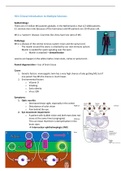
o A patient with dubble vision and both eyes does not
move at the same time (congregate).
This can mean that there is demyelination in the
brain stam.
→ Internuclear ophthalmoplegia (INO)
, 3. Lhermitte’s symptoms: lesions in the spinal cord, pain when they bend their
nek/back. This will cause an electric shock.
4. Motor functions impairment: lesions from the brain to the spinal cord. The location
of the lesion determines the affected motor function.
5. Bladder dysfunction: lesions in the lower spinal cord, sacral 2, 3, 4.
6. Psychological functions (common in 45-65%):
o Slowing of processing
o Attention deficit
o Disturbances of memory
o Disturbances of language functions
7. Fatigue: high prevalence, high impact for patients, but cause unknown
Diagnosis MS:
Remitting Relapsing MS (RRMS): patients can recover from the relapses. This phase can turn
into secondary progressive MS (SPMS), in this phase the patient cannot recover anymore.
The clinical symptoms are then higher than the clinical threshold, this can involve a walking
stick or wheelchair.
1. Remitting Relapsing MS
2. Secondary progressive MS
3. Primary progressive MS
,Dysfunction of variable areas of brain or spinal cord at more than one occasion in time:
→ Dissemination (verspreiding) in space and in time.
- Space: diagnosis with MRI (more than one lesion in one area)
- Time: > 1 relapses
o MRI: new lesions on follow-up MRI or contrast enhancing and non-contrast
enhancing (previous before the contrast lesions) lesions at the same time.
o Oligoclonal bands in the cerebrospinal fluid
Cerebrospinal fluid is obtained by a lumber biopsy in the spinal cord
1. Oligoclonal bands (IEF):
• sensitivity ± 90%
• specificity much lower
2. IgG-index
• sensitivity ± 65%
• even lower specificity
Oligoclonal bands: proteins in the cerebrospinal fluid secreted by the auto-antibodies.
Follow-up:
- Once a year or earlier when the patient asks for contact an appointment.
o Clinical, MRI, biochemical
, HC2 MS and therapy
MS is in a later phase very difficult to treat. This is the secondary progressive phase, where
the patient does not recover by themselves. This is the reason why the most treatments are
focused on the beginning of the disease, the relapsing-remitting phase.
Areas for therapy for MS:
Exacerbations
- Treatment of symptoms during exacerbations
- Steroids: 500-1000 mg IV 3-5 days
Symptomatic treatment
- Treatment of spasticity, urinary incontinence, pain etc..
Immunomodulation
- Prevention of exacerbations/relapses
There are a lot of drugs for treating MS:
- Switched to an earlier stage of the disease starting treatment
o Sooner: clinically isolated syndrome
- More agressive: Radiologically stable
- Continue for longer
→ The drugs for MS are very expensive.
Patient X = 28 years old
MRI shows demeylation regions
- Spinal fluid: oligoclonal bands in CSF
Conclusion: active RRMS
How would you choose the treatment?
- Effectiveness vs risk (side-effects)
- Short or long term: patient will be happy now but develop complications later on
- Mode of administration: pills, visit the hospital or injections
- Costs
Early therapy is important to delay the
accumulation of irreversible neurologic
damage and consequent disability.
Epidemiology:
There are 2-3 million MS-patients globally, in the Netherlands is that 1/2:1000 patients.
3:1 woman:men ratio (because of the hormones) and MS patients are 20-40 years old.
MS is a ‘western’ disease. Countries like china have low rates of MS.
Pathology:
MS is a disease of the central nervous system: brain and the spinal cord.
- The myelin around the axons is attacked by our own immune system.
Myelin is needed for quick signaling over the axon.
o Myelin is attacked = demyelination
Lesions can happen in the white matter, brain stam, cortex or spinal cord…
Axonal degeneration = loss of brain tissue
Cause:
1. Genetic factors: monozygotic twin has a very high chance of also getting MS, but if
one parent has MS the chance is much lower.
2. Environmental factors
o Vitamin D
o Smoking
o Early obesity
o Virus: EBV
Symptoms:
1. Optic neuritis:
o Decreased sharp sight, especially in the center
o Disturbance of color vision
o Pain behind the eye
2. Eye movement impairment:
o A patient with dubble vision and both eyes does not
move at the same time (congregate).
This can mean that there is demyelination in the
brain stam.
→ Internuclear ophthalmoplegia (INO)
, 3. Lhermitte’s symptoms: lesions in the spinal cord, pain when they bend their
nek/back. This will cause an electric shock.
4. Motor functions impairment: lesions from the brain to the spinal cord. The location
of the lesion determines the affected motor function.
5. Bladder dysfunction: lesions in the lower spinal cord, sacral 2, 3, 4.
6. Psychological functions (common in 45-65%):
o Slowing of processing
o Attention deficit
o Disturbances of memory
o Disturbances of language functions
7. Fatigue: high prevalence, high impact for patients, but cause unknown
Diagnosis MS:
Remitting Relapsing MS (RRMS): patients can recover from the relapses. This phase can turn
into secondary progressive MS (SPMS), in this phase the patient cannot recover anymore.
The clinical symptoms are then higher than the clinical threshold, this can involve a walking
stick or wheelchair.
1. Remitting Relapsing MS
2. Secondary progressive MS
3. Primary progressive MS
,Dysfunction of variable areas of brain or spinal cord at more than one occasion in time:
→ Dissemination (verspreiding) in space and in time.
- Space: diagnosis with MRI (more than one lesion in one area)
- Time: > 1 relapses
o MRI: new lesions on follow-up MRI or contrast enhancing and non-contrast
enhancing (previous before the contrast lesions) lesions at the same time.
o Oligoclonal bands in the cerebrospinal fluid
Cerebrospinal fluid is obtained by a lumber biopsy in the spinal cord
1. Oligoclonal bands (IEF):
• sensitivity ± 90%
• specificity much lower
2. IgG-index
• sensitivity ± 65%
• even lower specificity
Oligoclonal bands: proteins in the cerebrospinal fluid secreted by the auto-antibodies.
Follow-up:
- Once a year or earlier when the patient asks for contact an appointment.
o Clinical, MRI, biochemical
, HC2 MS and therapy
MS is in a later phase very difficult to treat. This is the secondary progressive phase, where
the patient does not recover by themselves. This is the reason why the most treatments are
focused on the beginning of the disease, the relapsing-remitting phase.
Areas for therapy for MS:
Exacerbations
- Treatment of symptoms during exacerbations
- Steroids: 500-1000 mg IV 3-5 days
Symptomatic treatment
- Treatment of spasticity, urinary incontinence, pain etc..
Immunomodulation
- Prevention of exacerbations/relapses
There are a lot of drugs for treating MS:
- Switched to an earlier stage of the disease starting treatment
o Sooner: clinically isolated syndrome
- More agressive: Radiologically stable
- Continue for longer
→ The drugs for MS are very expensive.
Patient X = 28 years old
MRI shows demeylation regions
- Spinal fluid: oligoclonal bands in CSF
Conclusion: active RRMS
How would you choose the treatment?
- Effectiveness vs risk (side-effects)
- Short or long term: patient will be happy now but develop complications later on
- Mode of administration: pills, visit the hospital or injections
- Costs
Early therapy is important to delay the
accumulation of irreversible neurologic
damage and consequent disability.