

INTRODUCTION & HYPOTHALAMUS
ENDOCRINE SYSTEM VS NERVOUS SYSTEM
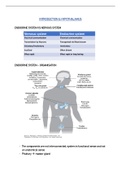
ENDOCRINE SYSTEM – ORGANISATION
‐ The components are not interconnected; system is functional sense and not
an anatomical sense
‐ Pituitary → master gland
,THE ENDOCRINE SYSTEM
‐ Endocrine glands are hormone secreting glands
‐ Definition: chemical messengers that are secreted into the bloodstream and
it affects the activity of the cells – specifically called target cells (cells with
receptors for the specific hormone)
• Chemicals – released in one part of body
• Travel through bloodstream
• Affect activity of cells – often distant parts of the body
• Affected cells → target cells – have hormone-specific receptors
HORMONE CLASSIFICATION – AMINES
‐ Small group of hormones derived from Tyrosine
‐ Made up of Catecholamines and Thyroid hormones
‐ Catecholamines:
• An example is Adrenaline & Noradrenaline
• Water-soluble
• Don’t require carrier proteins in plasma
• Receptors are located on membrane surface of the cell
‐ Thyroid hormones:
• An example is T3 & T4
• Poor solubility in water
• Require carrier proteins in the blood
, • Receptors are located inside cell (intracellularly)
HORMONE CLASSIFICATION – PEPTIDE & PROTEIN HORMONES
‐ Examples: growth hormone, insulin, glucagon, prolactin etc.
‐ Largest class of hormones
‐ Generally, water soluble
‐ Don’t require molecules in blood
‐ Receptors located on membrane surface
HORMONE CLASSIFICATION – STEROID HORMONES
‐ Examples: cortisol, aldosterone, oestrogen, progesterone etc.
‐ Synthesised from cholesterol
‐ Not stored in vesicles
‐ Rapidly diffused out of cell once synthesised – this is due to the high lipid
solubility
‐ Require carrier proteins in blood – due to low water solubility
‐ Free steroid hormones enter target cells primarily by passive diffusion
HYPOTHALAMUS
‐ Concerned with homeostasis
‐ Located in the brain, below the thalamus
‐ Funnel-shapes stalk → infundibulum connects the hypothalamus to the
pituitary
‐ Liberin’s & Statins regulate pituitary hormone secretion
‐ Links nervous and endocrine systems by way of pituitary gland
, HYPOTHALAMUS – SECRETES LIBERIN’S
‐ Liberin’s → releasing factors/ releasing hormones
• Thyrotropin-releasing hormone (TRH) – stimulates secretion of
Thyroid stimulating hormone (TSH)
• Corticotropin-releasing hormone (CRH) – stimulates secretion of
Adrenocorticotropic hormone (ACTH)
• Gonadotropin-releasing hormone (GnRH) – stimulated secretion of
follicle stimulating hormone (FSH) & Luteinising hormone (LH)
• Growth hormone-releasing hormone (GHRH) – stimulates secretion
of growth hormone, human (GH)
HYPOTHALAMUS – SECRETES STATINS
‐ Statins → inhibiting factors/ inhibiting hormones
• Inhibit hormone secretion
• Growth hormone inhibiting hormone (GHIH) – Somatostatin
• Prolactin inhibiting hormone/ factor (PIH/PIF)
ENDOCRINE SYSTEM VS NERVOUS SYSTEM
ENDOCRINE SYSTEM – ORGANISATION
‐ The components are not interconnected; system is functional sense and not
an anatomical sense
‐ Pituitary → master gland
,THE ENDOCRINE SYSTEM
‐ Endocrine glands are hormone secreting glands
‐ Definition: chemical messengers that are secreted into the bloodstream and
it affects the activity of the cells – specifically called target cells (cells with
receptors for the specific hormone)
• Chemicals – released in one part of body
• Travel through bloodstream
• Affect activity of cells – often distant parts of the body
• Affected cells → target cells – have hormone-specific receptors
HORMONE CLASSIFICATION – AMINES
‐ Small group of hormones derived from Tyrosine
‐ Made up of Catecholamines and Thyroid hormones
‐ Catecholamines:
• An example is Adrenaline & Noradrenaline
• Water-soluble
• Don’t require carrier proteins in plasma
• Receptors are located on membrane surface of the cell
‐ Thyroid hormones:
• An example is T3 & T4
• Poor solubility in water
• Require carrier proteins in the blood
, • Receptors are located inside cell (intracellularly)
HORMONE CLASSIFICATION – PEPTIDE & PROTEIN HORMONES
‐ Examples: growth hormone, insulin, glucagon, prolactin etc.
‐ Largest class of hormones
‐ Generally, water soluble
‐ Don’t require molecules in blood
‐ Receptors located on membrane surface
HORMONE CLASSIFICATION – STEROID HORMONES
‐ Examples: cortisol, aldosterone, oestrogen, progesterone etc.
‐ Synthesised from cholesterol
‐ Not stored in vesicles
‐ Rapidly diffused out of cell once synthesised – this is due to the high lipid
solubility
‐ Require carrier proteins in blood – due to low water solubility
‐ Free steroid hormones enter target cells primarily by passive diffusion
HYPOTHALAMUS
‐ Concerned with homeostasis
‐ Located in the brain, below the thalamus
‐ Funnel-shapes stalk → infundibulum connects the hypothalamus to the
pituitary
‐ Liberin’s & Statins regulate pituitary hormone secretion
‐ Links nervous and endocrine systems by way of pituitary gland
, HYPOTHALAMUS – SECRETES LIBERIN’S
‐ Liberin’s → releasing factors/ releasing hormones
• Thyrotropin-releasing hormone (TRH) – stimulates secretion of
Thyroid stimulating hormone (TSH)
• Corticotropin-releasing hormone (CRH) – stimulates secretion of
Adrenocorticotropic hormone (ACTH)
• Gonadotropin-releasing hormone (GnRH) – stimulated secretion of
follicle stimulating hormone (FSH) & Luteinising hormone (LH)
• Growth hormone-releasing hormone (GHRH) – stimulates secretion
of growth hormone, human (GH)
HYPOTHALAMUS – SECRETES STATINS
‐ Statins → inhibiting factors/ inhibiting hormones
• Inhibit hormone secretion
• Growth hormone inhibiting hormone (GHIH) – Somatostatin
• Prolactin inhibiting hormone/ factor (PIH/PIF)


