ATI RN Fundamentals Proctored Focus Exam
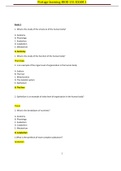
ATI RN Fundamentals Proctored Focus Exam A nurse educator is reviewing w/a newly hired nurse the difference in clinical manifestations of a localized vs. a systemic infection. The nurse indicates understanding when she states that which of the following are clinical manifestations of a systemic infection? Select all. A. Fever B. Malaise C. Edema D. Pain or tenderness E. Increase in pulse & respiratory rate A, B, E Rational: Edema and pain and tenderness is localized A nurse is teaching a young adult client about health promotion & illness prevention. Which of the following statements by the client indicates an understanding of the teaching? A. "I already had my immunizations as a child, so I'm protected in that area." B. "It is important to schedule routine health care visits even if I'm feeling well." C. "If I'm having any discomfort, I'll just got to an urgent care center." D. "If I am felling stressed, I will remind myself that this is something I should expect." B. "It is important to schedule routine health care visits even if I'm feeling well." Rational: Routine health screenings are important at any age A nursing instructor is explaining the various stages of the lifespan to a group of nursing students. The nurse should offer which of the following behaviors by a young adult as an example of appropriate psychosocial development? A. Becoming actively involved in providing guidance to the next generation B. Adjusting to major changes in roles and relationships due to losses C. Devoting a great deal of time to establishing an occupation D. Finding oneself "sandwiched" in between & being responsible for 2 generations C. Devoting a great deal of time to establishing an occupation Rational: Exploring and establishing career options & establishing oneself is important developmental task in a young adult A nurse is counseling a young adult who describes having difficulty dealing w/several issues. Which of the following problems the client verbalized should the nurse identify as the priority for further assessment & intervention? A. "I have my own apartment now, but it's not easy living away from my parents." B. "It's been so stressful for me to even think about having my own family." C. "I don't even know who I am yet, & now I'm supposed to know what to do." D. "My girlfriend is pregnant, & I don't think I have what it takes to be a good father." C. "I don't even know who I am yet, & now I'm supposed to know what to do." Rational: Applying Erikson stages of development, knowing oneself is done in adolescence, and this requires the most urgent help A nurse is reviewing safety precautions w/a group of young adults at a community health fair. Which of the following recommendations should the nurse include specifically for this age group? Select all. A. Install bath rails & grab bars in bathrooms B. Wear a helmet while skiing C. Install a carbon monoxide detector D. Secure firearms in a safe location E. Remove throw rugs from the home B, C, D Rational: A is recommended for older adults and E as well for risk of falls A nurse is reviewing the CDC's immunization recommendations w/a young adult client. Which of the following recommendations should the nurse include in this discussion? Select all. A. Human papillomavirus B. Measles, mumps, rubella C. Varicella D. Haemophilus influenzae type b E. Polio A, B, C Rational: D is not for after 18 months of age and polio is also given as a child and not usually beyond 18 yrs old A nurse is caring for an 82-yr-old client in the ER who has an oral body temp of 38.3 C (101 F), a pulse rate of 114/min, & a RR of 22/min. He is restless & his skin is warm. Which of the following are appropriate nursing interventions for this client? Select all. A. Obtain culture specimens before initiating antimicrobials B. Restrict the client's oral fluid intake C. Encourage the client to limit activity & rest D. Allow the client to shiver to dispel excess heat E. Assist the client w/oral hygiene frequently A, C, E Rational: The nurse should prevent shivering & encourage the client to increase fluids. Oral hygiene helps prevent cracking of dry mucous membranes of the mouth & lips. A nurse is instructing an AP in caring for a client who has a low platelet count as a result of chemo. Which of the following is the nurse's priority instruction for measuring vital signs for this client? A. "Don't measure the client's temp rectally." B. "Count the client's radial pulse for 30 sec & multiply by 2." C. "Don't let the client know you are counting her respirations." D. "Let the client rest for 5 mins before you measure her BP." A. "Don't measure the client's temp rectally." Rational: The greatest risk to a client w/a low platelet count is injury that results in bleeding, obtaining a temp this way increases the risk for bleeding. A nurse is instructing a group of nursing students in measuring a client's RR. Which of the following guidelines should the nurse include? Select all. A. Place the client in semi-Fowler's position B. Have the client rest an arm across the abdomen C. Observe 1 full respiratory cycle before counting the rate D. Count the rate for 1 min if it is regular E. Count & report any signs the client demonstrates A, B, C Rational: As for D, this is if the rate is irregular after initial count, for E, sighs are expected & don't need to be reported A nurse who is admitting a client who has a fractured femur obtains a BP reading of 140/94 mmHg. The client denies any history of HTN. Which of the following actions should the nurse take next? A. Request a prescription for an antihypertensive med B. Ask the client if she is having pain C. Request a prescription for an anti-anxiety med D. Return in 30min to recheck the client's BP B. Ask the client if she is having pain Rational: Perform a pain assessment would be the appropriate action to take next A nurse is performing an admission assessment on a client. When measuring her vital signs, the nurse finds that her radial pulse rate 68/min & her simultaneous apical pulse rate is 84/min. What is the client's pulse deficit? 16/min Rational: The pulse deficit is the difference between the apical & radial pulse rates. 84-68=16 A nurse is caring for a client who will perform fecal occult blood testing at home. Which of the following info should the nurse include when explaining the procedure to the client? A. Eating more protein is optimal prior to testing B. One stool specimen is sufficient for testing C. A red color change indicates a positive test D. The specimen cannot be contaminated D. The specimen cannot be contaminated Rational: The stool specimens cannot be contaminated with water or urine A nurse is talking w/a client who reports constipation. When the nurse discusses dietary changes that can help prevent constipation, which of the following foods should the nurse recommend? A. Macaroni & cheese B. Fresh fruit & whole wheat toast C. Rice pudding & ripe bananas D. Roast chicken & white rice B. Fresh fruit & whole wheat toast Rational: A high-fiber diet promotes normal bowel elimination A nurse is caring for a client who
Written for
- Institution
- ATI RN Fundamentals Proctored Focus
- Course
- ATI RN Fundamentals Proctored Focus
Document information
- Uploaded on
- December 13, 2021
- Number of pages
- 29
- Written in
- 2022/2023
- Type
- Exam (elaborations)
- Contains
- Questions & answers
Subjects
-
ati rn fundamentals proctored focus exam
-
a nurse educator is reviewing wa newly hired nurse the difference in clinical manifestations of a localized vs a systemic infection the nurse indicates unde

Also available in package deal