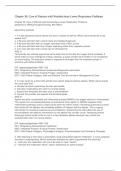
Chapter 69- Management of Patients With Musculoskeletal Trauma
Chapter 69- Management of Patients With Musculoskeletal Trauma Brunner: Medical-Surgical Nursing, 11th Edition Test Bank Chapter 69: Management of Patients With Musculoskeletal Trauma Multiple Choice 1. The emergency room nurse delivers a report on a patient that is arriving on the orthopedic floor and states that the patient has a fracture of the nose that has resulted in a skin tear and involvement of the mucous membranes of the nasal passages. The orthopedic nurse is aware that this description likely indicates which type of fracture? A) Compression B) Compound C) Impacted D) Transverse Ans: B Chapter: 69 Cognitive Level: Analysis Difficulty: Moderate Integrated Process: Nursing Process Objective: 3 Patient Needs: D-4 Feedback: A compound fracture involves damage to the skin or mucous membranes and is also called an open fracture. A compression fracture involves compression of bone and is seen in vertebral fractures. An impacted fracture occurs when a bone fragment is driven into another bone fragment. A transverse fracture occurs straight across the bone shaft. 2. The nurse is preparing a care plan for a patient who has sustained a long bone fracture. Which intervention will the nurse include in the care plan to enhance fracture healing? A) Limit weight bearing and exercising B) Monitor color, temperature, and pulses of the affected extremity C) Avoid immobilization of the fracture fragments D) Administer high doses of corticosteroids Ans: B Chapter: 69 Cognitive Level: Application Difficulty: Difficult Integrated Process: Nursing Process Objective: 6 Patient Needs: D-3 Feedback: The nurse should monitor for sufficient blood supply by assessing the color, temperature, and pulses of the affected extremity, as adequate blood supply enhances the healing of a fracture. Factors that inhibit fracture healing include inadequate or lack of immobilization of the fracture fragments and administration of corticosteroids. Weight-bearing exercises are encouraged for patients with long bone fractures. 3. An athletic patient presents to the ambulatory care facility complaining of pain in the right knee with weight bearing. He states that two days ago he ran 10 miles and woke up the next morning with knee pain. Upon examination, the nurse notes edema, tenderness, muscle spasms and, ecchymosis. Based upon these symptoms, the nurse anticipates the patient has experienced a:A) First-degree strain B) Second-degree strain C) First-degree sprain D) Second-degree sprain Ans: B Chapter: 69 Cognitive Level: Analysis Difficulty: Difficult Integrated Process: Nursing Process Objective: 1 Patient Needs: D-4 Feedback: A second-degree strain involves tearing of muscle fibers and is manifested by notable loss of load-bearing strength with accompanying edema, tenderness, muscle spasm, and ecchymosis. A first-degree strain involves tearing of few muscle fibers and is accompanied by minor edema, tenderness, and mild muscle spasm, without noticeable loss of function. A firstdegree sprain is caused by tearing of few ligamentous fibers and is manifested by mild edema, local tenderness, and pain that is elicited when the joint is moved, but there is no joint instability. A second-degree sprain involves tearing of nerve fibers and results in increased edema, tenderness, pain with motion, joint instability, and partial loss of normal joint function. 4. The nurse preparing the patient who has sustained a sprain of the left ankle for discharge from the emergency room to home correctly instructs the patient to: A) Apply heat for the first 24 to 48 hours after injury. B) Maintain the ankle in a dependent position. C) Exercise hourly by performing rotation exercises of the ankle. D) Apply an elastic compression bandage to the ankle. Ans: D Chapter: 69 Cognitive Level: Application Difficulty: Easy Integrated Process: Teaching/Learning Objective: 2 Patient Needs: D-3 Feedback: Treatment of a sprain consists of resting and elevating the affected part, applying cold, and using a compression bandage. After the acute inflammatory stage (usually 24 to 48 hours after injury), heat may be applied intermittently. 5. The nurse caring for a patient with an open fracture of the radius is developing a care plan for the patient. The nurse will assign priority to which of the following nursing diagnoses? A) Risk for infection B) Risk for activity intolerance C) Risk for imbalanced nutrition, less than body requirements D) Risk for powerlessness Ans: A Chapter: 69 Cognitive Level: Application Difficulty: Moderate Integrated Process: Nursing Process Objective: 4 Patient Needs: D-3 Feedback: All of these nursing diagnoses may be pertinent to the care of a patient with an open fracture of the radius, but the highest priority diagnosis is risk for infection of osteomyelitis and tetanus. The objectives of management are to prevent infection of the wound, soft tissue, and bone and to promote healing. Another priority diagnosis for a patient with an open fracture would be risk for peripheral neurovascular dysfunction.
Written for
- Institution
-
University Of Pittsburgh - Pittsburgh
- Course
-
BIOSC 0050
Document information
- Uploaded on
- December 10, 2021
- Number of pages
- 20
- Written in
- 2021/2022
- Type
- Exam (elaborations)
- Contains
- Questions & answers
Subjects
-
chapter 69 management of patients with musculoskeletal trauma
-
brunner medical surgical nursing
-
11th edition test bank chapter 69 management of patients with musculoskeletal trauma multiple choice