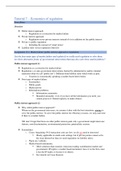
Tutorial 7 – Economics of regulation
PowerPoint
Overview
❖ Public interest approach
o Regulation as a correction for market failure
❖ Private interest approach
o Regulation serves private interests instead of (or in addition to) the public interest
❖ Private vs public regulation
o Including the concept of ‘smart mixes’
❖ Liability rules versus regulation (Shavell)
Assignment 13.1: Market failure (public interest approach to regulation)
List the four main types of market failure and explain if we really need regulation to solve them.
Are there alternative forms of (government) intervention that may also solve these market failures?
Public interest approach (1)
❖ Regulation as a correction for market failure
❖ Regulation = ex ante government intervention, backed by administrative and/or criminal
sanctions (what we call ‘public law’). Different from liability rules which work ex post.
o Taxation is economically speaking a market-based intervention.
❖ Four types of market failure:
o Externalities
o Public goods
o Market power
o Information problems
▪ Information asymmetry
▪ Bounded rationality: even if you have all the information you need, you
cannot process it: limited capacity to make choices.
Public interest approach (2)
❖ Why called public interest approach?
Whenever the government intervenes, we assume it does with the best intentions: aiming to
serve the public interest. To serve the public interest for efficiency reasons, we only intervene
if there is a market failure.
NB: don’t forget that there are other public interest goals why a government might intervene:
fairness, non-discrimination, environmental protection, paternalistic reasons.
❖ Externalities
o Coase: bargaining → if transaction costs are low, we do not need to intervene!
▪ Mostly applicable in small scale settings, but if private parties cannot solve
the issue themselves than we need regulation (or liability rules);
o Pigou tax / subsidy;
o Market-based instruments;
▪ Other solutions than taxation: emissions trading (combination market and
government), IP-rights (= market based instrument: leave it to the firm, once
it has the IP-rights, to license it to others);
▪ See tutorial on Coase theorem.
, ❖ Public goods
o Subsidize private provision of public good
o Production by government, financed by taxes
o Creating a market by introducing property rights (intellectual property rights) - see
lecture on property law
❖ The four main types of market failure:
1) Externalities: costs (or benefits spilling over) imposed on third parties as a result of
positive or negative side effects of production and/or consumption.
• Solution: have to be internalized with taxes or subsidies.
• Can we use regulation? Imposing conditions on the license (pollution),
occupational health and safety regulations, monitoring by inspectors, making sure
no one works longer than x amount of hours in a row behind the same machine,
and protective equipment for accidents at the workplace, traffic safety: speed
limits.
2) Public goods: goods that are non-rivalrous and non-excludable
• Main problem is the free-rider problem: because of this there will be insufficient
production of public goods. If parties produce it, they cannot fund it, this is the
problem of not being able to exclude people from using it. Everyone can use it for
free once it is there.
• Can be solved using taxation (government can force you to pay in a fact) or
subsidies for private production.
• Can we use regulation? In principle no for pure public goods.
NB: tragedy of the commons (not purely public good): private ownership is a
possibility.
3) Market power: lack of competition → Monopoly (leading to high price, lower output,
efficiency losses)
• Can we use regulation (when the problem is distorted or lack of competition)?
1) Competition policy: cartels, abuse of dominant position, merger control (see
tutorial on competition law), or 2) (price/quality) regulation of natural
monopolies.
NB: remember that in some situations it might be better to led only a few
companies (monopoly, etc.) exist: economies of scale, ever decreasing costs. That
doesn’t mean that we shouldn’t regulate – we might have to regulate price or
quality.
4) Information problems
• We only focus on asymmetric information. This is relevant in a few contexts:
1. Insurance: remedies for adverse selection and moral hazard
o Adverse selection
Insurance premium only reflects average risk. So people that are more
likely to need the insurance will take the insurance, but those that are
not so likely to need it will not take it, because the premium is too high.
PowerPoint
Overview
❖ Public interest approach
o Regulation as a correction for market failure
❖ Private interest approach
o Regulation serves private interests instead of (or in addition to) the public interest
❖ Private vs public regulation
o Including the concept of ‘smart mixes’
❖ Liability rules versus regulation (Shavell)
Assignment 13.1: Market failure (public interest approach to regulation)
List the four main types of market failure and explain if we really need regulation to solve them.
Are there alternative forms of (government) intervention that may also solve these market failures?
Public interest approach (1)
❖ Regulation as a correction for market failure
❖ Regulation = ex ante government intervention, backed by administrative and/or criminal
sanctions (what we call ‘public law’). Different from liability rules which work ex post.
o Taxation is economically speaking a market-based intervention.
❖ Four types of market failure:
o Externalities
o Public goods
o Market power
o Information problems
▪ Information asymmetry
▪ Bounded rationality: even if you have all the information you need, you
cannot process it: limited capacity to make choices.
Public interest approach (2)
❖ Why called public interest approach?
Whenever the government intervenes, we assume it does with the best intentions: aiming to
serve the public interest. To serve the public interest for efficiency reasons, we only intervene
if there is a market failure.
NB: don’t forget that there are other public interest goals why a government might intervene:
fairness, non-discrimination, environmental protection, paternalistic reasons.
❖ Externalities
o Coase: bargaining → if transaction costs are low, we do not need to intervene!
▪ Mostly applicable in small scale settings, but if private parties cannot solve
the issue themselves than we need regulation (or liability rules);
o Pigou tax / subsidy;
o Market-based instruments;
▪ Other solutions than taxation: emissions trading (combination market and
government), IP-rights (= market based instrument: leave it to the firm, once
it has the IP-rights, to license it to others);
▪ See tutorial on Coase theorem.
, ❖ Public goods
o Subsidize private provision of public good
o Production by government, financed by taxes
o Creating a market by introducing property rights (intellectual property rights) - see
lecture on property law
❖ The four main types of market failure:
1) Externalities: costs (or benefits spilling over) imposed on third parties as a result of
positive or negative side effects of production and/or consumption.
• Solution: have to be internalized with taxes or subsidies.
• Can we use regulation? Imposing conditions on the license (pollution),
occupational health and safety regulations, monitoring by inspectors, making sure
no one works longer than x amount of hours in a row behind the same machine,
and protective equipment for accidents at the workplace, traffic safety: speed
limits.
2) Public goods: goods that are non-rivalrous and non-excludable
• Main problem is the free-rider problem: because of this there will be insufficient
production of public goods. If parties produce it, they cannot fund it, this is the
problem of not being able to exclude people from using it. Everyone can use it for
free once it is there.
• Can be solved using taxation (government can force you to pay in a fact) or
subsidies for private production.
• Can we use regulation? In principle no for pure public goods.
NB: tragedy of the commons (not purely public good): private ownership is a
possibility.
3) Market power: lack of competition → Monopoly (leading to high price, lower output,
efficiency losses)
• Can we use regulation (when the problem is distorted or lack of competition)?
1) Competition policy: cartels, abuse of dominant position, merger control (see
tutorial on competition law), or 2) (price/quality) regulation of natural
monopolies.
NB: remember that in some situations it might be better to led only a few
companies (monopoly, etc.) exist: economies of scale, ever decreasing costs. That
doesn’t mean that we shouldn’t regulate – we might have to regulate price or
quality.
4) Information problems
• We only focus on asymmetric information. This is relevant in a few contexts:
1. Insurance: remedies for adverse selection and moral hazard
o Adverse selection
Insurance premium only reflects average risk. So people that are more
likely to need the insurance will take the insurance, but those that are
not so likely to need it will not take it, because the premium is too high.