11/11 Lecture 1: Kick-off, Environmental assessment and management approaches
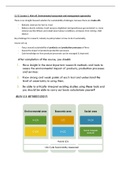
There is no straight-forward solution for sustainability challenges, because there are trade-offs.
- Biofuels: land-use for fuel vs. food
- Battery electric vehicles: fossil resource depletion (and greenhouse gas emission) vs. more
mineral use like lithium and cobalt (poor labour conditions, emissions from mining, child
labour)
Key challenge for research, industry & policymakers is how to do it sustainably.
Course set-up
- Focus around sustainability of products and production processes of firms
- Assess the impact of products/production processes
- Gain knowledge on how products/processes can be managed & improved.
,
,13/11 Lecture 2: LCA Goal & Scope definition
LCA in a nutshell
LCA is a cradle-to-grave model. Started in the 1960s and became real
‘LCA’ in 1990s.
- Different methods, datasets etc. led to different outcomes,
there was no standard methodology.
- Big companies were challenged by green parties to decrease
environmental impact.
- 1990s take-off of LCAs and harmonisation of methodology &
standardisation. Industrial adoption of LCA to make
claims/development. Gained academic recognition & policy
implications e.g. support for regulations.
International standards & Guidelines:
- ISO 14040/14044:2006: it is the base of all LCA methodologies but it is ambiguous and
unspecific because it is very broad.
o ISO 14040 definition of LCA: LCA is a technique for assessing the environmental
aspects and potential impacts associated with a product,
o An LCA consists of the Goal and scope definition, the Inventory analysis, an impact
assessment and the interpretation.
- ILCD handbook: detailed guidance on environmental LCA, criticized for being internally
inconsistent with respect to attributional and consequential modelling.
Use of LCA for
- Decision making (product/process design and development, purchasing (green procurement)
and policy)
- Learning (production system, identification of improvement possibilities, selection of
environmental performance indicators)
- Market claims (LCA-based ecolabelling, benchmarking, nog een )
, Goal definition
Iso 14044 on goal definition:
o Intended application (what)
E.g.
o Reasons for carrying out the study (why)
E.g.
o The intended audience (who)
o Comparative assertions disclosed to the public? (internal/external)
Goal definition should be formulated ‘smart’, include what, why and who.
Scope definition
- Temporal scope: look at the data requirements (e.g. not older than 10 years), minimum time
(e.g. one season), reference year, temporal scope for impacts (GWP over 20/ over 100 years).
- Geographical scope: region for which data will be collected, region where the results are
valid for, what happens where?
- Technological scope: are you looking for the best technology, worst, or average? Should fit
with geographical and temporal scope.
- Which impacts/impact categories: should be a comprehensive set of environmental impact
categories related to the product system and account for the goal and scope definition.
A lifecycle assessment looks at a product and the functions of this product. It covers all processes
from cradle to grave and only measures environmental impacts. It is a quantitative assessment.
Types of LCA and limitations
- Attributional: Accounting Type (descriptive/retrospective) e.g. what are the environmental
impacts of cooking with natural gas?
- Consequential: Change-oriented (Prospective) e.g. what are the environmental impacts of
changing from conventional cars to battery electric cars?
- Attributional studies are more precise, but less complete while consequential studies are
more complete but less precise. Consequential modelling is used for policy and decision-
making.
There is no straight-forward solution for sustainability challenges, because there are trade-offs.
- Biofuels: land-use for fuel vs. food
- Battery electric vehicles: fossil resource depletion (and greenhouse gas emission) vs. more
mineral use like lithium and cobalt (poor labour conditions, emissions from mining, child
labour)
Key challenge for research, industry & policymakers is how to do it sustainably.
Course set-up
- Focus around sustainability of products and production processes of firms
- Assess the impact of products/production processes
- Gain knowledge on how products/processes can be managed & improved.
,
,13/11 Lecture 2: LCA Goal & Scope definition
LCA in a nutshell
LCA is a cradle-to-grave model. Started in the 1960s and became real
‘LCA’ in 1990s.
- Different methods, datasets etc. led to different outcomes,
there was no standard methodology.
- Big companies were challenged by green parties to decrease
environmental impact.
- 1990s take-off of LCAs and harmonisation of methodology &
standardisation. Industrial adoption of LCA to make
claims/development. Gained academic recognition & policy
implications e.g. support for regulations.
International standards & Guidelines:
- ISO 14040/14044:2006: it is the base of all LCA methodologies but it is ambiguous and
unspecific because it is very broad.
o ISO 14040 definition of LCA: LCA is a technique for assessing the environmental
aspects and potential impacts associated with a product,
o An LCA consists of the Goal and scope definition, the Inventory analysis, an impact
assessment and the interpretation.
- ILCD handbook: detailed guidance on environmental LCA, criticized for being internally
inconsistent with respect to attributional and consequential modelling.
Use of LCA for
- Decision making (product/process design and development, purchasing (green procurement)
and policy)
- Learning (production system, identification of improvement possibilities, selection of
environmental performance indicators)
- Market claims (LCA-based ecolabelling, benchmarking, nog een )
, Goal definition
Iso 14044 on goal definition:
o Intended application (what)
E.g.
o Reasons for carrying out the study (why)
E.g.
o The intended audience (who)
o Comparative assertions disclosed to the public? (internal/external)
Goal definition should be formulated ‘smart’, include what, why and who.
Scope definition
- Temporal scope: look at the data requirements (e.g. not older than 10 years), minimum time
(e.g. one season), reference year, temporal scope for impacts (GWP over 20/ over 100 years).
- Geographical scope: region for which data will be collected, region where the results are
valid for, what happens where?
- Technological scope: are you looking for the best technology, worst, or average? Should fit
with geographical and temporal scope.
- Which impacts/impact categories: should be a comprehensive set of environmental impact
categories related to the product system and account for the goal and scope definition.
A lifecycle assessment looks at a product and the functions of this product. It covers all processes
from cradle to grave and only measures environmental impacts. It is a quantitative assessment.
Types of LCA and limitations
- Attributional: Accounting Type (descriptive/retrospective) e.g. what are the environmental
impacts of cooking with natural gas?
- Consequential: Change-oriented (Prospective) e.g. what are the environmental impacts of
changing from conventional cars to battery electric cars?
- Attributional studies are more precise, but less complete while consequential studies are
more complete but less precise. Consequential modelling is used for policy and decision-
making.