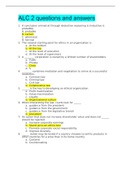
ALC 2 Possible Verified Predictor questions and answers
ALC 2 Possible Verified Predictor questions and answers ALC 2 questions and answers 1. A conclusion arrived at through deductive reasoning is (inductive is probable) A. probable B. certain C. whimsical D. farcical 2. The rational starting point for ethics in an organization is a. At the bottom b. At the top c. At the level of execution d. At the level of supervisors 3. A ________ corporation is owned by a limited number of shareholders. a. Public b. Private c. Close d. S 4. ________ combines mediation and negotiation to arrive at a successful resolution. a. Common law b. Criminal law c. Civil law d. Collaborative law 5. ______ is the key to developing an ethical organization. a. Profit maximization b. Value maximization c. Loyalty d. Organizational culture 6. When interpreting the law, courts look for ______ a. guidance from the president b. guidance from the government c. guidance from the legislative branch d. precedent 7. An action that does not increase shareholder value and does not ______ should be rejected. a. Increase corporate earnings b. Stand up to an ethics test c. Promote corporate social responsibility d. Improve diversity 8. ______ duties may be levied if a country chooses to sell its products in other countries for a price than in its home country. a. Customs b. Countervailing c. Tariff d. Anti-dumping 9. Under common law, the acceptance of a contract should reflect the _______ of the offer. a. Essential terms b. Major terms c. Exact terms d. Understanding 10. The most important characteristic of a closely held corporation is that_____. a. It has a smaller # of shareholders b. it has a large number of shareholders c. its shares are not traded on the stock market d. its shares are listed on at least two stock markets 11. U.S. business must comply with the Foreign Corrupt Practices Act, which bans _______, but not ______ payments. a. Grease; facilitation b. Facilitation; bribes c. Facilitation; grease d. Bribes; facilitation 12. ______ damages compensate a party for losses that occur as a foreseeable result of the breach. a. Incidental b. Reliance c. Restitution d. Consequential 13. A business decision may be ______, but not be _______. a. Ethical; legal b. Financially astute; legal c. Environmentally sound; ethical d. Legal; ethical 14. _____ publishes every year a ranking of countries based on perceived corruption. 15. The objective of ______ damages is to compensate the non-breaching party for any expenses incurred in anticipation of the contract being fulfilled. a. Compensatory b. Consequential c. Liquidated d. Reliance 16. ______ is a form of organization primarily suited for groups of professionals. a. LLP b. LLC c. General partnership d. S corporation 17. Manufacturing in the home country and marketing in other countries is called _____. a. Exporting b. Licensing c. Franchising d. Joint venture 18. ______ involves a degree of compromise, a spirit of give and take. a. Negotiation b. Arbitration c. Litigation d. Game theory 19. The decisions of courts, taken together, is referred to as blank______ a. Civil law b. Common law c. Criminal law d. Statutes 20. Law that provides remedies when one individual injures another is the law of blank______. a. Torts b. Administration c. Criminality d. Federal 21. To prove negligence, an injured party must prove a duty of care and______. a. Defamatory statement b. Breach of the duty that caused damages c. Communication d. Assault 22. Which one of the following does not generally render a contract voidable? a. Unilateral mistake of fact b. Misrepresentation c. Fraud d. Duress 23. Contracts that are contrary to established law or public policy are blank______. a. Voidable b. Fraudulent c. Void d. Valid 24. Contracts where one party insists on its conditions are called blank______. a. Arbitrary contracts b. Adhesion contracts c. Unilateral contracts d. Division contracts 25. ______ damages are the economic losses suffered by one party as a result of the other party reneging on the contract. a. Compensatory b. Consequential c. Liquidated d. Expectation 26. Offer + Acceptance = blank______. a. Contract b. Agreement c. Consideration d. Damages 27. What we want to achieve in life can be called blank______ values. a. Abstract b. Instrumental c. Terminal d. Conclusive 28. The principal cause of unethical behavior is blank______. a. Greed b. Convivence c. Fear d. Jealousy 29. Those who make ethical decisions purely on the basis of whether the decision benefits them personally can be called blank______. a. Utilitarian’s b. Maximizers c. Egoists d. Deontologist 30. Utilitarianism suggests that it is ethical to make decisions based on blank______. a. what is good for the work group b. what is good for oneself c. what is good for the organization d. what is good for most people 31. Even when employees know that something in their organization is wrong, most will not speak up because they fear blank______. a. Being ostracized b. Anger c. Retaliation d. Embarrassment 32. Corporations are subject to blank______ taxation. a. Single b. Dual c. Pass-through d. Multiple 33. A ______ corporation typically has no more than thirty shareholders. a. Close b. S c. C d. LLC 34. When a corporation deliberately lacks adequate capital to meet its obligations, a court may treat this as blank______. a. Unconscionable b. Retaliation c. Irresponsible d. Fraud 35. The phenomenon of organizations that think globally but act locally can be called blank______. a. Global b. Glocal c. Multinational d. Transactional 36. The ______ of a treaty describes what the parties have agreed upon. a. Introduction b. Preamble c. Substance d. Annexure 37. An alternative to using courts to settle disputes, in which a neutral third party makes a binding decision, is blank______. a. Mediation b. Negotiation c. Arbitration d. Litigation 38. ______ publishes every year a ranking of countries based on perceived corruption. a. The world Bank b. The IMF c. The OECD d. Transparency International 39. ____ occurs when a provision that is sought to be enforced is buried inside a large document and couched in language that a reasonable person cannot understand. a. Deceit b. Oppression c. Fraud d. Surprise 40. Law can create ____ by citing monopoly or national security. a. Buyer power b. Supplier power c. Entry barriers d. Fragmentation 41. The long-term goal of many firms has traditionally been to _____. a. Maximize shareholder wealth b. Maximize stakeholder wealth c. Promote corporate social responsibility d. Increase size and breadth of the firm 42. Those affected by a company’s actions, such as employees, customer, and shareholders, are referred to as ______. a. Emigrees b. Stakeholders c. Utilitarian’s d. Cohorts 43. International arbitration awards will be enforced by the _______ Convention. a. CISG b. Paris c. New York d. London 44. The value Chain concept views the organization as a set of ____ and ______ activities. a. Strategic; tactical b. Tactical; operational c. Primary; support d. Primary; secondary 45. ______ are co-operative arrangements between two or more companies for a specific purpose. a. Joint ventures b. Strategic alliances c. Franchises d. Mergers 46. When owners of a corporation so thoroughly mingle their own affairs with the corporation’s, that they are no longer distinct, a court may ______. a. Rescind the incorporation b. Dual-tax the owners c. Pierce the corporate veil of liability protection d. Remove the directors 47. Singapore and Hong Kong follow the principle of _____. a. National Tax Jurisdiction b. Territorial Tax Jurisdiction c. Regional Tax Jurisdiction d. Local Tax Jurisdiction 48. Which one of the following is true regarding acceptance of a contract? a. Acceptance must be delivered by email b. Acceptance is effective when deposited into a mailbox c. Acceptance must be by fax d. Acceptance must be conveyed in person 49. Small corporations can avoid double taxation by electing to be treaty as a(n) ____ corporation. a. C b. Close c. LLC d. S 50. A _____ is created when two or more persons agree to place their resources, skills, and time in a business and to share its profits and losses. a. Sole proprietorship b. General partnership c. Limited partnership d. C corporation 51. A ______ has general partners and limited partners a. General partnership b. Close company c. S corporation d. Limited partnership 52. S Corporations may not own ____ percent or more of any other corporation a. 30 b. 50 c. 60 d. 80 53. Countries with monetary resources and capabilities to harness new technologies, recognized by the OECD, are referred to as _____. (Section 5) a. The developed world b. The developing world c. Third-world nation states d. Western nation states
Written for
- Institution
- ALC EXAMS
- Course
- ALC EXAMS
Document information
- Uploaded on
- December 6, 2021
- Number of pages
- 7
- Written in
- 2021/2022
- Type
- Exam (elaborations)
- Contains
- Questions & answers
Subjects
- alc
-
alc 2 questions and answers
-
alc 2 possible 2021 2022 verified predictor questions and answers
-
1 a conclusion arrived at through deductive reasoning is inductive is probable
-
2 the rational star

Also available in package deal