Notes on the lectures from the course (2021) Economics for Political Scientists. INCLUDES lectures
1-13 (Total: 56 pages).
1
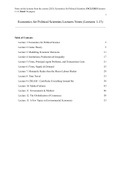
Economics for Political Scientists Lectures Notes (Lectures 1-13)
Table of Contents
Lecture 1: Economics for Political Science 2
Lecture 2: Game Theory 5
Lecture 3: Modelling Economic Decisions 11
Lecture 4: Institutions, Production & Inequality 17
Lecture 5: Firms, Principal-Agent Problems, and Transactions Costs 21
Lecture 6: Firms, Supply & Demand 25
Lecture 7: Monopoly Redux then the Macro Labour Market 29
Lecture 8: Time Travel 33
Lecture 9: CREAM - Cash Rules Everything Around Me 38
Lecture 10: Market Failures 43
Lecture 11: Governments & Markets 46
Lecture 12: The Globalisation of Commerce 50
Lecture 13: A Few Topics in Environmental Economics 53
, 2
Lecture 1: Economics for Political Science
Economics
Incentives influence and dictate human behaviour.
➔ E.g. empirical evidence strongly confirms that tipping produces better service.
The study of economics centres on the study of human behaviour, specifically on:
● Economic Incentives:
○ How outcomes improve economic welfare.
○ How choices are shaped by markets and other circumstances.
○ How people make choices about scarcity.
● Economic Outcomes:
○ Microeconomic: The study of individual incentives.
○ Macroeconomics: The study of aggregated outcomes.
Economics is NOT primarily interested in what is ‘fair/just’ (i.e. it can motivate topics, but it does
NOT influence the conclusions drawn).
Economics and politics are intertwined.
➔ Politics is about “who gets what, where, when and how”.
➔ Outcomes are shaped by political and economic incentives.
➔ Politics shapes economic incentives in intended and unintended ways.
Growth and Inequality
Nominal GDP: The gross domestic product (GDP) in the current currency amount. It does not account
for inflation or differences in purchasing power parity (PPP) across countries.
➔ E.g. the “sticker price”.
Real GDP: GDP growth in constant prices. It is important for measuring changes over time. Its growth
is adjusted for changes in inflation. The current nominal prices are converted to a consistent baseline.
Therefore, it can apply to any type of price measure.
Purchasing Power Parity (PPP): Important for measuring changes across countries and time. Growth
is adjusted for differences in currencies and what those currencies purchase. Generally converts the
local economic activity into the equivalent $US dollars (looking at a Consumer Price Index - CPI).
Economic Growth
Economic Growth: Measured in GDP (an imperfect measure), which we can use to compare the size
of economies across time (GDP growth) or across countries (levels of development).
➔ Economic growth is increased by natural resource discovery, physical capital/infrastructure,
population, technology, law, etc..
➔ Short-term causes include external shocks, new government monetary or fiscal policy,
consumer/business sentiment.
“Economic growth is increased by learning to produce more with the same stuff.”
GDP
, 3
GDP: Measures the market value (the highest price of the goods and services and services sold on the
competitive market) of all finished goods and services produced within a country (usually annually).
It does NOT include things that are imported from other countries, but it does include things exported
to other countries.
➔ Finished Good/Service: Goods and services that will not be sold again as part of another
good.
➔ Unfinished/Intermediate Good/Service: Goods and services that will be used to make
something else that will be sold.
➔ Capital Good/Service: Finished goods and services that are used to produce other goods and
services, but not a part of other goods and services.
𝑌 = 𝐶 + 𝐼 + 𝐺 + (𝑋 − 𝑀)
Where:
● 𝑌 =GDP (National Income)
● 𝐶 =Consumer Spending (on finished goods and services)
● 𝐼 =Investment (in capital goods and services)
● 𝐺 =Government spending (on finished goods and services)
● 𝑋 =Exports
● 𝑀 =Imports
(𝑋 − 𝑀) =Often seen as “NX” or net exports. It does not mean that imports (𝑀) decrease growth. It is an
accounting device to adjust consumer and government spending.
Calculate Economic Growth
GDP can be misleading when displaying the wealth or development of a country.
➔ GDP: Tells us how large a country is.
➔ GDP per capita: Tells us how wealthy a country is by dividing the GDP by a country’s total
population.
𝐺𝐷𝑃
𝐺𝐷𝑃 𝑝𝑒𝑟 𝑐𝑎𝑝𝑖𝑡𝑎 = 𝑝𝑜𝑝𝑢𝑙𝑎𝑡𝑖𝑜𝑛
To calculate economic growth between two years, use:
𝐺𝐷𝑃𝑡−𝐺𝐷𝑃𝑡−1
% 𝑐ℎ𝑎𝑛𝑔𝑒 𝑖𝑛 𝐺𝐷𝑃 = 𝐺𝐷𝑃𝑡−1
* 100
OR
𝐺𝐷𝑃𝑝𝑐𝑡−𝐺𝐷𝑃𝑝𝑐𝑡−1
% 𝑐ℎ𝑎𝑛𝑔𝑒 𝑖𝑛 𝐺𝐷𝑃𝑝𝑒𝑟 𝑐𝑎𝑝𝑖𝑡𝑎 = 𝐺𝐷𝑃𝑝𝑐𝑡−1
* 100
Where:
● 𝑡 =Time (year)
GDP is a good indicator of “development”, as it is correlated with many things we care about (e.g.,
health, happiness, education). HOWEVER, it does not count for:
● Labour completed at home.
● The distribution of income within a country (inequality). Although historically GDP growth
is usually correlated with growth in everyone’s income.
1-13 (Total: 56 pages).
1
Economics for Political Scientists Lectures Notes (Lectures 1-13)
Table of Contents
Lecture 1: Economics for Political Science 2
Lecture 2: Game Theory 5
Lecture 3: Modelling Economic Decisions 11
Lecture 4: Institutions, Production & Inequality 17
Lecture 5: Firms, Principal-Agent Problems, and Transactions Costs 21
Lecture 6: Firms, Supply & Demand 25
Lecture 7: Monopoly Redux then the Macro Labour Market 29
Lecture 8: Time Travel 33
Lecture 9: CREAM - Cash Rules Everything Around Me 38
Lecture 10: Market Failures 43
Lecture 11: Governments & Markets 46
Lecture 12: The Globalisation of Commerce 50
Lecture 13: A Few Topics in Environmental Economics 53
, 2
Lecture 1: Economics for Political Science
Economics
Incentives influence and dictate human behaviour.
➔ E.g. empirical evidence strongly confirms that tipping produces better service.
The study of economics centres on the study of human behaviour, specifically on:
● Economic Incentives:
○ How outcomes improve economic welfare.
○ How choices are shaped by markets and other circumstances.
○ How people make choices about scarcity.
● Economic Outcomes:
○ Microeconomic: The study of individual incentives.
○ Macroeconomics: The study of aggregated outcomes.
Economics is NOT primarily interested in what is ‘fair/just’ (i.e. it can motivate topics, but it does
NOT influence the conclusions drawn).
Economics and politics are intertwined.
➔ Politics is about “who gets what, where, when and how”.
➔ Outcomes are shaped by political and economic incentives.
➔ Politics shapes economic incentives in intended and unintended ways.
Growth and Inequality
Nominal GDP: The gross domestic product (GDP) in the current currency amount. It does not account
for inflation or differences in purchasing power parity (PPP) across countries.
➔ E.g. the “sticker price”.
Real GDP: GDP growth in constant prices. It is important for measuring changes over time. Its growth
is adjusted for changes in inflation. The current nominal prices are converted to a consistent baseline.
Therefore, it can apply to any type of price measure.
Purchasing Power Parity (PPP): Important for measuring changes across countries and time. Growth
is adjusted for differences in currencies and what those currencies purchase. Generally converts the
local economic activity into the equivalent $US dollars (looking at a Consumer Price Index - CPI).
Economic Growth
Economic Growth: Measured in GDP (an imperfect measure), which we can use to compare the size
of economies across time (GDP growth) or across countries (levels of development).
➔ Economic growth is increased by natural resource discovery, physical capital/infrastructure,
population, technology, law, etc..
➔ Short-term causes include external shocks, new government monetary or fiscal policy,
consumer/business sentiment.
“Economic growth is increased by learning to produce more with the same stuff.”
GDP
, 3
GDP: Measures the market value (the highest price of the goods and services and services sold on the
competitive market) of all finished goods and services produced within a country (usually annually).
It does NOT include things that are imported from other countries, but it does include things exported
to other countries.
➔ Finished Good/Service: Goods and services that will not be sold again as part of another
good.
➔ Unfinished/Intermediate Good/Service: Goods and services that will be used to make
something else that will be sold.
➔ Capital Good/Service: Finished goods and services that are used to produce other goods and
services, but not a part of other goods and services.
𝑌 = 𝐶 + 𝐼 + 𝐺 + (𝑋 − 𝑀)
Where:
● 𝑌 =GDP (National Income)
● 𝐶 =Consumer Spending (on finished goods and services)
● 𝐼 =Investment (in capital goods and services)
● 𝐺 =Government spending (on finished goods and services)
● 𝑋 =Exports
● 𝑀 =Imports
(𝑋 − 𝑀) =Often seen as “NX” or net exports. It does not mean that imports (𝑀) decrease growth. It is an
accounting device to adjust consumer and government spending.
Calculate Economic Growth
GDP can be misleading when displaying the wealth or development of a country.
➔ GDP: Tells us how large a country is.
➔ GDP per capita: Tells us how wealthy a country is by dividing the GDP by a country’s total
population.
𝐺𝐷𝑃
𝐺𝐷𝑃 𝑝𝑒𝑟 𝑐𝑎𝑝𝑖𝑡𝑎 = 𝑝𝑜𝑝𝑢𝑙𝑎𝑡𝑖𝑜𝑛
To calculate economic growth between two years, use:
𝐺𝐷𝑃𝑡−𝐺𝐷𝑃𝑡−1
% 𝑐ℎ𝑎𝑛𝑔𝑒 𝑖𝑛 𝐺𝐷𝑃 = 𝐺𝐷𝑃𝑡−1
* 100
OR
𝐺𝐷𝑃𝑝𝑐𝑡−𝐺𝐷𝑃𝑝𝑐𝑡−1
% 𝑐ℎ𝑎𝑛𝑔𝑒 𝑖𝑛 𝐺𝐷𝑃𝑝𝑒𝑟 𝑐𝑎𝑝𝑖𝑡𝑎 = 𝐺𝐷𝑃𝑝𝑐𝑡−1
* 100
Where:
● 𝑡 =Time (year)
GDP is a good indicator of “development”, as it is correlated with many things we care about (e.g.,
health, happiness, education). HOWEVER, it does not count for:
● Labour completed at home.
● The distribution of income within a country (inequality). Although historically GDP growth
is usually correlated with growth in everyone’s income.