Grade 11 Trigonometric Functions
Document 5: Finding the equations of Trig functions
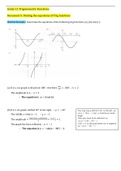
Worked Example: Determine the equations of the following trig functions (a), (b) and (c):
360°
(a) It is a cos graph, with period 180°, therefore = 180°, ∴ 𝑘 = 2
𝑘
The amplitude is 2, ∴ 𝑎 = 2
∴ The equation is 𝒚 = 𝟐 𝐜𝐨𝐬 𝟐𝒙
(b) It is a sin graph, shifted 30° to the right, ∴ 𝑝 = −30° You may see a shift of 150° to the left , so
𝑠𝑖𝑛(𝑥 + 150) − 1, but 𝑝 must be an acute
The middle 𝑦 value is −1, ∴ 𝑞 = −1
angle
𝑚𝑎𝑥𝑖𝑚𝑢𝑚−𝑚𝑖𝑛𝑖𝑚𝑢𝑚 0—2 Then you have to do reduction i.e.
The amplitude = = 2=1
2 𝑠𝑖𝑛(𝑥 + 180 − 30) − 1
The graph has been reflected, ∴ 𝑎 = −1 (180 + 𝑥) is 3rd quad where sin is negative
so −𝑠𝑖𝑛(𝑥 − 30) − 1
∴ The equation is 𝒚 = − 𝐬𝐢𝐧(𝒙 − 𝟑𝟎°) − 𝟏
Document 5: Finding the equations of Trig functions
Worked Example: Determine the equations of the following trig functions (a), (b) and (c):
360°
(a) It is a cos graph, with period 180°, therefore = 180°, ∴ 𝑘 = 2
𝑘
The amplitude is 2, ∴ 𝑎 = 2
∴ The equation is 𝒚 = 𝟐 𝐜𝐨𝐬 𝟐𝒙
(b) It is a sin graph, shifted 30° to the right, ∴ 𝑝 = −30° You may see a shift of 150° to the left , so
𝑠𝑖𝑛(𝑥 + 150) − 1, but 𝑝 must be an acute
The middle 𝑦 value is −1, ∴ 𝑞 = −1
angle
𝑚𝑎𝑥𝑖𝑚𝑢𝑚−𝑚𝑖𝑛𝑖𝑚𝑢𝑚 0—2 Then you have to do reduction i.e.
The amplitude = = 2=1
2 𝑠𝑖𝑛(𝑥 + 180 − 30) − 1
The graph has been reflected, ∴ 𝑎 = −1 (180 + 𝑥) is 3rd quad where sin is negative
so −𝑠𝑖𝑛(𝑥 − 30) − 1
∴ The equation is 𝒚 = − 𝐬𝐢𝐧(𝒙 − 𝟑𝟎°) − 𝟏