
Nervous system
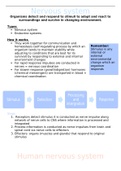
Organisms detect and respond to stimuli to adapt and react to
surroundings and survive in changing environment.
Types
Nervous system
Endocrine systems
How it works
They work together for communication and
homeostasis (self-regulating process by which an Remember:
organism tends to maintain stability while Stimulus is any
adjusting to conditions that are best for its internal or
survival) by responding to external and internal external
environment changes environmental
For rapid response impulses are conducted in change which an
nerves = nervous coordination organism
For slower response (growth/digestion) hormones responds
(chemical messengers) are transported in blood =
chemical coordination
Processing
Stimulus Detection and Response
intergration
Steps
1. Receptors detect stimulus it is conducted as nerve impulse along
network of nerve cells to CNS where information is processed and
integrated
2. Process information is conducted as nerve impulses from brain and
spinal cord via nerve cells to effectors
3. Effectors: organs (muscles and glands) that respond to original
stimulus
Human nervous system
,Subdivisions
Nervous system
Central nervous Perpheral nervous
system: 12 pairs of
sytem: brain and cranial nerves and 31
spinal cord pairs of spinal nerves
Motor nerves: consuct Sensory nerves:
impulses from CNS tp conduct impulses
effectors from receptors to CNS
Autonomic: consucts Somatic: conducts
Central nervous system impulses from CNS to impulses from CNS to
invoulentary muscles and
To receive nerve impulses from
some glands receptors, interoperate
vounlentary musclesinformation and
transmit it to effectors to bring about response
Protection of system
Sympathetic division: Parasympathetic:
Nervous tissue is action
prepares for very soft and most cells cannot repair/regenerate.
returns body to
"fight or flight" normal "status qou"
CNS is surrounded by external bone (skull and vertebral column)
Cartilaginous discs between vertebrae and S-shaped aid shock
absorption and make it more flexible.
Three meninges (cerebral membranes) enveloping brain
Pia mater: innermost that is tightly wrapped around brain and spinal
cord, rich in blood vessels to provide oxygen and nutrients to CNS
Dura mater: tough outermost that lines skull cavity and spinal canal
Arachnoid membrane: thin membrane between pia and dura
Cerebral fluid
Between pia and arachnoid
Shock absorber
Supplies neurons with nutrients and oxygen
Removes waste and prevents dehydration of neurons
Maintains constant pressure around CNS
Grey matter vs white matter
Grey matter: darker cell bodies and dendrites of neurons
White matter: myelinated axons that appear white due to fatty
myelin sheaths that enclose axons
Grey matter in brain is mostly outside and surrounds white matter
and is opposite in the spinal cord
, Brain
Enlarged upper part of spinal cord and is divided into following parts:
Cerebrum, hypothalamus, cerebellum, medulla oblongata, midbrain,
pons, thalamus, corpus callosum, hypophysis/pituitary gland
Cerebrum
Largest part
Cerebral cortex: Outer layer with grey matter that has folds (gyri)
and groves (sulci) that enlarge brain surface
White matter on the inside
Cerebral hemispheres: Deep longitudinal fissure (groove) dividing
cerebrum in half
Hemispheres are divided into lobes which are associated into
functions
Lobes: frontal, temporal, parietal and occipital
Corpus callosum: layer of white matter that partially joins two
hemispheres
Functions
Origin of all voluntary actions
Receives and interoperates nerves impulses from sense organs
where sensation of 5 senses arise
seat of higher mental functions
Hypothalamus
Situated below thalamus which is positioned below corpus callosum
Tiny but important
Functions
Maintenance of homeostasis regulating: blood pressure, heartbeat,
body temperature, water balance, hunger, apatite, thirst and sleep
Responsible for driving forces: defence, reproductive behaviour,
migratory instincts and territory
Control of emotions
Controls functioning of hypophysis: secretes vital hormones
Cerebellum
Behind and below cerebrum
Vermis: worm like mass of nerve tissue connecting two hemispheres
Surface has grooves that are more shallow and parallel
Grey matter is outside white matter
White matter is arranged like branched tree hence term ‘arbor vitae’
(Latin term for tree of life)
Functions
Organisms detect and respond to stimuli to adapt and react to
surroundings and survive in changing environment.
Types
Nervous system
Endocrine systems
How it works
They work together for communication and
homeostasis (self-regulating process by which an Remember:
organism tends to maintain stability while Stimulus is any
adjusting to conditions that are best for its internal or
survival) by responding to external and internal external
environment changes environmental
For rapid response impulses are conducted in change which an
nerves = nervous coordination organism
For slower response (growth/digestion) hormones responds
(chemical messengers) are transported in blood =
chemical coordination
Processing
Stimulus Detection and Response
intergration
Steps
1. Receptors detect stimulus it is conducted as nerve impulse along
network of nerve cells to CNS where information is processed and
integrated
2. Process information is conducted as nerve impulses from brain and
spinal cord via nerve cells to effectors
3. Effectors: organs (muscles and glands) that respond to original
stimulus
Human nervous system
,Subdivisions
Nervous system
Central nervous Perpheral nervous
system: 12 pairs of
sytem: brain and cranial nerves and 31
spinal cord pairs of spinal nerves
Motor nerves: consuct Sensory nerves:
impulses from CNS tp conduct impulses
effectors from receptors to CNS
Autonomic: consucts Somatic: conducts
Central nervous system impulses from CNS to impulses from CNS to
invoulentary muscles and
To receive nerve impulses from
some glands receptors, interoperate
vounlentary musclesinformation and
transmit it to effectors to bring about response
Protection of system
Sympathetic division: Parasympathetic:
Nervous tissue is action
prepares for very soft and most cells cannot repair/regenerate.
returns body to
"fight or flight" normal "status qou"
CNS is surrounded by external bone (skull and vertebral column)
Cartilaginous discs between vertebrae and S-shaped aid shock
absorption and make it more flexible.
Three meninges (cerebral membranes) enveloping brain
Pia mater: innermost that is tightly wrapped around brain and spinal
cord, rich in blood vessels to provide oxygen and nutrients to CNS
Dura mater: tough outermost that lines skull cavity and spinal canal
Arachnoid membrane: thin membrane between pia and dura
Cerebral fluid
Between pia and arachnoid
Shock absorber
Supplies neurons with nutrients and oxygen
Removes waste and prevents dehydration of neurons
Maintains constant pressure around CNS
Grey matter vs white matter
Grey matter: darker cell bodies and dendrites of neurons
White matter: myelinated axons that appear white due to fatty
myelin sheaths that enclose axons
Grey matter in brain is mostly outside and surrounds white matter
and is opposite in the spinal cord
, Brain
Enlarged upper part of spinal cord and is divided into following parts:
Cerebrum, hypothalamus, cerebellum, medulla oblongata, midbrain,
pons, thalamus, corpus callosum, hypophysis/pituitary gland
Cerebrum
Largest part
Cerebral cortex: Outer layer with grey matter that has folds (gyri)
and groves (sulci) that enlarge brain surface
White matter on the inside
Cerebral hemispheres: Deep longitudinal fissure (groove) dividing
cerebrum in half
Hemispheres are divided into lobes which are associated into
functions
Lobes: frontal, temporal, parietal and occipital
Corpus callosum: layer of white matter that partially joins two
hemispheres
Functions
Origin of all voluntary actions
Receives and interoperates nerves impulses from sense organs
where sensation of 5 senses arise
seat of higher mental functions
Hypothalamus
Situated below thalamus which is positioned below corpus callosum
Tiny but important
Functions
Maintenance of homeostasis regulating: blood pressure, heartbeat,
body temperature, water balance, hunger, apatite, thirst and sleep
Responsible for driving forces: defence, reproductive behaviour,
migratory instincts and territory
Control of emotions
Controls functioning of hypophysis: secretes vital hormones
Cerebellum
Behind and below cerebrum
Vermis: worm like mass of nerve tissue connecting two hemispheres
Surface has grooves that are more shallow and parallel
Grey matter is outside white matter
White matter is arranged like branched tree hence term ‘arbor vitae’
(Latin term for tree of life)
Functions



