
Biodiversity of
microorganisms
Their biodiversity
Form significant part of all life
Vital role in ecosystems and make life on earth possible
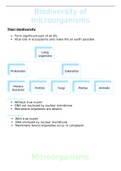
Living
organisims
Prokaryotes Eukaryotes
Monera
Protista Fungi Plantae Animalia
(bacteria)
Prokaryotes
Without true nuclei
DNA not enclosed by nuclear membrane
Membrane organelles are absent
Eukaryotes
With true nuclei
DNA enclosed by nuclear membrane
Membrane bound organelles occur in cytoplasm
Microorganisms
,Basics
Micro = small and macro = big
Most abundant organisms, found in huge numbers in environment.
Favorable conditions: sufficient food, moisture, and optimum
temperature
Most are harmless but pathogens cause disease
Disease caused by microorganisms: infectious
Historical developments
1796 – Edward Jenner introduced vaccination as treatment for
smallpox (viral disease)
1862 – Louis Pasture a German chemist developed heating process
called pasteurization that destroyed bacteria. discovered useful role
of bacteria (milk yogurt etc.) and developed Jenner’s idea to using
weakened or dead strains
1876 – Robert Koch a German physician proved that bacteria caused
disease and described bacillus and later discovered that bacteria
caused cholera and TB. He discovered staining technique for
studying bacteria under microscope
1928 – Alexander Fleming a Scottish biologist discovered penicillin
mold leading to effective antibiotic penicillin to destroy bacteria.
Shared 1945 noble prize.
Viruses
Structure
Very small with simple composition
Have central nucleic acid surrounded by protein capsule
Can inflict plant, animal, or bacterial cells
Contain either DNA or RNA
Some are enclosed by sheath of lipid and protein molecules (from
hosts cells outer membrane)
Acellular with no nucleus, cytoplasm, or organelles
Shape varies
, Characteristics
Parasites that only reproduce in living cells and are known as
obligate intercellular parasites (compulsory, within cell, organism
living on living material and causes harm)
Pathogens: cause disease on plants and animals
Reproduce by converting genetic material (DNA or RNA) of the host
cells into viral nucleic acids so new viruses can be produced
Bacteria
microorganisms
Their biodiversity
Form significant part of all life
Vital role in ecosystems and make life on earth possible
Living
organisims
Prokaryotes Eukaryotes
Monera
Protista Fungi Plantae Animalia
(bacteria)
Prokaryotes
Without true nuclei
DNA not enclosed by nuclear membrane
Membrane organelles are absent
Eukaryotes
With true nuclei
DNA enclosed by nuclear membrane
Membrane bound organelles occur in cytoplasm
Microorganisms
,Basics
Micro = small and macro = big
Most abundant organisms, found in huge numbers in environment.
Favorable conditions: sufficient food, moisture, and optimum
temperature
Most are harmless but pathogens cause disease
Disease caused by microorganisms: infectious
Historical developments
1796 – Edward Jenner introduced vaccination as treatment for
smallpox (viral disease)
1862 – Louis Pasture a German chemist developed heating process
called pasteurization that destroyed bacteria. discovered useful role
of bacteria (milk yogurt etc.) and developed Jenner’s idea to using
weakened or dead strains
1876 – Robert Koch a German physician proved that bacteria caused
disease and described bacillus and later discovered that bacteria
caused cholera and TB. He discovered staining technique for
studying bacteria under microscope
1928 – Alexander Fleming a Scottish biologist discovered penicillin
mold leading to effective antibiotic penicillin to destroy bacteria.
Shared 1945 noble prize.
Viruses
Structure
Very small with simple composition
Have central nucleic acid surrounded by protein capsule
Can inflict plant, animal, or bacterial cells
Contain either DNA or RNA
Some are enclosed by sheath of lipid and protein molecules (from
hosts cells outer membrane)
Acellular with no nucleus, cytoplasm, or organelles
Shape varies
, Characteristics
Parasites that only reproduce in living cells and are known as
obligate intercellular parasites (compulsory, within cell, organism
living on living material and causes harm)
Pathogens: cause disease on plants and animals
Reproduce by converting genetic material (DNA or RNA) of the host
cells into viral nucleic acids so new viruses can be produced
Bacteria



