Lecture 1: Introduction
What is this course about?
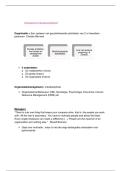
- An organization is “a system of consciously coordinated activities or forces of two or
more people.”
- Four common denominators:
● Coordination of effort -> achieved by policies, rules, and regulations.
● A common goal.
● Division of labor -> individuals perform separate but related tasks to achieve
the common goal.
● Hierarchy of authority -> chain of command dedicated to make sure that the
right people do the right things at the right time, often reflected in an
organizational chart.
- Organizational behavior (OB) -> an interdisciplinary field dedicated to better
understanding and managing people at work. OB draws on knowledge from different
disciplines including communication science and organization science. It is neither a
discipline or indersiciplinary, perhaps multidisciplinary.
A historical perspective of OB
- Scientific Management (1880 - 1930):
● Creating standards established by facts or truths gained through systematic
observation, experiment, or reasoning to improve organizational efficiency.
● Also referred to as “Taylorism”, because Frederick Taylor (1856 - 1915) is seen
as the founder. Negative connotation because of its association with mass
production, the assembly line, and negative perception of workers.
● However, some principles of scientific management were groundbreaking ->
scientific selection and training of people. Scientific job redesign based on time-
motion research. Reducing tasks to basic elements or motions and subsequently
redesigning tasks to reduce the number of elements and motions.
- The Human Relations Movement (1930 - 1970)
- The Quality Movement (1980’s)
- The Internet and Social Media Revolution (1990’s)
● Makes virtual organization possible -> organizations where people work (partly)
independent of location supported by ICT.
Diversity
- Diversity represents the multitude of individual differences and similarities that exist
among people. It is based on 4 different layers:
● Personality.
● Internal (surface- level) dimensions.
● External (secondary) dimensions.
● Organizational dimensions.
- The positive and negative effects of diverse work environments:
● Diversity is good for workgroups -> Information/Decision- making theory.
Proposes that diverse workgroups should outperform homogenous workgroups
because of more informational diversity: diverse groups are expected to do a
, better job in earlier phases of problem solving because they are more likely to
use their diverse background to generate a more comprehensive view of a
problem. The existence of diverse perspectives can help groups to brainstorm or
uncover more novel alternatives during problem- solving activities. Diversity can
enhance the number of contacts a group or work unit has at its disposal.
● Diversity is bad for workgroups -> Social categorization theory. Proposes that
similarities and differences are used as a basis for categorization of self and
others into groups, resulting in group dynamics with negative consequences for
workgroups. Creates ingroup and outgroup mentality. Minimal group paradigm:
Two groups are formed based on an arbitrary criterion, e.g., preference for
painters. Group members are then asked to divide outcomes among ingroup vs
outgroup members.
● The negative effects of group dynamics are stronger when “fault lines” are more
salient -> making social categorization more likely. Fault line is a hypothetical
dividing line that may split a group into subgroups based on one or more
attributes (i.e., dimensions of diversity). Make fault lines less salient by team
composition.
Organizational culture
- Organizational culture is defined as a set of shared, taken- for- granted implicit
assumptions that a group holds and that determines how it perceives, thinks about and
reacts to its various environments.
- Layers of organizational culture:
● Observable artifacts -> consist of the physical manifestation of an organization’s
culture, e.g., acronyms, manner of dress, awards, myths and stories.
● Espoused values -> explicitly stated values and norms are preferred by an
organization.
International OB
Understanding cultural differences
- Societal culture is a set of values and beliefs about what is desirable and undesirable in
a community of people, and a set of formal or informal practices to support the values.
,Expatriates and cultural shock
- Expatriates refers to people living and/or working outside their home country.
- Cultural differences may lead to culture shock -> anxiety and doubt caused by an
overload of new expectations and cues. Between 10% and 20% of all US managers sent
abroad returned early because of job dissatisfaction or difficulties in adjusting to a
foreign country.
Chapter 1: Foundations of organizational behavior and research
1. The early development of the organizational behavior field
First studies on organizational behavior were made by the sociologists. However, studies of the
working of organizations started at the very beginning of the twentieth century with the birth of
scientific management in which a rational- system view of organizations is taken. The main
researchers of this view were Taylor, Fayol, Barnard and Simon. Later, alternative views on the
working of organizations developed, such as symbolic interactionism, postmodernism, conflict
theory and critical theory. Around 1930, the human relations movement arose with more
attention paid to the human factor in organizations. The Hawthorne studies, Mary Parker Follet
and McGregor’s theory Y provided the most influential ideas in this movement.
2. Taylor’s principles
Taylor increased productivity by studying work methods. He divided tasks into many small
subtasks for which he determined the most optimal time and manner to do the task. All tasks
should be standardized, controlled and routinised. The management of the tasks and the
execution of the tasks should be clearly separated.
3. The five key tasks of a manager according to Fayol
The key tasks are: planning, organizing, commanding, co- ordinating and controlling. Every
person in the company has to do these tasks to some degree but the higher in the hierarchy, the
more time is spent on these five sequential tasks.
4. Barnards’s view on co- operation
There are several conditions that need to be fulfilled to allow co- operation, such as a
willingness to co- operate, a common purpose and communication.This needs to be
, accomplished with specialisation, incentives, authority and decision- making to allow efficient
co- operation in organizations. Managers need to create the conditions for efficient co- operation
but have to pay attention to informal aspects as well, such as the existence of informal groups
and power.
5. Simon’s ideas about motivating workers and bounded rationality
There are three ways in which employees can be motivated: identification with the organization,
training and coercion. To make the right decisions in organizations, we need to think rationally
but humans are bound, physically and socially in their ability to process information and to be
rational.
6. Four alternative views of organization studies
Symbolic interactionism explains that our world is subjectively created through interactions.
Postmodernism questions the existence of any objective concept and principle. Conflict theory
is based on the idea that all organizational structures are based on conflict. Critical theory reacts
against the dominant capitalistic view of organizations, which is based on control over
resources.
7. McGregor’s Theory X and Theory Y assumptions about employees
Theory X employees, according to traditional thinking, dislike work, require close supervision
and are primarily interested in security. According to the modern Theory Y, employees are
capable of self- direction, seeking responsibility and being creative.
8. Morgan’s eight organizational metaphors
- Machines -> a system view on organizations
- Organisms -> organizations are like human organisms
- Brains -> dispersed information- processing and knowledge- creating capacity
- Culture -> organization is a culture
- Political system -> competition is the core of organizations
- Psychic prison -> our lives are completely dominated by the organization
- Flux and transformation -> there are fundamental change processes in organizations
- Instruments of domination -> organizations dominate their internal and external
environment.
9. Why OB is a horizontal discipline
OB is an interdisciplinary field dedicated to better understanding and managing people at work.
It is both research and application oriented. Except for teaching and research positions, one
does not normally get a job in OB. Rather, because OB is a horizontal discipline, its concepts
and lessons are applicable to virtually every job category, business function and professional
specialty.
Chapter 2: Personality dynamics
1. Self- esteem and hot iw can be improved
Self- esteem is a belief about one’s own self- worth based on an overall self- evaluation. It refers
to the degree to which people like or dislike themselves. People with high self- esteem see
themselves as worthwhile, capable and acceptable. People with low self- esteem do not feel
good about themselves and are hampered by self- doubts. Organizations can build employee’s
self- esteem in for ways:
- Being supportive and showing concern
What is this course about?
- An organization is “a system of consciously coordinated activities or forces of two or
more people.”
- Four common denominators:
● Coordination of effort -> achieved by policies, rules, and regulations.
● A common goal.
● Division of labor -> individuals perform separate but related tasks to achieve
the common goal.
● Hierarchy of authority -> chain of command dedicated to make sure that the
right people do the right things at the right time, often reflected in an
organizational chart.
- Organizational behavior (OB) -> an interdisciplinary field dedicated to better
understanding and managing people at work. OB draws on knowledge from different
disciplines including communication science and organization science. It is neither a
discipline or indersiciplinary, perhaps multidisciplinary.
A historical perspective of OB
- Scientific Management (1880 - 1930):
● Creating standards established by facts or truths gained through systematic
observation, experiment, or reasoning to improve organizational efficiency.
● Also referred to as “Taylorism”, because Frederick Taylor (1856 - 1915) is seen
as the founder. Negative connotation because of its association with mass
production, the assembly line, and negative perception of workers.
● However, some principles of scientific management were groundbreaking ->
scientific selection and training of people. Scientific job redesign based on time-
motion research. Reducing tasks to basic elements or motions and subsequently
redesigning tasks to reduce the number of elements and motions.
- The Human Relations Movement (1930 - 1970)
- The Quality Movement (1980’s)
- The Internet and Social Media Revolution (1990’s)
● Makes virtual organization possible -> organizations where people work (partly)
independent of location supported by ICT.
Diversity
- Diversity represents the multitude of individual differences and similarities that exist
among people. It is based on 4 different layers:
● Personality.
● Internal (surface- level) dimensions.
● External (secondary) dimensions.
● Organizational dimensions.
- The positive and negative effects of diverse work environments:
● Diversity is good for workgroups -> Information/Decision- making theory.
Proposes that diverse workgroups should outperform homogenous workgroups
because of more informational diversity: diverse groups are expected to do a
, better job in earlier phases of problem solving because they are more likely to
use their diverse background to generate a more comprehensive view of a
problem. The existence of diverse perspectives can help groups to brainstorm or
uncover more novel alternatives during problem- solving activities. Diversity can
enhance the number of contacts a group or work unit has at its disposal.
● Diversity is bad for workgroups -> Social categorization theory. Proposes that
similarities and differences are used as a basis for categorization of self and
others into groups, resulting in group dynamics with negative consequences for
workgroups. Creates ingroup and outgroup mentality. Minimal group paradigm:
Two groups are formed based on an arbitrary criterion, e.g., preference for
painters. Group members are then asked to divide outcomes among ingroup vs
outgroup members.
● The negative effects of group dynamics are stronger when “fault lines” are more
salient -> making social categorization more likely. Fault line is a hypothetical
dividing line that may split a group into subgroups based on one or more
attributes (i.e., dimensions of diversity). Make fault lines less salient by team
composition.
Organizational culture
- Organizational culture is defined as a set of shared, taken- for- granted implicit
assumptions that a group holds and that determines how it perceives, thinks about and
reacts to its various environments.
- Layers of organizational culture:
● Observable artifacts -> consist of the physical manifestation of an organization’s
culture, e.g., acronyms, manner of dress, awards, myths and stories.
● Espoused values -> explicitly stated values and norms are preferred by an
organization.
International OB
Understanding cultural differences
- Societal culture is a set of values and beliefs about what is desirable and undesirable in
a community of people, and a set of formal or informal practices to support the values.
,Expatriates and cultural shock
- Expatriates refers to people living and/or working outside their home country.
- Cultural differences may lead to culture shock -> anxiety and doubt caused by an
overload of new expectations and cues. Between 10% and 20% of all US managers sent
abroad returned early because of job dissatisfaction or difficulties in adjusting to a
foreign country.
Chapter 1: Foundations of organizational behavior and research
1. The early development of the organizational behavior field
First studies on organizational behavior were made by the sociologists. However, studies of the
working of organizations started at the very beginning of the twentieth century with the birth of
scientific management in which a rational- system view of organizations is taken. The main
researchers of this view were Taylor, Fayol, Barnard and Simon. Later, alternative views on the
working of organizations developed, such as symbolic interactionism, postmodernism, conflict
theory and critical theory. Around 1930, the human relations movement arose with more
attention paid to the human factor in organizations. The Hawthorne studies, Mary Parker Follet
and McGregor’s theory Y provided the most influential ideas in this movement.
2. Taylor’s principles
Taylor increased productivity by studying work methods. He divided tasks into many small
subtasks for which he determined the most optimal time and manner to do the task. All tasks
should be standardized, controlled and routinised. The management of the tasks and the
execution of the tasks should be clearly separated.
3. The five key tasks of a manager according to Fayol
The key tasks are: planning, organizing, commanding, co- ordinating and controlling. Every
person in the company has to do these tasks to some degree but the higher in the hierarchy, the
more time is spent on these five sequential tasks.
4. Barnards’s view on co- operation
There are several conditions that need to be fulfilled to allow co- operation, such as a
willingness to co- operate, a common purpose and communication.This needs to be
, accomplished with specialisation, incentives, authority and decision- making to allow efficient
co- operation in organizations. Managers need to create the conditions for efficient co- operation
but have to pay attention to informal aspects as well, such as the existence of informal groups
and power.
5. Simon’s ideas about motivating workers and bounded rationality
There are three ways in which employees can be motivated: identification with the organization,
training and coercion. To make the right decisions in organizations, we need to think rationally
but humans are bound, physically and socially in their ability to process information and to be
rational.
6. Four alternative views of organization studies
Symbolic interactionism explains that our world is subjectively created through interactions.
Postmodernism questions the existence of any objective concept and principle. Conflict theory
is based on the idea that all organizational structures are based on conflict. Critical theory reacts
against the dominant capitalistic view of organizations, which is based on control over
resources.
7. McGregor’s Theory X and Theory Y assumptions about employees
Theory X employees, according to traditional thinking, dislike work, require close supervision
and are primarily interested in security. According to the modern Theory Y, employees are
capable of self- direction, seeking responsibility and being creative.
8. Morgan’s eight organizational metaphors
- Machines -> a system view on organizations
- Organisms -> organizations are like human organisms
- Brains -> dispersed information- processing and knowledge- creating capacity
- Culture -> organization is a culture
- Political system -> competition is the core of organizations
- Psychic prison -> our lives are completely dominated by the organization
- Flux and transformation -> there are fundamental change processes in organizations
- Instruments of domination -> organizations dominate their internal and external
environment.
9. Why OB is a horizontal discipline
OB is an interdisciplinary field dedicated to better understanding and managing people at work.
It is both research and application oriented. Except for teaching and research positions, one
does not normally get a job in OB. Rather, because OB is a horizontal discipline, its concepts
and lessons are applicable to virtually every job category, business function and professional
specialty.
Chapter 2: Personality dynamics
1. Self- esteem and hot iw can be improved
Self- esteem is a belief about one’s own self- worth based on an overall self- evaluation. It refers
to the degree to which people like or dislike themselves. People with high self- esteem see
themselves as worthwhile, capable and acceptable. People with low self- esteem do not feel
good about themselves and are hampered by self- doubts. Organizations can build employee’s
self- esteem in for ways:
- Being supportive and showing concern