Strategy Analytics – Tilburg University, Strategic Management
Summary book
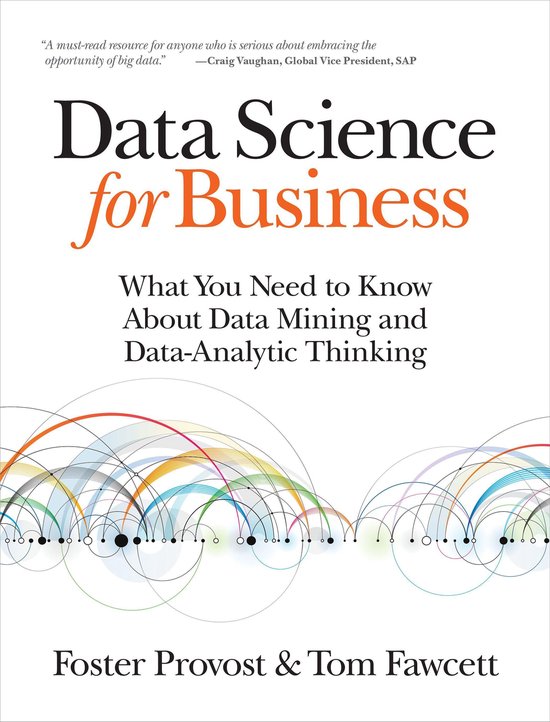
Data science for Business (Foster Provost & Rom Fawcett)
Chapter 1 – Introduction: Data-Analytic thinking
Widest applications of data-mining techniques can be found in marketing, for tasks as targeted
marketing, online advertising, cross-selling. Data mining is used for general relationship management
to analyze customer behavior in order to manage attrition and maximize expected customer value
Finance industry used data mining for credit scoring and trading, and in operations via fraud
detection and workforce management
Data science involves principles, processes and techniques for understanding phenomena via the
analysis of data. The ultimate goal is to improve decision-making via data science
Data driven decision making (DDD) refers to the practice of basing decisions on the analysis of data,
rather than purely on intuition. DDD is not all-or-nothing practice and different firms engage in DDD
in different ways. The more data-driven a firm is, the more productive it is, even controlling for a
wide range of possible confounding factors. DDD also provides a high ROA, ROE, asset utilization and
market value
Nowadays, business decisions are being made automatically by computer systems. Different
industries have adopted automatic decision-making at different rates -> finance and
telecommunications are early adopters because of the data networks and implementation of massive
scale computing
Data processing is not always data science. Data engineering and processing are critical to support
data science, but are more general
- Data science needs access to data and it often benefits from sophisticated data engineering
that data processing facilities facilitate -> but these technologies are not necessarily data
science = they just support data science
- Data processing technologies are very important for many data-oriented business tasks, that
do not involve extracting knowledge or data-driven decision-making
Big data = datasets that are too large for traditional data processing systems, require new processing
technologies. Big data technologies are used for many tasks, including data engineering -> often used
for implementing data mining techniques, but much more often for data processing in support of the
data mining techniques and other data science activities
Using big data technologies is associated with significant additional productivity growth
Fundamental principle of data science = data and the capability to extract full knowledge from data,
should be regarded as key strategic assets. Viewing this as assets can lead to the realization of them
as being complementary -> best data science team can yield little value without the appropriate data,
right data often cannot substantially improve decisions without suitable data science talent
Businesses are increasingly driven by data analytics, they have a great professional advantage I being
able to interact competently with and within such businesses -> it will help to envision opportunities
for improving DDD or to see data-oriented competitive threats
Fundamental concepts of data science
1) Extracting useful knowledge from data to solve business problems can be treated
systematically by following a process with reasonably well-defined stages -> it provides a
, framework to structure data analytics problems. Structured thinking about analytics
emphasized the often under-appreciated aspects of supporting decision-making with data
2) From a large mass of data, information technology can be sued to find informative
descriptive attributes of entities of interest. -> this can be used to recursively build models
ot predict churn based on multiple attributes
3) If you look too hard at a set of data, you will find something – but it might not generalize
beyond the data you’re looking at. -> this is overfitting a dataset, you should avoid this.
Concept of overfitting and avoidance permeates data science processes, algorithms and
evaluation methods
4) Formulating data mining solutions and evaluating the results involves thinking carefully
about the context in which they will be used -> consider the application in question. How
are you going to use the data
Churn prediction = One of the ways to calculate a churn rate is to divide the number of customers
lost during a given time interval by the number of active customers at the beginning of the period
Customer churn (also known as customer attrition) refers to when a
customer (player, subscriber, user, etc.) Online businesses typically
treat a customer as churned once a particular amount of time has
elapsed since the customer's last interaction with the site or service.
To predict whether a customer will be a churner or non-churner, there
are a number of data mining techniques applied for churn prediction, such as artificial neural
networks, decision trees, and support vector machines
o Churn means “leaving the company”. It is very critical for a business to have an idea
about why and when customers are likely to churn
Chapter 2 – business problems and data science solutions
Data mining process breaks up the overall task of finding patterns from data into a set of well-defined
subtasks -> it is also useful for structuring discussions about data science
Each DDD problem is unique, comprising its own combination of goals, desires, constraints and
personalities. There are sets of common tasks that underlie the business problems
In collaboration with business stakeholders, data scientists decompose a business problem
into subtasks. The solution of these subtasks can be composed to solve the overall problem
A subtask that is likely to be part of the solution to any churn problem is to estimate from
historical data
Critical skill in data science is the ability to decompose a data-analytics problem into pieces such that
each piece matches a known task for which tools are available. Recognizing familiar problems and
their solutions avoids wasting time and resources reinventing the wheel
Classification and class probability estimation attempt to predit, for each individual in the
population, which of a (small) set of classes this individual belongs to, most often these classes are
mutually exclusive. Closely related task is scoring or class probability estimation.
- Scoring model applied to an individual produces a score representing the probability that the
individual belongs to each class
Regression (= value estimation) attempts to estimate or predict, for each individual, the numerical
value of some variable for that individual. A regression procedure produces a model that, given an
individual, estimates the value of the particular variable specific to that individual. Regression
predicts how much something will happen
Summary book
Data science for Business (Foster Provost & Rom Fawcett)
Chapter 1 – Introduction: Data-Analytic thinking
Widest applications of data-mining techniques can be found in marketing, for tasks as targeted
marketing, online advertising, cross-selling. Data mining is used for general relationship management
to analyze customer behavior in order to manage attrition and maximize expected customer value
Finance industry used data mining for credit scoring and trading, and in operations via fraud
detection and workforce management
Data science involves principles, processes and techniques for understanding phenomena via the
analysis of data. The ultimate goal is to improve decision-making via data science
Data driven decision making (DDD) refers to the practice of basing decisions on the analysis of data,
rather than purely on intuition. DDD is not all-or-nothing practice and different firms engage in DDD
in different ways. The more data-driven a firm is, the more productive it is, even controlling for a
wide range of possible confounding factors. DDD also provides a high ROA, ROE, asset utilization and
market value
Nowadays, business decisions are being made automatically by computer systems. Different
industries have adopted automatic decision-making at different rates -> finance and
telecommunications are early adopters because of the data networks and implementation of massive
scale computing
Data processing is not always data science. Data engineering and processing are critical to support
data science, but are more general
- Data science needs access to data and it often benefits from sophisticated data engineering
that data processing facilities facilitate -> but these technologies are not necessarily data
science = they just support data science
- Data processing technologies are very important for many data-oriented business tasks, that
do not involve extracting knowledge or data-driven decision-making
Big data = datasets that are too large for traditional data processing systems, require new processing
technologies. Big data technologies are used for many tasks, including data engineering -> often used
for implementing data mining techniques, but much more often for data processing in support of the
data mining techniques and other data science activities
Using big data technologies is associated with significant additional productivity growth
Fundamental principle of data science = data and the capability to extract full knowledge from data,
should be regarded as key strategic assets. Viewing this as assets can lead to the realization of them
as being complementary -> best data science team can yield little value without the appropriate data,
right data often cannot substantially improve decisions without suitable data science talent
Businesses are increasingly driven by data analytics, they have a great professional advantage I being
able to interact competently with and within such businesses -> it will help to envision opportunities
for improving DDD or to see data-oriented competitive threats
Fundamental concepts of data science
1) Extracting useful knowledge from data to solve business problems can be treated
systematically by following a process with reasonably well-defined stages -> it provides a
, framework to structure data analytics problems. Structured thinking about analytics
emphasized the often under-appreciated aspects of supporting decision-making with data
2) From a large mass of data, information technology can be sued to find informative
descriptive attributes of entities of interest. -> this can be used to recursively build models
ot predict churn based on multiple attributes
3) If you look too hard at a set of data, you will find something – but it might not generalize
beyond the data you’re looking at. -> this is overfitting a dataset, you should avoid this.
Concept of overfitting and avoidance permeates data science processes, algorithms and
evaluation methods
4) Formulating data mining solutions and evaluating the results involves thinking carefully
about the context in which they will be used -> consider the application in question. How
are you going to use the data
Churn prediction = One of the ways to calculate a churn rate is to divide the number of customers
lost during a given time interval by the number of active customers at the beginning of the period
Customer churn (also known as customer attrition) refers to when a
customer (player, subscriber, user, etc.) Online businesses typically
treat a customer as churned once a particular amount of time has
elapsed since the customer's last interaction with the site or service.
To predict whether a customer will be a churner or non-churner, there
are a number of data mining techniques applied for churn prediction, such as artificial neural
networks, decision trees, and support vector machines
o Churn means “leaving the company”. It is very critical for a business to have an idea
about why and when customers are likely to churn
Chapter 2 – business problems and data science solutions
Data mining process breaks up the overall task of finding patterns from data into a set of well-defined
subtasks -> it is also useful for structuring discussions about data science
Each DDD problem is unique, comprising its own combination of goals, desires, constraints and
personalities. There are sets of common tasks that underlie the business problems
In collaboration with business stakeholders, data scientists decompose a business problem
into subtasks. The solution of these subtasks can be composed to solve the overall problem
A subtask that is likely to be part of the solution to any churn problem is to estimate from
historical data
Critical skill in data science is the ability to decompose a data-analytics problem into pieces such that
each piece matches a known task for which tools are available. Recognizing familiar problems and
their solutions avoids wasting time and resources reinventing the wheel
Classification and class probability estimation attempt to predit, for each individual in the
population, which of a (small) set of classes this individual belongs to, most often these classes are
mutually exclusive. Closely related task is scoring or class probability estimation.
- Scoring model applied to an individual produces a score representing the probability that the
individual belongs to each class
Regression (= value estimation) attempts to estimate or predict, for each individual, the numerical
value of some variable for that individual. A regression procedure produces a model that, given an
individual, estimates the value of the particular variable specific to that individual. Regression
predicts how much something will happen