Revision of Grade 11 Probability:
The key things that you need to recall from grade 11 probability are as follows:
Addition rule for probabilities
Mutually exclusive events
Exhaustive events
Complementary events
independent and not independent events
Contingency tables
Venn diagrams
Tree diagrams
Notation:
The following notation is also worth restating:
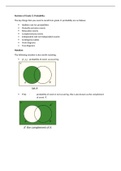
P( A)- probability of event A occurring
P’(A) - probability of event A not occurring, this is also known as the complement
of event A .
, P( A∨B) The probability of either of event A or event B
occurring. In textbooks we often see the union symbol
used here 𝖴
𝑃(𝐴 𝑜𝑟 𝐵) = 𝑃(𝐴 𝖴 𝐵)
P( A∧B) Probability of BOTH event A and event B occurring
simultaneously. In textbooks we often see the intersection
symbol used here ∩
𝑃(𝐴 𝑎𝑛𝑑 𝐵) = 𝑃(𝐴 ∩ 𝐵)
P ¿) Probability of event A occurring, given that B has already
occurred. This is known as a conditional probability.
This is not in the curriculum, but is useful nonetheless.
The key things that you need to recall from grade 11 probability are as follows:
Addition rule for probabilities
Mutually exclusive events
Exhaustive events
Complementary events
independent and not independent events
Contingency tables
Venn diagrams
Tree diagrams
Notation:
The following notation is also worth restating:
P( A)- probability of event A occurring
P’(A) - probability of event A not occurring, this is also known as the complement
of event A .
, P( A∨B) The probability of either of event A or event B
occurring. In textbooks we often see the union symbol
used here 𝖴
𝑃(𝐴 𝑜𝑟 𝐵) = 𝑃(𝐴 𝖴 𝐵)
P( A∧B) Probability of BOTH event A and event B occurring
simultaneously. In textbooks we often see the intersection
symbol used here ∩
𝑃(𝐴 𝑎𝑛𝑑 𝐵) = 𝑃(𝐴 ∩ 𝐵)
P ¿) Probability of event A occurring, given that B has already
occurred. This is known as a conditional probability.
This is not in the curriculum, but is useful nonetheless.