DOMAIN AND RANGE
Recall:
DOMAIN = {All the possible input values (𝑥)}
RANGE = {All the possible output values (𝑦)}
Sometimes there will be restrictions on the domain and the range of a graph.
When working out the domain, it is often easier to consider what may not be an input.
The domain of a function is often given as part of the function description.
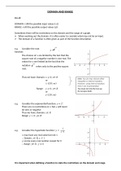
e.g. Consider the root
y x .
function:
The choices of 𝑥 are limited by the fact that the
square root of a negative number is non-real. The
values for 𝑦 are limited by the fact that the
notation x refers only to the positive square
root.
Thus we have: Domain: 𝑥 ≥ 0; 𝑥 𝑅
Note: You are may choose either
or inequality or interval notation.
𝑥 ∈ [0; ∞) However, using interval notation
here is not recommended.
Range: 𝑦 ≥ 0; 𝑦 𝑅 You must not mix the two up.
or Do not give both.
𝑦 ∈ [0; ∞)
e.g. Consider the exponential function: 𝑦 = 2𝑥.
There are no restrictions on 𝑥 but 𝑦 will never
be zero or negative
Thus we have: Domain: 𝑥 𝑅
Range: 𝑦 > 0; 𝑦 𝑅
1
e.g. Consider the hyperbolic function: 𝑦 =
x 1
𝑥 may have any real value but not 1
∴ Domain: 𝑥 𝑅; 𝑥 1
𝑦 can be every real number except for 0
∴ Range: 𝑦 𝑅 ; 𝑦 ≠ 0
It is important when defining a function to state the restrictions on the domain and range.
Recall:
DOMAIN = {All the possible input values (𝑥)}
RANGE = {All the possible output values (𝑦)}
Sometimes there will be restrictions on the domain and the range of a graph.
When working out the domain, it is often easier to consider what may not be an input.
The domain of a function is often given as part of the function description.
e.g. Consider the root
y x .
function:
The choices of 𝑥 are limited by the fact that the
square root of a negative number is non-real. The
values for 𝑦 are limited by the fact that the
notation x refers only to the positive square
root.
Thus we have: Domain: 𝑥 ≥ 0; 𝑥 𝑅
Note: You are may choose either
or inequality or interval notation.
𝑥 ∈ [0; ∞) However, using interval notation
here is not recommended.
Range: 𝑦 ≥ 0; 𝑦 𝑅 You must not mix the two up.
or Do not give both.
𝑦 ∈ [0; ∞)
e.g. Consider the exponential function: 𝑦 = 2𝑥.
There are no restrictions on 𝑥 but 𝑦 will never
be zero or negative
Thus we have: Domain: 𝑥 𝑅
Range: 𝑦 > 0; 𝑦 𝑅
1
e.g. Consider the hyperbolic function: 𝑦 =
x 1
𝑥 may have any real value but not 1
∴ Domain: 𝑥 𝑅; 𝑥 1
𝑦 can be every real number except for 0
∴ Range: 𝑦 𝑅 ; 𝑦 ≠ 0
It is important when defining a function to state the restrictions on the domain and range.