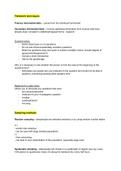
Fieldwork techniques
Primary information/data ~ comes from the individual her/himself
Secondary information/data ~ involves gathering information from sources that have
already been compiled in statistical/mapped forms ; research
Questionnaires:
- Avoid closed (yes or no) questions
- Do not ask intrusive/potentially sensitive questions
- Make the questions easy and quick to answer (multiple choice, include degree of
agreement/disagreement)
- Include a short introduction
- Ask for the gender/age
Why is it necessary to ask whether the person is from the area at the beginning of the
questionnaire?
- Eliminates any people who are irrelevant to the question and would not be able to
answer it, preventing wasting other people’s time
Reasons for a pilot study:
Allows you to eliminate any questions that were
- too intrusive/sensitive
- Irrelevant to your investigation question
- Unclear
- Leading/biased
- Too long
Sampling methods
Random sampling - sites/people are selected randomly or by using random number tables
(+)
- avoids bias selection
- can be used with large sample populations
(-)
- time consuming
- can lead to poor presentation of the population, especially large ones
Systematic sampling - sites/people are chosen in a systematic or regular way (eg. every
10th person is questioned, every 2m along the transect line, every half hour)
, (+)
- more straight-forward/organised
- more even coverage of the sample area
- less time-confusing
(-)
- more biased, leading to under/over representation of a particular pattern
Stratified sampling - collecting a set number/amount of data for each subset of the area’s
population (eg. 6 questionnaires completed by each gender, female and male, in the school)
(+)
- can generate more accurate, representative results
- flexible and applicable to many different types of data
(-)
- the subset sizes must be known which can be troublesome to gather
- more time consuming
Confirming hypotheses:
1. State whether you agree/disagree
→ hypothesis is true/correct/accurate/partially correct
→ hypothesis is false/inaccurate
2. Summary statement supporting your decision on the hypothesis (positive)
3. Statement opposite to your hypothesis (negative)
4. Pair of evidence (*calculate percentages and look at the piece of data compared to
the total)
Eg.
Hypothesis = Students travel to school in different ways but most travel by car
This is incorrect. There was a larger percentage of students that traveled to school by bus.
Only 39 out of 125 students traveled by car. 86 students, 69% do not travel by car.
Describing how to investigate housing/building conditions:
- Conduct building quality survey
- Draw field sketches of the buildings and label/annotate to show the conditions
- Take photos/videos of the buildings
- Collect secondary data online/local government records
Improving reliability of results:
- Have more than one person collecting data
- Take readings on the same day/time OR take readings on more days
- Take more measurements
Primary information/data ~ comes from the individual her/himself
Secondary information/data ~ involves gathering information from sources that have
already been compiled in statistical/mapped forms ; research
Questionnaires:
- Avoid closed (yes or no) questions
- Do not ask intrusive/potentially sensitive questions
- Make the questions easy and quick to answer (multiple choice, include degree of
agreement/disagreement)
- Include a short introduction
- Ask for the gender/age
Why is it necessary to ask whether the person is from the area at the beginning of the
questionnaire?
- Eliminates any people who are irrelevant to the question and would not be able to
answer it, preventing wasting other people’s time
Reasons for a pilot study:
Allows you to eliminate any questions that were
- too intrusive/sensitive
- Irrelevant to your investigation question
- Unclear
- Leading/biased
- Too long
Sampling methods
Random sampling - sites/people are selected randomly or by using random number tables
(+)
- avoids bias selection
- can be used with large sample populations
(-)
- time consuming
- can lead to poor presentation of the population, especially large ones
Systematic sampling - sites/people are chosen in a systematic or regular way (eg. every
10th person is questioned, every 2m along the transect line, every half hour)
, (+)
- more straight-forward/organised
- more even coverage of the sample area
- less time-confusing
(-)
- more biased, leading to under/over representation of a particular pattern
Stratified sampling - collecting a set number/amount of data for each subset of the area’s
population (eg. 6 questionnaires completed by each gender, female and male, in the school)
(+)
- can generate more accurate, representative results
- flexible and applicable to many different types of data
(-)
- the subset sizes must be known which can be troublesome to gather
- more time consuming
Confirming hypotheses:
1. State whether you agree/disagree
→ hypothesis is true/correct/accurate/partially correct
→ hypothesis is false/inaccurate
2. Summary statement supporting your decision on the hypothesis (positive)
3. Statement opposite to your hypothesis (negative)
4. Pair of evidence (*calculate percentages and look at the piece of data compared to
the total)
Eg.
Hypothesis = Students travel to school in different ways but most travel by car
This is incorrect. There was a larger percentage of students that traveled to school by bus.
Only 39 out of 125 students traveled by car. 86 students, 69% do not travel by car.
Describing how to investigate housing/building conditions:
- Conduct building quality survey
- Draw field sketches of the buildings and label/annotate to show the conditions
- Take photos/videos of the buildings
- Collect secondary data online/local government records
Improving reliability of results:
- Have more than one person collecting data
- Take readings on the same day/time OR take readings on more days
- Take more measurements