100% satisfaction guarantee Immediately available after payment Both online and in PDF No strings attached 4.2 TrustPilot
logo-home
Exam (elaborations)

Exam (elaborations) TEST BANK FOR Managerial Accounting 3rd Edition by Wild and Shaw

Rating
-
Sold
-
Pages
159
Grade
A+
Uploaded on
13-11-2021
Written in
2021/2022

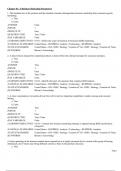
Exam (elaborations) TEST BANK FOR Managerial Accounting 3rd Edition by Wild and Shaw Managerial-Accounting,-3rd-Edition-Wil Chapter 01 Managerial Accounting Concepts and Principles True / False Questions 1. Much of managerial accounting is directed at gathering useful information about costs for planning and control decisions. True False 2. Control is the process of setting goals and determining ways to achieve them. True False 3. Managerial accounting is an activity that provides financial and nonfinancial information to an organization's managers and other internal decision makers. True False 4. One of the usual differences between financial and managerial accounting is the time dimension of the information reported. True False 5. Managerial accounting information can be forwarded to the managers of a company quickly since external auditors do not have to review it, and estimates and projections are acceptable. True False 6. One difference between financial and managerial accounting is that the external users that use financial information must plan a company's future, but the internal users of managerial accounting information generally must decide whether to invest in or lend to a company. True False 1-1 Full file at 7. Financial accounting relies on accepted principles that are enforced through an extensive set of rules and guidelines; on the other hand, managerial accounting systems are flexible. True False 8. The focus of financial accounting is on an organization's projects, processes, and subdivisions, and the focus of managerial accounting is on the whole organization. True False 9. Both financial and managerial accounting report monetary information; managerial accounting also reports considerable nonmonetary information. True False 10. Both financial and managerial accounting affect people's decisions and actions. True False 11. The concept of total quality management focuses on continuous improvement. True False 12. The orientation of just-in-time manufacturing is that products are "pulled" through the manufacturing process by the orders received from customers. True False 13. When the attitude of continuous improvement exists throughout an organization, every manager and employee seeks to continuously experiment with new and improved business practices. True False 1-2 Full file at 14. The main principle of the lean business model is the elimination of waste of every kind while satisfying the customer and providing a positive return to the company. True False 15. The management concept of customer orientation causes a company to spend large amounts on advertising to convince customers to buy the company's standard products. True False 16. The management concept of customer orientation encourages a company to set up its production system to produce large quantities of the same product for all customers. True False 17. Total quality management and just-in-time manufacturing are two modern systems designed to improve the quality of management and the products and services offered. True False 18. Under a just-in-time manufacturing system, large quantities of inventory are accumulated throughout the factory to be certain that needed components are available each time that they are needed. True False 19. The balanced scorecard aids in continuous improvement by augmenting financial measures with drivers or indicators of future financial performance. True False 20. The Lean Business Model should have no effect on cost in a modern manufacturing environment. True False 1-3 Full file at 21. Fraud affects all business. True False 22. Fraud involves the deliberate or accidental misuse of the employer's assets. True False 23. Direct materials are not usually easily traced to a product. True False 24. Costs may be classified by many different cost classifications. True False 25. Product costs can be classified as one of three types: direct materials, direct labor, or overhead. True False 26. Whether a cost is controllable or not controllable by an employee depends on the employee's level of responsibility. True False 27. Indirect materials are accounted for as factory overhead because they are not easily traced to specific units or batches of production. True False 28. A variable cost changes in proportion to changes in the volume in activity. True False 1-4 Full file at 29. Direct costs are incurred for the benefit of more than one cost object. True False 30. A sunk cost has already been incurred and cannot be avoided or changed, so it is irrelevant to decision making. True False 31. An out-of-pocket cost requires a future cash outlay and is relevant for decision making. True False 32. An opportunity cost requires a future cash outlay and is relevant for decision making. True False 33. Period costs are incurred by purchasing merchandise or manufacturing finished goods. True False 34. Product costs are expenditures necessary and integral to finished products. True False 35. Cost concepts such as variable, fixed, mixed, direct and indirect apply only to manufacturers and not to service companies. True False 36. Although direct labor and raw materials costs are treated as manufacturing costs and therefore make up part of the finished goods inventory cost, factory overhead is charged to expense as it is incurred because it is a period cost. True False 1-5 Full file at 37. Selling and administrative expenses are normally product costs. True False 38. The cost of partially completed products is included in the balance of the Goods in Process Inventory account. True False 39. Raw materials that become part of a product and are identified with specific units or batches of a product are called direct materials. True False 40. Manufacturers usually have three inventories: raw materials, goods in process, and finished goods. True False 41. Raw materials inventory includes only direct materials. True False 42. The Goods in Process Inventory account is found only in the ledgers of merchandising companies. True False 43. The main difference between the income statement of a manufacturer and a merchandiser is that the merchandiser includes cost of goods manufactured rather than cost of goods purchased. True False 1-6 Full file at 44. Raw materials purchased plus beginning raw materials inventory equals the ending balance of raw materials inventory. True False 45. Four factors come together in the manufacturing process: beginning goods in process inventory, direct materials, direct labor, and factory overhead. True False 46. Newly completed units are combined with beginning finished goods inventory to make up total ending goods in process inventory. True False 47. The series of activities that add value to a company's products or services is called a value chain. True False 48. Cycle time equals process time plus inspection time plus move time plus wait time. True False 49. A manufacturer's cost of goods manufactured is the sum of direct materials, direct labor, and factory overhead costs incurred in producing products. True False 50. Indirect labor refers to the cost of the workers whose efforts are directly traceable to specific units or batches of product. True False 1-7 Full file at 51. Factory overhead includes selling and administrative expenses because they are indirect costs of a product. True False 52. Prime costs consist of direct labor and factory overhead. True False 53. The manufacturing statement is also known as the schedule of manufacturing activities or the schedule of cost of goods manufactured. True False 54. The manufacturing statement must be prepared monthly as it is a required general-purpose financial statement. True False Multiple Choice Questions 55. Managerial accounting information: A. Is used mainly by external users. B. Involves gathering information about costs for planning and control decisions. C. Is generally the only accounting information available to managers. D. Can be used for control purposes but not for planning purposes. E. Has little to do with controlling costs. 1-8 Full file at 56. Managerial accounting is different from financial accounting in that: A. Managerial accounting is more focused on the organization as a whole and financial accounting is more focused on subdivisions of the organization. B. Managerial accounting never includes nonmonetary information. C. Managerial accounting includes many projections and estimates whereas financial accounting has a minimum of predictions. D. Managerial accounting is used extensively by investors, whereas financial accounting is used only by creditors. E. Managerial accounting is mainly used to set stock prices. 57. Flexibility of practice when applied to managerial accounting means that: A. The information must be presented in electronic format so that it is easily changed. B. Managers must be willing to accept the information as the accountants present it to them, rather than in the format they ask for. C. The managerial accountants need to be on call twenty-four hours a day. D. The design of a company's managerial accounting system largely depends on the nature of the business and the arrangement of the internal operations of the company. E. Managers must be flexible with information provided in varying forms and using inconsistent measures. 58. Which of the following items does not represent a difference between financial and managerial accounting? A. Users of the information. B. Flexibility of practices. C. Timeliness and time dimension of the information reported. D. Nature of the information. E. Purpose of accounting. 59. Which of the following items is a management concept that was not created to improve companies' performances? A. Just-in-time manufacturing. B. Customer orientation. C. Total quality management. D. Continuous improvement. E. Theory of Constraints. 1-9 Full file at

Show more Read less


Whoops! We can’t load your doc right now. Try again or contact support.

Document information

Uploaded on
November 13, 2021
Number of pages
159
Written in
2021/2022
Type
Exam (elaborations)
Contains
Questions & answers

Subjects

Content preview

,Full file at http://gettestbank.eu/Test-Bank-for-Managerial-Accounting,-3rd-Edition-Wil

Chapter 01
Managerial Accounting Concepts and Principles

True / False Questions


1. Much of managerial accounting is directed at gathering useful information about costs for
planning and control decisions.
True False


2. Control is the process of setting goals and determining ways to achieve them.
True False


3. Managerial accounting is an activity that provides financial and nonfinancial information to
an organization's managers and other internal decision makers.
True False


4. One of the usual differences between financial and managerial accounting is the time
dimension of the information reported.
True False


5. Managerial accounting information can be forwarded to the managers of a company
quickly since external auditors do not have to review it, and estimates and projections are
acceptable.
True False


6. One difference between financial and managerial accounting is that the external users that
use financial information must plan a company's future, but the internal users of managerial
accounting information generally must decide whether to invest in or lend to a company.
True False


1-1

,Full file at http://gettestbank.eu/Test-Bank-for-Managerial-Accounting,-3rd-Edition-Wil


7. Financial accounting relies on accepted principles that are enforced through an extensive
set of rules and guidelines; on the other hand, managerial accounting systems are flexible.
True False


8. The focus of financial accounting is on an organization's projects, processes, and
subdivisions, and the focus of managerial accounting is on the whole organization.
True False


9. Both financial and managerial accounting report monetary information; managerial
accounting also reports considerable nonmonetary information.
True False


10. Both financial and managerial accounting affect people's decisions and actions.
True False


11. The concept of total quality management focuses on continuous improvement.
True False


12. The orientation of just-in-time manufacturing is that products are "pulled" through the
manufacturing process by the orders received from customers.
True False


13. When the attitude of continuous improvement exists throughout an organization, every
manager and employee seeks to continuously experiment with new and improved business
practices.
True False


1-2

, Full file at http://gettestbank.eu/Test-Bank-for-Managerial-Accounting,-3rd-Edition-Wil


14. The main principle of the lean business model is the elimination of waste of every kind
while satisfying the customer and providing a positive return to the company.
True False


15. The management concept of customer orientation causes a company to spend large
amounts on advertising to convince customers to buy the company's standard products.
True False


16. The management concept of customer orientation encourages a company to set up its
production system to produce large quantities of the same product for all customers.
True False


17. Total quality management and just-in-time manufacturing are two modern systems
designed to improve the quality of management and the products and services offered.
True False


18. Under a just-in-time manufacturing system, large quantities of inventory are accumulated
throughout the factory to be certain that needed components are available each time that they
are needed.
True False


19. The balanced scorecard aids in continuous improvement by augmenting financial
measures with drivers or indicators of future financial performance.
True False


20. The Lean Business Model should have no effect on cost in a modern manufacturing
environment.
True False


1-3
Get to know the seller

Seller avatar
Reputation scores are based on the amount of documents a seller has sold for a fee and the reviews they have received for those documents. There are three levels: Bronze, Silver and Gold. The better the reputation, the more your can rely on the quality of the sellers work.
Expert001 Chamberlain School Of Nursing
View profile
Follow You need to be logged in order to follow users or courses
Sold
798
Member since
4 year
Number of followers
566
Documents
1190
Last sold
1 week ago
Expert001

High quality, well written Test Banks, Guides, Solution Manuals and Exams to enhance your learning potential and take your grades to new heights. Kindly leave a review and suggestions. We do take pride in our high-quality services and we are always ready to support all clients.

4.2

159 reviews

5
104
4
18
3
14
2
7
1
16

Recently viewed by you

Why students choose Stuvia

Created by fellow students, verified by reviews

Quality you can trust: written by students who passed their tests and reviewed by others who've used these notes.

Didn't get what you expected? Choose another document

No worries! You can instantly pick a different document that better fits what you're looking for.

Pay as you like, start learning right away

No subscription, no commitments. Pay the way you're used to via credit card and download your PDF document instantly.

Student with book image

“Bought, downloaded, and aced it. It really can be that simple.”

Alisha Student

Frequently asked questions