

100% satisfaction guarantee Immediately available after payment Both online and in PDF No strings attached 4.2 TrustPilot
logo-home
Exam (elaborations)

Exam (elaborations) TEST BANK FOR Financial Reporting and Analysis Using Financial Accounting Information (with Thomson Analytics Access Code) 10th Edition by Charles H. Gibson

Rating
-
Sold
1
Pages
468
Grade
A+
Uploaded on
12-11-2021
Written in
2021/2022

Exam (elaborations) TEST BANK FOR Financial Reporting and Analysis Using Financial Accounting Information (with Thomson Analytics Access Code) 10th Edition by Charles H. Gibson TABLE OF CONTENTS SOLUTIONS MANUAL Chapter 1 Introduction to Financial Reporting . . . . . . . . . . . . 1 Chapter 2 Introduction to Financial Statements and Other Financial Reporting Topics. . . . . . . . . . . . . . . . . . . . . . 20 Chapter 3 Balance Sheet . . . . . . . . . . . . . . . . . . . . . . . 41 Chapter 4 Income Statement. . . . . . . . . . . . . . . . . . . . . . 68 Chapter 5 Basics of Analysis. . . . . . . . . . . . . . . . . . . . . 88 Chapter 6 Liquidity of Short-term Assets; Related Debt-Paying Ability 107 Chapter 7 Long-Term Debt-Paying Ability . . . . . . . . . . . . . . . 160 Chapter 8 Profitability . . . . . . . . . . . . . . . . . . . . . . . 187 Chapter 9 For the Investor. . . . . . . . . . . . . . . . . . . . . . 234 Chapter 10 Statement of Cash Flows . . . . . . . . . . . . . . . . . . 260 Chapter 11 Expanded Analysis . . . . . . . . . . . . . . . . . . . . . 299 Chapter 12 Special Industries: Banks, Utilities, Oil and Gas, Transportation, Insurance, Real Estate Companies. . . . . . 340 Chapter 13 Personal Financial Statements and Accounting for Governments and Not-For-Profit Organizations. . . . . . . . 366 1 Chapter 1 Introduction to Financial Reporting TO THE NET 1. a. he Mission of the Financial Accounting Standard Board (In Part) The mission of the Financial Accounting Standards Board (FASB)is to establish and improve standards of financial accounting and reporting for the guidance and education of the public, including issuers, auditors and users of financial information. Accounting standards are essential to the efficient functioning of the economy because decisions about the allocation of resources rely heavily on credible, concise, transparent and understandable financial information. Financial information about the operations and financial position of individual entities also is used by the public in making various other kinds of decisions. To accomplish its mission, the FASB acts to: · Improve the usefulness of financial reporting by focusing on the primary characteristics of relevance and reliability and on the qualities of comparability and constancy; · Keep standards current to reflect changes in methods of doing business and changes in the economic environment; · Consider promptly any significant areas of deficiency in financial reporting that 2 might be improved through the standardsetting process; · Promote the international convergence of accounting standards concurrent with improving the quality of financial reporting; and · Improve the common understanding of the nature and purposes of information contained in financial reports. b Financial Accounting Standards Advisory Council An Overview The Financial Accounting Standards Advisory Council, FASAC or “the Council” for short, was formed in 1973 concurrent with the establishment of the Financial Accounting Standards Board (the FASB or the Board). The primary function of FASAC is to advise the Board on issues related to projects on the Board’s agenda, possible new agenda items, project priorities, procedural matters that may require the attention of the FASB, and other matters as requested by the chairman of the FASB. FASAC meetings provide the Board with an opportunity to obtain and discuss the views of a very diverse group of individuals from varied business and professional backgrounds. The members of FASAC are drawn from the ranks of CEOs, CFOs, senior partners of public accounting firms, executive directors of professional organizations, and senior members of the academic and analyst communities, all disclosure. Carrying Out the Mission It is the job of the FASB to establish the “generally accepted accounting principles,” or GAAP, to which public financial reporting by U.S. corporations must conform and to keep those principles current. In conducting its activities, the Board strives to carefully weight the views of its users, preparers, and auditors of financial report. The Council provides an important sounding board to help the FASB understand what constituents are thinking about a wide range of issues. 3 FASAC’s role is not to reach a consensus or to vote on the issues that it considers at its meetings. Rather, FASAC operates as a window through which the Board can obtain and discuss the representative views of the diverse groups the FASB affects. Thus, FASAC provides the forum for two-way communication. While it is important to convene the Council members as a group, that is so that the Board can hear the individual views of those members and so that the members can hear and respond to each other’s views. Members of FASAC are urged to speak out publicly on matters before the FASB and also to be supportive of the Board’s process, and the principle of privatesector standard setting. Individual Council members are not expected to agree with the Board’s decisions on all of the technical aspects of the projects on the Board’s agenda, but it is important that FASAC members support the institution and its due process. Structure of the Organization FASAC is an operating arm of the financial Accounting Foundation, an organization that is independent of any other business or professional organization. The Foundation is run by a 16-member Board of Trustees who are leaders in the business, accounting, financial, government and academic communities. The Foundation selects the members of FASAC including the chairman and broadly oversees its operations. The Council comprises 33 members who represent a broad cross section of the Board’s constituency. They are appointed for a one-year term are eligible to be reappointed for three additional one-year terms. The Process The Council meets once a quarter at the FASB’s offices in Norwalk, Ct. Like the FASB, FASAC is committed to following an open, orderly process that is open to public observation. In addition to eh Council members, the members of the FASB, its director of research and technical activities, several members of the FASB’s staff, and the chief accountant of the SEC attend each meeting. 2. Each student will select a company and obtain a copy of their annual report, 10-K, and proxy. 4 5 QUESTIONS 1- 1. a. The AICPA is an organization of CPAs that prior to 1973 accepted the primary responsibility for the development of generally accepted accounting principles. Their role was substantially reduced in 1973 when the Financial Accounting Standards Board was established. Their role was further reduced with the establishment of the Public Company Accounting Oversight Board was established in 2002. b. The Financial Accounting Standards Board replaced the Accounting Principles Board as the primary rulemaking body. It is an independent organization and includes members other than public accountants. c. The SEC has the authority to determine generally accepted accounting principles and to regulate the accounting profession. The SEC has elected to leave much of the determination of generally accepted accounting principles to the private sector. For accounting standards the Financial Accounting Standards Board has played the major role since 1973. Regulation of the accounting profession was substantially turned over to the Public Company Accounting Oversight Board in 2002. 1- 2. Consistency allows for the same accounting principle from period to period. A change in principle requires statement disclosure. 1- 3. The concept of historical cost determines the balance sheet valuation of land. The realization concept requires that a transaction has occurred for the profit to be recognized. 1- 4. a. Entity f. Historical cost b. Realization g. Disclosure c. Materiality d. Conservatism e. Historical cost 1- 5. Entity concept 6 1- 6. Generally accepted accounting principles do not apply when a firm does not appear to be a going concern. In this case the liquidation values are the appropriate figures. 1- 7. With the time period assumption, inaccuracies of accounting for the entity, short of its complete life span, are accepted. The assumption is made that the entity can be accounted for reasonably accurately for a particular period of time. In other words, the decision is made to accept some inaccuracy because of incomplete information about the future in exchange for more timely reporting. The statements are considered to be meaningful because material inaccuracies are not acceptable. 1- 8. It is true that the only accurate way to account for the success or failure of an entity is to accumulate all transactions from the opening of business until the business eventually liquidates. But it is not necessary that the statements be completely accurate in order for them to be meaningful. 1- 9. a. Natural business year A year that ends when operations are at a low ebb for the year. b. Calendar year The accounting time period is ended on December 31. c. Fiscal year A twelve-month accounting period that ends at the end of a month other than December 31. 1-10. Money. 1-11. When money does not hold a stable value, the financial statements can lose much of their significance. To the extent that money does not remain stable, it loses usefulness as the standard for measuring financial transactions. 1-12. No. There is a problem with determining the index in order to adjust the statements. The items that are included in 7 the index must be representative and the price of items change because of various factors, such as quality, technology, and inflation. Yes. A reasonable adjustment to the statements can be made for inflation. 8 1-13. False. An arbitrary write-off of inventory cannot be justified under the conservatism concept. The conservatism concept can only be applied where there are alternative measurements and each of these alternative measurements has reasonable support. 1-14. Yes, inventory that has a market value below the historical cost should be written down in order to recognize a loss. This is done based upon the concept of conservatism. Losses that can be reasonably anticipated should be taken in order to reflect the least favorable effect on net income of the current period. 1-15. End of production The realization of revenue at the completion of the production process is acceptable when the price of the item is known and there is a ready market. Receipt of cash This method should only be used when the prospects of collection are especially doubtful at the time of sale. During production This method is allowed for long-term construction projects because recognizing revenue on long-term construction projects as work progresses tends to give a fairer picture of the results for a given period in comparison with having the entire revenue realized in one period of time from a project. 1-16. It is difficult to apply the matching concept when there is no direct connection between the cost and revenue. Under these circumstances, accountants often charge off the cost in the period incurred in order to be conservative. 1-17. If the entity can justify the use of an alternative accounting method on the basis that it is preferable, then the change can be made. 1-18. The accounting reports must disclose all facts that may influence the judgment of an informed reader. Usually this is a judgment decision for the accountant to make. Because of the complexity of many businesses and the 9 increased expectations of the public, the full disclosure concept has become one of the most difficult concepts for the accountant to apply. 1-19. There is a preference for the use of objectivity in the preparation of financial statements, but financial statements cannot be completely prepared based upon objective data; estimates must be made in many situations. 1-20. This is a true statement. The concepts of materiality allow the accountant to handle immaterial items in the most economical and expedient manner possible. 1-21. Some industry practices lead to accounting reports that do not conform to generally accepted accounting principles. These reports are considered to be acceptable, but the accounting profession is making an effort to eliminate particular industry practices that do not conform to the normal generally accepted accounting principles. 1-22. Events that fall outside of the financial transactions of the entity are not recorded. An example would be the loss of a major customer. 1-23. True. The accounting profession is making an effort to reduce or eliminate specific industry practices. 1-24. The entity must usually use the accrual basis of accounting. Only under limited circumstances can the entity use the cash basis. 1-25. There is no one source or list of accounting principles that has substantial authoritative support; therefore, the accountant must be familiar with acceptable sources to refer to in order to decide whether any particular accounting principle has substantial authoritative support. The ultimate responsibility is with the accountant to prove that generally acceptable accounting principles have been followed. 1-26. The separate entity concept directs that personal transactions of the owners not be recorded on the books of the entity. 1-27. At the point of sale. 1-28. a. The building should be recorded at cost, which is $50,000. 10 b. Revenue should not be recorded for the savings between the cost of $50,000 and the bid of $60,000. Revenue comes from selling, not from purchasing. 11 1-29. The materiality concept supports this policy. 1-30. The Securities and Exchange Commission (SEC). 1-31. The basic problem with the monetary assumption when there has been significant inflation is that the monetary assumption assumes a stable dollar in terms of purchasing power. When there has been inflation, the dollar has not been stable in terms of purchasing power and, therefore, dollars are being compared that are not of the same purchasing power. 1-32. The matching principle deals with the costs to be matched against revenue. The realization concept has to do with the determination of revenue. The combination of revenue and costs determine income. 1-33. The term "generally accepted accounting principles" is used to refer to accounting principles that have substantial authoritative support. 1-34. The process of considering a Statement of Financial Accounting Standards begins when the Board elects to add a topic to its technical agenda. The Board only considers topics that are "broke" for its technical agenda. On projects with a broad impact, a Discussion Memorandum or an Invitation to Comment is issued. The Discussion Memorandum or Invitation to Comment is distributed as a basis for public comment. After considering the written comments and the public hearing comments, the Board resumes deliberations in one or more public Board meetings. The final Statement on Financial Accounting Standards must receive a majority affirmative vote of the Board. 1-35. The FASB Conceptual Framework for Accounting and Reporting is intended to set forth a system of interrelated objectives and underlying concepts that will serve as the basis for evaluating existing standards of financial accounting and reporting. 1-36. a. Committee on Accounting Procedures: A committee of the AICPA that played an important role in the determination of generally accepted accounting principles in the United States between 1939 and 1959. 12 b. Committee on Accounting Terminology: A committee of the AICPA that played an important role in the defining of accounting terminology between 1939 and 1959. c. Accounting Principles Board: An AICPA board that played a leading role in the development of generally accepted accounting principles in the United States between 1959 and 1973. d. Financial Accounting Standards Board: The Board that has played the leading role in the development of generally accepted accounting principles in the United States since 1973. 1-37. Concepts Statement No. 1 indicates that the objectives of general-purpose external financial reporting are primarily for the needs of external users who lack the authority to prescribe the information they want and must rely on information management communicates to them. 1-38. Financial accounting is not designed to measure directly the value of a business enterprise. Concepts Statement No. 1 indicates that financial accounting is not designed to measure directly the value of a business enterprise, but the information it provides may be helpful to those who wish to estimate its value. 1-39. According to Concepts Statement No. 2, to be relevant, information must be timely and it must have predictive value or feedback value or both. To be reliable, information must have representational faithfulness and it must be verifiable and neutral. 1-40. 1. Definition 2. Measurability 3. Relevance 4. Reliability 1-41. 1. Historical cost 2. Current cost 3. Current market value 4. Net realizable value 5. Present value 13 1-42. The accrual basis income statement recognizes revenue when it is realized (realization concept) and expenses recognized when they are incurred (matching concept). The cash basis recognizes revenue when the cash is received and expenses when payments are made. 1-43. True. Usually the cash basis does not indicate when the revenue was earned and when the cost should be recognized. The cash basis recognizes cash receipts as revenue and cash payments as expenses. 1-44. When cash is received and when payment is made is important. For example, the timing of cash receipts and cash payments can have a bearing on a company's ability to pay bills on time. 14 PROBLEMS PROBLEM 1 - 1 1. b 3 b 5. d__ 7. e_ 9. g__ 2. a 4 c_ 6. i_ 8. f__ PROBLEM 1 - 2 1. o 6. e 11. h 2. a 7. f 12. k 3. b 8. j 13. c 4. l 9. i 14. m 5. d 10. g 15. n PROBLEM 1 - 3 a. 2 Typically, much judgment and estimates go into the preparation of financial statements. b. 4 Financial accounting is not designed to measure directly the value of a business enterprise. The end result statements can be used as part of the data to aid in estimating the value of the business. c. 4 FASB Statement of Concepts No. 2 lists timeliness, predictive value, and feedback value as ingredients of the quality of relevance. d. 2 The Securities and Exchange Commission has the primary right and responsibility for generally accepted accounting principles. They have primarily elected to have the private sector develop generally accepted accounting principles and have designated the Financial Accounting Standards Board as the primary source. e. 4 The concept of conservatism directs that the measurement with the least favorable effect on net income and financial position in the current period be selected. f. 3 The Internal Revenue Service deals with Federal tax law, not generally accepted accounting principles. 15 g. 5 Opinions were issued by The Accounting Principles Board. 16 PROBLEM 1 - 4 a. 1 Statements of Position have been issued by the AICPA. b. 2 This is the definition contained in SFAC No. 6 c. 2 This is the definition contained in SFAC No. 6. d. 5 Comparability is not one of the criteria for an item to be recognized. e. 2 Future cost is not one of the measurement attributes recognized in SFAC No. 5. f. 1 Revenue is usually recognized at point of sale. g. 1 Financial accounting is not designed to measure directly the value of a business enterprise. PROBLEM 1-5 a. Sales on credit $ 80,000 Cost of inventory sold on credit <65,000> Payment to sales clerk <10,000> Income $ 5,000 b. Collections from customers $ 60,000 Payment for purchases <55,000> Payment to sales clerk <10,000> Loss $< 5,000> 17 CASES CASE 1 - 1 STANDARDS OVERLOAD ? (As more financial accounting standards were issued, a charge of standards overload emerged. This issue took many forms, including the issue of different accounting standards for nonpublic companies than for public companies. Another form of this issue was whether different accounting standards should apply to small vs. large companies.) Note: The standards overload issue has been reviewed extensively in the literature since approximately 1980. Excellent material for reviewing the standards overload issue are: 1. Mosso, David "Standards Overload - No Simple Solution," Journal of Accountancy, November 1983, pg. 120-122. 2. News Report "Standards overload relief requires top priority, says AICPA Committee report," Journal of Accountancy, May, 1983, pg. 18-22. 3. Abdel-halik, Rashad "Financial Reporting by Private Companies: Diagnosis and Analysis," Management Accounting, October, 1983, pg. 80-81. (The entire study was published by the Financial Accounting Standards Board.) A. This is an opinion question: The Financial Accounting Standards Board published a report entitled "Financial Reporting by Private Companies: Diagnosis and Analysis". This research report supports that GAAP financial statements for private companies are perceived to benefit managers and bankers. Managers and bankers tend to find a single set of GAAP financial statements to be useful. B. The research report, "Financial Reporting by Private Companies: Diagnosis and Analysis," indicates that there is a reasonable amount of support by CPAs for a distinction in GAAP between public and nonpublic companies. This support from the CPAs may be because of billing problems with the nonpublic companies, which would tend to be smaller companies. It could also be that the smaller CPA firms work extensively with nonpublic companies. The smaller CPA 18 firms would tend to have more problems than the big CPA firms in keeping up with changing standards. C. Most small business owner-managers would likely object to continually increased reporting requirements. They see them as increased costs without improved benefits, since their user groups tend to be confined to owners and bankers. Although most small business owner-managers would prefer to have fewer standards, they do not favor a distinction between financial reporting standards for small and large companies. They do not want their statements to be viewed as inferior. D. CPAs in a small CPA firm are likely to view standards overload as a bigger problem than do CPAs in a large CPA firm. Likely reasons for this are the problems of keeping up with GAAP, lack of specialization in a small firm, and small CPA firms work more with small businesses. Therefore, they are more likely to experience fee resistance than are large firms. E. Standards overload does not appear to be a major problem from the viewpoint of the objectives of financial reporting. Providing information useful to present and potential investors and creditors and other users in making rational investment, credit, and similar decisions may require many standards and somewhat complicated standards. CASE 1-2 STANDARD-SETTING: "A POLITICAL ASPECT" A. The hierarchy of accounting qualities in SFAC No. 2 includes neutrality as one of the ingredients. SFAC indicates that, to be reliable, the information must be verifiable, subject to representational faithfulness, and neutral. To quote from the Beresford letter: "If financial statements are to be useful, they must report economic activity without coloring the message to influence behavior in a particular direction." B. Costs of transactions do exist whether or not the FASB mandates their recognition in financial statements. The markets may not be able to recognize these costs in the short run if they are

Show more Read less


Whoops! We can’t load your doc right now. Try again or contact support.

Document information

Uploaded on
November 12, 2021
Number of pages
468
Written in
2021/2022
Type
Exam (elaborations)
Contains
Questions & answers

Subjects

Content preview

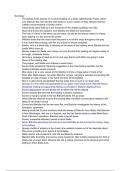
, TABLE OF CONTENTS

SOLUTIONS MANUAL
Chapter 1 Introduction to Financial Reporting . . . . . . . . . . . . 1
Chapter 2 Introduction to Financial Statements and Other Financial
Reporting Topics. . . . . . . . . . . . . . . . . . . . . . 20
Chapter 3 Balance Sheet . . . . . . . . . . . . . . . . . . . . . . . 41
Chapter 4 Income Statement. . . . . . . . . . . . . . . . . . . . . . 68
Chapter 5 Basics of Analysis. . . . . . . . . . . . . . . . . . . . . 88
Chapter 6 Liquidity of Short-term Assets; Related Debt-Paying Ability 107
Chapter 7 Long-Term Debt-Paying Ability . . . . . . . . . . . . . . . 160
Chapter 8 Profitability . . . . . . . . . . . . . . . . . . . . . . . 187
Chapter 9 For the Investor. . . . . . . . . . . . . . . . . . . . . . 234
Chapter 10 Statement of Cash Flows . . . . . . . . . . . . . . . . . . 260
Chapter 11 Expanded Analysis . . . . . . . . . . . . . . . . . . . . . 299
Chapter 12 Special Industries: Banks, Utilities, Oil and Gas,
Transportation, Insurance, Real Estate Companies. . . . . . 340
Chapter 13 Personal Financial Statements and Accounting for
Governments and Not-For-Profit Organizations. . . . . . . . 366


1

, Chapter 1
Introduction to Financial Reporting

TO THE NET

1. a. he Mission of the Financial Accounting Standard Board
(In Part)

The mission of the Financial Accounting Standards
Board (FASB)is to establish and improve standards of
financial accounting and reporting for the guidance
and education of the public, including issuers,
auditors and users of financial information.

Accounting standards are essential to the efficient
functioning of the economy because decisions about
the allocation of resources rely heavily on credible,
concise, transparent and understandable financial
information. Financial information about the
operations and financial position of individual
entities also is used by the public in making various
other kinds of decisions.

To accomplish its mission, the FASB acts to:

• Improve the usefulness of financial
reporting by focusing on the primary
characteristics of relevance and
reliability and on the qualities of
comparability and constancy;

• Keep standards current to reflect
changes in methods of doing business and
changes in the economic environment;

• Consider promptly any significant areas
of deficiency in financial reporting that

2

, might be improved through the standard-
setting process;

• Promote the international convergence of
accounting standards concurrent with
improving the quality of financial
reporting; and

• Improve the common understanding of the
nature and purposes of information
contained in financial reports.

b Financial Accounting Standards Advisory Council

An Overview
The Financial Accounting Standards Advisory Council,
FASAC or “the Council” for short, was formed in 1973
concurrent with the establishment of the Financial
Accounting Standards Board (the FASB or the Board).

The primary function of FASAC is to advise the Board
on issues related to projects on the Board’s agenda,
possible new agenda items, project priorities,
procedural matters that may require the attention of
the FASB, and other matters as requested by the
chairman of the FASB. FASAC meetings provide the
Board with an opportunity to obtain and discuss the
views of a very diverse group of individuals from
varied business and professional backgrounds.

The members of FASAC are drawn from the ranks of
CEOs, CFOs, senior partners of public accounting
firms, executive directors of professional
organizations, and senior members of the academic and
analyst communities, all disclosure.

Carrying Out the Mission
It is the job of the FASB to establish the “generally
accepted accounting principles,” or GAAP, to which
public financial reporting by U.S. corporations must
conform and to keep those principles current.

In conducting its activities, the Board strives to
carefully weight the views of its users, preparers,
and auditors of financial report. The Council
provides an important sounding board to help the FASB
understand what constituents are thinking about a
wide range of issues.

3
Get to know the seller

Seller avatar
Reputation scores are based on the amount of documents a seller has sold for a fee and the reviews they have received for those documents. There are three levels: Bronze, Silver and Gold. The better the reputation, the more your can rely on the quality of the sellers work.
Expert001 Chamberlain School Of Nursing
View profile
Follow You need to be logged in order to follow users or courses
Sold
798
Member since
4 year
Number of followers
566
Documents
1190
Last sold
6 days ago
Expert001

High quality, well written Test Banks, Guides, Solution Manuals and Exams to enhance your learning potential and take your grades to new heights. Kindly leave a review and suggestions. We do take pride in our high-quality services and we are always ready to support all clients.

4.2

159 reviews

5
104
4
18
3
14
2
7
1
16

Recently viewed by you

Why students choose Stuvia

Created by fellow students, verified by reviews

Quality you can trust: written by students who passed their tests and reviewed by others who've used these notes.

Didn't get what you expected? Choose another document

No worries! You can instantly pick a different document that better fits what you're looking for.

Pay as you like, start learning right away

No subscription, no commitments. Pay the way you're used to via credit card and download your PDF document instantly.

Student with book image

“Bought, downloaded, and aced it. It really can be that simple.”

Alisha Student

Frequently asked questions
