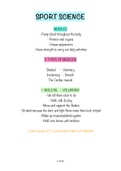
SPORT SCIENCE
MUSCLES
- Pump blood throughout the body
- Protect vital organs
- Unique appearance
- Have strength to carry out daily activities
3 TYPES OF MUSCLES!
Skeletal - Voluntary
Involuntary - Smooth
The Cardiac muscle
1 : SKELETAL - VOLUNTARY
- We tell them what to do
- Walk, talk & play
- Move and support the Skelton
- Striated because the dark and light fibres make them look striped
- Make up musculoskeletal system
- Held onto bones with tendons
- Come in pairs of 2, each moves in their own direction.
1 of 37
, 2 : SMOOTH - INVOLUNTARY
- Controlled by the nervous system
- Work automatically
- Bladder, uterus, bowel
- found in the walls of our blood vessels
- Made of layers running in different directions for different movement
3 : THE CARDIAC MUSCLE
- Known as the myocardium
- Involuntary
- Fibres contract all the time
- Pumps blood throughout the body
- Contract to let blood out
- Relax to let blood enter
SUPERFICIAL MUSCLES
- Closer to the skin
DEEP MUSCLES
Closer to the bone
MUSCLE MOVEMENT
AdDuction - closer to the midline
ABduction - further from midline
Flexion - decreased angle between two bones
Extension - straightening to increase the angle between two bones
Rotation - moving body parts around the axis
Dorsiflexion - foot moving up
Plantarflexion - foot staying down on the surface
2 of 37
, Contracting muscle - agonist muscle
lengthening muscle - antagonist muscle
Anterior - in front or forward
Posterior - behind or toward the back of the body
Medial - near or in the midline of the body
Lateral - to the side of the midline
Superior - above or towards the top
Inferior - below or downward
Proximal - closer to the midline
Distal - away from the midline
Prone - facing down
Supine - facing upwards
Hyperextension - going beyond the anatomical position : back bend
Circumduction - complete circular motion of the body
TENDONS
- Cords made up of tissue to connect bone to muscle
BONES ARE NAMED ACCORDING TO :
Shape
Direction of fibres
Point of attachment
Location
Action
Group relationships
Number of heads
Size
3 of 37
, JOINTS
Hinge - eg. Elbow and knee
Ball & Socket - eg. Shoulder and hip
3 DIFFERENT TYPES OF BONES
Irregular - protect the spinal chord ; short bones
Long bones - weight, flow of blood throughout, easy movement
Flat bones - protect the internal organs
ANATOMICAL POSITION
Facing forward
Inner palms facing the front
FUNCTIONS OF A SKELETON
Structural support
Protection of organs
Helps with movement
Joined by ligament
BLOOD PRODUCTION
Red & white blood cells in the marrow of larger longer bones
Storage of minerals in the bones - calcium and phosphorus
BONE FORMATION - OSSIFICATION
Cartilage forms, then bone forms over it
When cartilage wares, no more growth
4 of 37
MUSCLES
- Pump blood throughout the body
- Protect vital organs
- Unique appearance
- Have strength to carry out daily activities
3 TYPES OF MUSCLES!
Skeletal - Voluntary
Involuntary - Smooth
The Cardiac muscle
1 : SKELETAL - VOLUNTARY
- We tell them what to do
- Walk, talk & play
- Move and support the Skelton
- Striated because the dark and light fibres make them look striped
- Make up musculoskeletal system
- Held onto bones with tendons
- Come in pairs of 2, each moves in their own direction.
1 of 37
, 2 : SMOOTH - INVOLUNTARY
- Controlled by the nervous system
- Work automatically
- Bladder, uterus, bowel
- found in the walls of our blood vessels
- Made of layers running in different directions for different movement
3 : THE CARDIAC MUSCLE
- Known as the myocardium
- Involuntary
- Fibres contract all the time
- Pumps blood throughout the body
- Contract to let blood out
- Relax to let blood enter
SUPERFICIAL MUSCLES
- Closer to the skin
DEEP MUSCLES
Closer to the bone
MUSCLE MOVEMENT
AdDuction - closer to the midline
ABduction - further from midline
Flexion - decreased angle between two bones
Extension - straightening to increase the angle between two bones
Rotation - moving body parts around the axis
Dorsiflexion - foot moving up
Plantarflexion - foot staying down on the surface
2 of 37
, Contracting muscle - agonist muscle
lengthening muscle - antagonist muscle
Anterior - in front or forward
Posterior - behind or toward the back of the body
Medial - near or in the midline of the body
Lateral - to the side of the midline
Superior - above or towards the top
Inferior - below or downward
Proximal - closer to the midline
Distal - away from the midline
Prone - facing down
Supine - facing upwards
Hyperextension - going beyond the anatomical position : back bend
Circumduction - complete circular motion of the body
TENDONS
- Cords made up of tissue to connect bone to muscle
BONES ARE NAMED ACCORDING TO :
Shape
Direction of fibres
Point of attachment
Location
Action
Group relationships
Number of heads
Size
3 of 37
, JOINTS
Hinge - eg. Elbow and knee
Ball & Socket - eg. Shoulder and hip
3 DIFFERENT TYPES OF BONES
Irregular - protect the spinal chord ; short bones
Long bones - weight, flow of blood throughout, easy movement
Flat bones - protect the internal organs
ANATOMICAL POSITION
Facing forward
Inner palms facing the front
FUNCTIONS OF A SKELETON
Structural support
Protection of organs
Helps with movement
Joined by ligament
BLOOD PRODUCTION
Red & white blood cells in the marrow of larger longer bones
Storage of minerals in the bones - calcium and phosphorus
BONE FORMATION - OSSIFICATION
Cartilage forms, then bone forms over it
When cartilage wares, no more growth
4 of 37