THEME 3: STEREOCHEMISTRY: CHIRAL MOLECULES
CHIRALITY (HANDEDNESS)
‐ Left- and right-hand mirror images of one another
‐ Mirror images not identical
‐ Mirror images are non-superimposable
‐ Objects and molecules that aren’t superimposable on their mirror images are said to
be chiral
‐ Some objects have mirror images that are identical (i.e. superimposable and achiral)
‐ These objects all have a plane of symmetry which means that half the object is a
mirror image of the other half
‐ Organic molecules that are not superimposable on their mirror images are said to be
chiral
‐ These molecules do not have an internal plane of symmetry in any of their
conformations
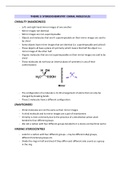
‐ The configuration of a molecule is its 3D arrangement of atoms that can only be
changed by breaking bonds
‐ These 2 molecules have a different configuration
ENANTIOMERS
‐ Chiral molecules are not the same as their mirror images
‐ A chiral molecule and its mirror images are a pair of enantiomers
‐ Chirality is most commonly due to the presence of a tetrahedral carbon atom
bonded to four different groups
‐ We call a carbon with four different groups bonded to it a stereo centre/chiral centre
FINDING STEREOCENTRES
‐ Look for a carbon with four different groups – may be different alkyl groups,
different functional groups etc.
‐ Divide the rings in half and check if they differ each different side counts as a group
in the ring
, DETERMINING IF A MOLECULE IS CHIRAL
‐ Imposable → achiral – do not fit on one another when mirror image
‐ Superimposable → chiral – when put mirror images on top of one another they line
up
‐ 2 conditions for molecule to be chiral:
➢ Presence of stereo genic centre
➢ No plane of symmetry in molecule
THE BIOLOGICAL IMPORTANCE OF CHIRALITY
‐ The binding specificity of a chiral receptor site for a chiral molecule is usually only
favourable in one way
‐ Chiral molecules are like hands and the receptors like gloves
NAMING ENANTIOMERS
‐ Because enantiomers are different compounds, each must have a different name
‐ The R, S system is a way to distinguish between enantiomers without having to draw
them and point to one another
THE R,S SYSTEM TO SPECIFY CONFIGURATION
‐ Specifying the configuration of a molecule as R or S is a way of describing the
complete structure of a molecule
1. Assign a priority from 1 (highest) to 4 (lowest) to each group bonded to the stereo
centre using the Cahn- Ingold-Prelog sequence rules
2. Orientate the molecule in space so that the group of lowest priority (4) is directed
away (dashed) away from you. The other 3 groups then project towards you
CHIRALITY (HANDEDNESS)
‐ Left- and right-hand mirror images of one another
‐ Mirror images not identical
‐ Mirror images are non-superimposable
‐ Objects and molecules that aren’t superimposable on their mirror images are said to
be chiral
‐ Some objects have mirror images that are identical (i.e. superimposable and achiral)
‐ These objects all have a plane of symmetry which means that half the object is a
mirror image of the other half
‐ Organic molecules that are not superimposable on their mirror images are said to be
chiral
‐ These molecules do not have an internal plane of symmetry in any of their
conformations
‐ The configuration of a molecule is its 3D arrangement of atoms that can only be
changed by breaking bonds
‐ These 2 molecules have a different configuration
ENANTIOMERS
‐ Chiral molecules are not the same as their mirror images
‐ A chiral molecule and its mirror images are a pair of enantiomers
‐ Chirality is most commonly due to the presence of a tetrahedral carbon atom
bonded to four different groups
‐ We call a carbon with four different groups bonded to it a stereo centre/chiral centre
FINDING STEREOCENTRES
‐ Look for a carbon with four different groups – may be different alkyl groups,
different functional groups etc.
‐ Divide the rings in half and check if they differ each different side counts as a group
in the ring
, DETERMINING IF A MOLECULE IS CHIRAL
‐ Imposable → achiral – do not fit on one another when mirror image
‐ Superimposable → chiral – when put mirror images on top of one another they line
up
‐ 2 conditions for molecule to be chiral:
➢ Presence of stereo genic centre
➢ No plane of symmetry in molecule
THE BIOLOGICAL IMPORTANCE OF CHIRALITY
‐ The binding specificity of a chiral receptor site for a chiral molecule is usually only
favourable in one way
‐ Chiral molecules are like hands and the receptors like gloves
NAMING ENANTIOMERS
‐ Because enantiomers are different compounds, each must have a different name
‐ The R, S system is a way to distinguish between enantiomers without having to draw
them and point to one another
THE R,S SYSTEM TO SPECIFY CONFIGURATION
‐ Specifying the configuration of a molecule as R or S is a way of describing the
complete structure of a molecule
1. Assign a priority from 1 (highest) to 4 (lowest) to each group bonded to the stereo
centre using the Cahn- Ingold-Prelog sequence rules
2. Orientate the molecule in space so that the group of lowest priority (4) is directed
away (dashed) away from you. The other 3 groups then project towards you