
THEME 3: AQEUOUS EQUILIBRIA PART 1 & 2
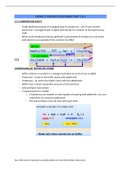
17.1 COMMON ION EFFECT
‐ If add significant amount of conjugate base to acetate ion – pH of such solution
(weak acid + conjugate base) is higher than the pH of a solution of the weak acid by
itself
‐ Effect on pH produce by having significant concentration of acetate ion in an acetic
acid solution is an example of the common ion effect
17.2
CONTROLLING pH: BUFFER SOLUTIONS
‐ Buffer solution is resistant to a change in pH when an acid or base is added
‐ If add acid – a base in the buffer reacts with added acid
‐ If add base – an acid in the buffer reacts with the added base
‐ Buffer must contain reasonable amounts of acid and base
‐ Acid and base must coexist
‐ 2 requirements for a buffer:
o 2 substances are needed: an acid capable of reacting with added OH- ions and
a base that can consume added H3O+
o The acid and base must not react with each other
Any reference to examples or pasted photos are from Mr de Beers class notes
, GENERAL EXPRESSIONS FOR BUFFER SOLUTIONS
‐ True for all solutions of a weak acid and its conjugate base:
[𝑎𝑐𝑖𝑑]
[H3O+] = [𝑐𝑜𝑛𝑗𝑢𝑔𝑎𝑡𝑒 𝑏𝑎𝑠𝑒] x Ka
[𝑐𝑜𝑛𝑗𝑢𝑔𝑎𝑡𝑒 𝑏𝑎𝑠𝑒]
‐ Henderson-Hasselbalch equation: pH = pKa + log [𝑎𝑐𝑖𝑑]
‐ To use Henderson-Hasselbalch equation, you assume that the acid and conjugate
base concentrations at equilibrium are essentially unchanged from the
concentrations used to prepare the buffer
‐ Can use the HH equation when the following criteria is met:
o pH of buffer falls in a pH range of 3 to 11 – the pH of a buffer will be close to
the pKa for the weak acid
o the concentrations of the acid and conjugate base are large so that a small
amount of ionisation of the acid (or conjugate base) will not result in a big
change in concentration
Any reference to examples or pasted photos are from Mr de Beers class notes
17.1 COMMON ION EFFECT
‐ If add significant amount of conjugate base to acetate ion – pH of such solution
(weak acid + conjugate base) is higher than the pH of a solution of the weak acid by
itself
‐ Effect on pH produce by having significant concentration of acetate ion in an acetic
acid solution is an example of the common ion effect
17.2
CONTROLLING pH: BUFFER SOLUTIONS
‐ Buffer solution is resistant to a change in pH when an acid or base is added
‐ If add acid – a base in the buffer reacts with added acid
‐ If add base – an acid in the buffer reacts with the added base
‐ Buffer must contain reasonable amounts of acid and base
‐ Acid and base must coexist
‐ 2 requirements for a buffer:
o 2 substances are needed: an acid capable of reacting with added OH- ions and
a base that can consume added H3O+
o The acid and base must not react with each other
Any reference to examples or pasted photos are from Mr de Beers class notes
, GENERAL EXPRESSIONS FOR BUFFER SOLUTIONS
‐ True for all solutions of a weak acid and its conjugate base:
[𝑎𝑐𝑖𝑑]
[H3O+] = [𝑐𝑜𝑛𝑗𝑢𝑔𝑎𝑡𝑒 𝑏𝑎𝑠𝑒] x Ka
[𝑐𝑜𝑛𝑗𝑢𝑔𝑎𝑡𝑒 𝑏𝑎𝑠𝑒]
‐ Henderson-Hasselbalch equation: pH = pKa + log [𝑎𝑐𝑖𝑑]
‐ To use Henderson-Hasselbalch equation, you assume that the acid and conjugate
base concentrations at equilibrium are essentially unchanged from the
concentrations used to prepare the buffer
‐ Can use the HH equation when the following criteria is met:
o pH of buffer falls in a pH range of 3 to 11 – the pH of a buffer will be close to
the pKa for the weak acid
o the concentrations of the acid and conjugate base are large so that a small
amount of ionisation of the acid (or conjugate base) will not result in a big
change in concentration
Any reference to examples or pasted photos are from Mr de Beers class notes


