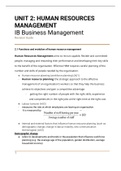
UNIT 2: HUMAN RESOURCES
MANAGEMENT
IB Business Management
Revision Guide
2.1 Functions and evolution of human resource management
Human Resources Management aims to recruit capable, flexible and committed
people, managing and rewarding their performance and developing their key skills
to the benefit of the organisation. Effective HRM requires careful planning of the
number and skills of people needed by the organisation.
● Human resource planning (workforce planning) (A01)
- Human resource planning: the strategic approach to the effective
management of an organisation’s workers so that they help the business
achieve its objectives and gain a competitive advantage
- getting the right number of people with the right skills, experience
and competencies in the right jobs at the right time at the right cost.
● Labour turnover (AO2)
- measures the rate at which employees are leaving an organisation.
- It is measured by:
● Internal and external factors that influence human resource planning (such as
demographic change, change in labour mobility, new communication
technologies) (AO3)
Demographic change
● refers to developments and trends in the population that influence workforce
planning (e.g. the average age of the population, gender distribution, average
household income)
1
, ● an ageing population can lead to reduced labour mobility, lower labour
productivity levels and changing consumption patterns
● in many countries, there has been an increased number of women in the
workforce. More females are choosing to have children at a later stage in their
lives, opting instead to participate in the workforce and pursue their professional
aspirations.
Change in labour mobility
● Occupational mobility refers to the ease and flexibility of workers in moving from
one job to another due to their ability and willingness to switch.
● By contrast occupational immobility is the inability of workers to move from one
job to another, due to a lack of skills, expertise or qualifications.
● Geographical mobility refers to the extent to which workers are able and willing
to relocate to another area for employment purposes.
● Geographical immobility is the reluctance of workers to move to another
location. (can be due to personal reasons or financial factors)
● International labour mobility is even more difficult to achieve. Expatriate workers
are often highly remunerated as an incentive for them to relocate overseas.
● Labour mobility can be improved b the business offering training and
development programmes to its employees.
New communications technologies
● New communications technologies make it easier for larger businesses to recruit
globally through their websites and video-conferencing facilities, resulting in
reduced costs of online advertising, recruitment and interviews.
● Improved computer and mobile technologies also mean that flexitime,
homeworking and teleworking become more attractive and accessible to
workers.
● The technologies make it possible to train and develop employees in a more
efficient manner (e.g. online training courses or webinars where a large number
of employees can be trained very quickly at the same time)
2
, ● The use of computerized testing programs helps firms to asses the
understanding and progress of trainees.
● Common steps in the process of recruitment (AO2)
Recruitment: the process of identifying the need for a new employee, defining
the job to be filled and the type of person needed to fill it, attracting suitable
candidates for the job and selecting the best one
Common Steps in Recruiting
1. Establish the exact nature of the job vacancy and draw up a job description.
The job description provides a complete picture of the job and includes:
1. job title
2. details of the tasks to be performed
3. responsibilities involved
4. place in the hierarchical structure
5. working conditions
6. how the job will be assessed and performance measured.
The advantage of the job description is that it should attract the right type of
people to apply for the job, as potential recruits will have an idea of whether they
are suited to the position or not.
2. Draw up a person specification
This analyses the qualities and skills being looked for in suitable applicants. It is
clearly based on the job description because these skills can only be assessed
once the nature and complexity of the job have been identified.The person
specification is like a ‘person profile’ and helps in the selection process by
eliminating applicants who do not match up to the necessary requirements.
3. Prepare a job advertisement reflecting the requirements of the job and the
personal qualities looked for
The job advertisement can be displayed within the business premises –
particularly if an internal appointment is looked for – on the firm’s website or in
government job centres, recruitment agencies and/or newspapers. Care must be
taken to ensure that there is no element of discrimination implied by the
3
, advertisement as nearly all countries outlaw unfair selection on the basis of race,
gender or religion.
4. Draw up a shortlist of applicants
A few applicants are chosen based on their application forms and personal
details, often contained in a CV (curriculum vitae). References may have been
obtained in order to check on the character and previous work performance of
the applicants.
5. Conduct interviews
Interviews are designed to question the applicant on their skills, experience and
character to see if they are likely to perform well and fit into the organisation.
Some interviewers use a seven-point plan to carry out a methodical interview.
Candidates are assessed according to achievements, intelligence, skills,
interests, personal manner, physical appearance and personal circumstances.
● The following types of training: on the job (including induction and mentoring),
off the job, cognitive, behavioural (AO2)
On the job
- when an employee is trained while they are doing their normal job
- usually takes place through mentoring (an experienced employee guides the
employee being trained) or shadowing (the new employee follows another to
learn a new skill)
instruction at the place of work on how a job should be carried out
Pro: usually costs less than off the job training
Con: can be disruptive to the regular work environment
4
MANAGEMENT
IB Business Management
Revision Guide
2.1 Functions and evolution of human resource management
Human Resources Management aims to recruit capable, flexible and committed
people, managing and rewarding their performance and developing their key skills
to the benefit of the organisation. Effective HRM requires careful planning of the
number and skills of people needed by the organisation.
● Human resource planning (workforce planning) (A01)
- Human resource planning: the strategic approach to the effective
management of an organisation’s workers so that they help the business
achieve its objectives and gain a competitive advantage
- getting the right number of people with the right skills, experience
and competencies in the right jobs at the right time at the right cost.
● Labour turnover (AO2)
- measures the rate at which employees are leaving an organisation.
- It is measured by:
● Internal and external factors that influence human resource planning (such as
demographic change, change in labour mobility, new communication
technologies) (AO3)
Demographic change
● refers to developments and trends in the population that influence workforce
planning (e.g. the average age of the population, gender distribution, average
household income)
1
, ● an ageing population can lead to reduced labour mobility, lower labour
productivity levels and changing consumption patterns
● in many countries, there has been an increased number of women in the
workforce. More females are choosing to have children at a later stage in their
lives, opting instead to participate in the workforce and pursue their professional
aspirations.
Change in labour mobility
● Occupational mobility refers to the ease and flexibility of workers in moving from
one job to another due to their ability and willingness to switch.
● By contrast occupational immobility is the inability of workers to move from one
job to another, due to a lack of skills, expertise or qualifications.
● Geographical mobility refers to the extent to which workers are able and willing
to relocate to another area for employment purposes.
● Geographical immobility is the reluctance of workers to move to another
location. (can be due to personal reasons or financial factors)
● International labour mobility is even more difficult to achieve. Expatriate workers
are often highly remunerated as an incentive for them to relocate overseas.
● Labour mobility can be improved b the business offering training and
development programmes to its employees.
New communications technologies
● New communications technologies make it easier for larger businesses to recruit
globally through their websites and video-conferencing facilities, resulting in
reduced costs of online advertising, recruitment and interviews.
● Improved computer and mobile technologies also mean that flexitime,
homeworking and teleworking become more attractive and accessible to
workers.
● The technologies make it possible to train and develop employees in a more
efficient manner (e.g. online training courses or webinars where a large number
of employees can be trained very quickly at the same time)
2
, ● The use of computerized testing programs helps firms to asses the
understanding and progress of trainees.
● Common steps in the process of recruitment (AO2)
Recruitment: the process of identifying the need for a new employee, defining
the job to be filled and the type of person needed to fill it, attracting suitable
candidates for the job and selecting the best one
Common Steps in Recruiting
1. Establish the exact nature of the job vacancy and draw up a job description.
The job description provides a complete picture of the job and includes:
1. job title
2. details of the tasks to be performed
3. responsibilities involved
4. place in the hierarchical structure
5. working conditions
6. how the job will be assessed and performance measured.
The advantage of the job description is that it should attract the right type of
people to apply for the job, as potential recruits will have an idea of whether they
are suited to the position or not.
2. Draw up a person specification
This analyses the qualities and skills being looked for in suitable applicants. It is
clearly based on the job description because these skills can only be assessed
once the nature and complexity of the job have been identified.The person
specification is like a ‘person profile’ and helps in the selection process by
eliminating applicants who do not match up to the necessary requirements.
3. Prepare a job advertisement reflecting the requirements of the job and the
personal qualities looked for
The job advertisement can be displayed within the business premises –
particularly if an internal appointment is looked for – on the firm’s website or in
government job centres, recruitment agencies and/or newspapers. Care must be
taken to ensure that there is no element of discrimination implied by the
3
, advertisement as nearly all countries outlaw unfair selection on the basis of race,
gender or religion.
4. Draw up a shortlist of applicants
A few applicants are chosen based on their application forms and personal
details, often contained in a CV (curriculum vitae). References may have been
obtained in order to check on the character and previous work performance of
the applicants.
5. Conduct interviews
Interviews are designed to question the applicant on their skills, experience and
character to see if they are likely to perform well and fit into the organisation.
Some interviewers use a seven-point plan to carry out a methodical interview.
Candidates are assessed according to achievements, intelligence, skills,
interests, personal manner, physical appearance and personal circumstances.
● The following types of training: on the job (including induction and mentoring),
off the job, cognitive, behavioural (AO2)
On the job
- when an employee is trained while they are doing their normal job
- usually takes place through mentoring (an experienced employee guides the
employee being trained) or shadowing (the new employee follows another to
learn a new skill)
instruction at the place of work on how a job should be carried out
Pro: usually costs less than off the job training
Con: can be disruptive to the regular work environment
4