

CHAPTER 5 – GENERAL MANAGEMENT & CORPORATE GOVERNANCE
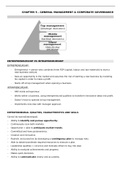
Top management
(strategic decisions)
Middle
management
(tactical decisions)
Lower
management
(day-to-day
decisions)
ENTREPRENEURSHIP VS INTRAPRENEURSHIP
ENTREPRENEURSHIP:
- Entrepreneur = person who combines three FOP (capital, labour and raw materials) to start a
new business venture.
- Sees an opportunity in the market and assumes the risk of starting a new business by investing
his capital in order to make a profit.
- Starts off at top management when opening a business.
INTRAPRENEURSHIP:
- AKA inside entrepreneur.
- Works within a business, using entrepreneurial qualities to transform innovative ideas into profit.
- Doesn’t have to operate at top management.
- Implements new idea with manager approval.
ENTREPRENEURIAL QUALITIES, CHARACTERISTICS AND SKILLS
Cannot be learned/developed.
- Ability to identify and pursue opportunity.
- Continuously scan both markets.
- Opportunist = able to anticipate market trends.
- Committed and have perseverance.
- Creative and innovative.
- Realistic and proactive by developing a contingency plan to manage risks.
- Able to obtain/coordinate required resources to execute a plan.
- Leadership qualities = convince and motivate others to buy into plan.
- Ability to evaluate achievements and progress.
- Makes quick decisions.
- Ability to communicate clearly and accurately.
, - Personally motivated.
LEADERSHIP VS MANAGEMENT
- A manager is appointed in a position of authority which enables him to insist on people
doing as he instructs.
- A leader has expertise to make people aware of the advantages of pursuing a certain course
of action, thereby creating a desire in people to follow him to achieve a goal.
- Successful manager should be a leader.
Manager Leader
Maintains systems Develops new methods to do things
Focuses on systems & structures Focuses on people
Relies on control Inspires trust
Accepts the status quo Challenges the status quo
MANAGEMENT
MANAGEMENT STYLES
Democratic:
o Allows for subordinates to provide input and participate in the decision- making process.
o Advantage - usually ensures buy-in and commitment from people involved.
o Disadvantage - can lead to slower decision-making.
Autocratic:
o Manager makes all the decisions.
o Advantage - quick decisions are made in crises.
o Disadvantage - employees often have a lower morale and feel invaluable.
Laissez-faire:
o Manager believes that he should not interfere in the process of carrying out the tasks.
o Advantage - if staff are highly skilled, they will produce excellent results.
o Disadvantage – longer decision-making time.
Transactional:
o Give and take, manager motivates staff with rewards.
o Advantage - employees will work hard for the rewards
o Disadvantage - as soon as staff regard the reward as insufficient, they become demotivated
Transformational:
o Charismatic by nature, motivates employees by helping them understand the meaning of their
work - emphasis is on teamwork.
o Advantage - employees trust manager, improves their overall performance in the workplace.
o Manager leads his team and empowers team members to achieve their full potential.
Situational:
Top management
(strategic decisions)
Middle
management
(tactical decisions)
Lower
management
(day-to-day
decisions)
ENTREPRENEURSHIP VS INTRAPRENEURSHIP
ENTREPRENEURSHIP:
- Entrepreneur = person who combines three FOP (capital, labour and raw materials) to start a
new business venture.
- Sees an opportunity in the market and assumes the risk of starting a new business by investing
his capital in order to make a profit.
- Starts off at top management when opening a business.
INTRAPRENEURSHIP:
- AKA inside entrepreneur.
- Works within a business, using entrepreneurial qualities to transform innovative ideas into profit.
- Doesn’t have to operate at top management.
- Implements new idea with manager approval.
ENTREPRENEURIAL QUALITIES, CHARACTERISTICS AND SKILLS
Cannot be learned/developed.
- Ability to identify and pursue opportunity.
- Continuously scan both markets.
- Opportunist = able to anticipate market trends.
- Committed and have perseverance.
- Creative and innovative.
- Realistic and proactive by developing a contingency plan to manage risks.
- Able to obtain/coordinate required resources to execute a plan.
- Leadership qualities = convince and motivate others to buy into plan.
- Ability to evaluate achievements and progress.
- Makes quick decisions.
- Ability to communicate clearly and accurately.
, - Personally motivated.
LEADERSHIP VS MANAGEMENT
- A manager is appointed in a position of authority which enables him to insist on people
doing as he instructs.
- A leader has expertise to make people aware of the advantages of pursuing a certain course
of action, thereby creating a desire in people to follow him to achieve a goal.
- Successful manager should be a leader.
Manager Leader
Maintains systems Develops new methods to do things
Focuses on systems & structures Focuses on people
Relies on control Inspires trust
Accepts the status quo Challenges the status quo
MANAGEMENT
MANAGEMENT STYLES
Democratic:
o Allows for subordinates to provide input and participate in the decision- making process.
o Advantage - usually ensures buy-in and commitment from people involved.
o Disadvantage - can lead to slower decision-making.
Autocratic:
o Manager makes all the decisions.
o Advantage - quick decisions are made in crises.
o Disadvantage - employees often have a lower morale and feel invaluable.
Laissez-faire:
o Manager believes that he should not interfere in the process of carrying out the tasks.
o Advantage - if staff are highly skilled, they will produce excellent results.
o Disadvantage – longer decision-making time.
Transactional:
o Give and take, manager motivates staff with rewards.
o Advantage - employees will work hard for the rewards
o Disadvantage - as soon as staff regard the reward as insufficient, they become demotivated
Transformational:
o Charismatic by nature, motivates employees by helping them understand the meaning of their
work - emphasis is on teamwork.
o Advantage - employees trust manager, improves their overall performance in the workplace.
o Manager leads his team and empowers team members to achieve their full potential.
Situational:


