
IFRS 9 Financial Instruments
Financial assets
A financial instrument is any contract giving rise to a financial asset to one entity, and a financial liability or equity in
another entity
A contract is an agreement between two or more parties, with clear economic consequences and where parties have
limited discretion to avoid and is usually enforceable through law
Examples
Cash or
Contractual right to receive cash or financial assets or
Contractual right to exchange financial instruments under favourable conditions
Recognition and measurement are determined by category of financial asset
A rights issue is an invitation to existing shareholders to purchase additional new shares in an entity
Initial recognition
At Fair Value + Transaction cost
Recognised when the entity becomes party to the contractual provisions of the instrument
Transaction costs - Incremental costs that are directly attributable to the acquisition, issue or disposal of a financial
asset or financial liability (see paragraph B5.4.8). Excludes premiums, discounts, financing cost, internal admin and
holding cost
An incremental cost is one that would not have been incurred if the entity had not acquired, issued, or disposed of
the financial instrument
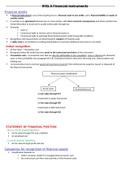
Financial assets classification
At fair value At amortised cost
@ Fair value through P/F
Investment in equity instrument
@ Fair value through OCI
Investment in debt instrument
@ Fair value through OCI
STATEMENT OF FINANCIAL POSITION
Non-current assets/liabilities
At fair value through OCI (not a liability)
At amortised cost
Current assets/ liabilities
At fair value through profit and loss
Categories for recognition of financial assets
Classification depends on
entity’s business model for managing financial assets, and
the contractual cash flow characteristics of the financial asset
, At amortised cost
Criteria
1. Business model with objective to hold financial assets for contractual cash flow
2. The contractual terms of the financial asset must give rise on specific dates to cash flows that are solely payments of
principal, and interest on principal amount outstanding
if these criteria are not met you will default back and classify the instrument as at fair value through profit or loss
when the criteria have been met the subsequent measurement of this category will be at amortised cost using the
effective interest rate method
Thus initial measurement at fair value plus transaction costs, and subsequent measurement at amortised cost
Investment in debt instruments at fair value through OCI (not examples
calculations in 201)
Criteria
1. the asset must be held within a business model whose objective is achieved by both to collect contractual cash
flows by holding the asset and selling the financial assets (twofold business model)
2. the contractual terms must give rise on specific dates to cash flows that are solely payments of principal and
interest on principal amount outstanding
if these criteria are not met you will default back and classify the instrument as at fair value through profit or loss
E.g. debentures held for interest until maturity date
Subsequent measurement
- @ Amortised cost using effective interest rate method
Investment in equity instruments at fair value through OCI
Entity elects to classify instrument into this category
- only on equity instruments
- not held for trading
E.g. investment in ordinary shares held for long term purposes
***Initial measurement
at fair value including transaction costs
Subsequent measurement
fair value adjustments through OCI, excluding transaction costs
Dr investment
Cr Mark to market reserve in equity instruments
all movements go to OCI
thus if fair value adjustment needs to be determined, remember to take into account transaction costs
that were capitalised at initial measurement
Fair value adjustment column= Mark-to-market reserve on equity instruments
If initial balance includes transaction costs, fair value adjustments need to take that into account
After equity instruments are sold, the balance of the mark to market reserve on equity instruments is closed
(recycled) to retained earnings, only if that is the accounting policy choice- thus can remain as a balance after it is
sold
Dr Mark to market reserve on equity instrument
Cr Retained earnings
(cumulative fair value adjustments)
First adjust to FV for all shares on date of disposal
If portion is sold then calc portion of cum FV adjustments must be recycled
All movements go through OCI, thus can be negative
***Brokerage fees- if shares bought, capitalise to shares; if selling shares goes through P/L
Sale of shares
If not all shares are sold, can remeasure to fair value all of the shares or only those sold
Calculate total mark-to-market, and apportion using number of shares sold.
Any transaction costs incurred at date of disposal are expensed
Dr Transaction cost
Cr Bank
Financial assets
A financial instrument is any contract giving rise to a financial asset to one entity, and a financial liability or equity in
another entity
A contract is an agreement between two or more parties, with clear economic consequences and where parties have
limited discretion to avoid and is usually enforceable through law
Examples
Cash or
Contractual right to receive cash or financial assets or
Contractual right to exchange financial instruments under favourable conditions
Recognition and measurement are determined by category of financial asset
A rights issue is an invitation to existing shareholders to purchase additional new shares in an entity
Initial recognition
At Fair Value + Transaction cost
Recognised when the entity becomes party to the contractual provisions of the instrument
Transaction costs - Incremental costs that are directly attributable to the acquisition, issue or disposal of a financial
asset or financial liability (see paragraph B5.4.8). Excludes premiums, discounts, financing cost, internal admin and
holding cost
An incremental cost is one that would not have been incurred if the entity had not acquired, issued, or disposed of
the financial instrument
Financial assets classification
At fair value At amortised cost
@ Fair value through P/F
Investment in equity instrument
@ Fair value through OCI
Investment in debt instrument
@ Fair value through OCI
STATEMENT OF FINANCIAL POSITION
Non-current assets/liabilities
At fair value through OCI (not a liability)
At amortised cost
Current assets/ liabilities
At fair value through profit and loss
Categories for recognition of financial assets
Classification depends on
entity’s business model for managing financial assets, and
the contractual cash flow characteristics of the financial asset
, At amortised cost
Criteria
1. Business model with objective to hold financial assets for contractual cash flow
2. The contractual terms of the financial asset must give rise on specific dates to cash flows that are solely payments of
principal, and interest on principal amount outstanding
if these criteria are not met you will default back and classify the instrument as at fair value through profit or loss
when the criteria have been met the subsequent measurement of this category will be at amortised cost using the
effective interest rate method
Thus initial measurement at fair value plus transaction costs, and subsequent measurement at amortised cost
Investment in debt instruments at fair value through OCI (not examples
calculations in 201)
Criteria
1. the asset must be held within a business model whose objective is achieved by both to collect contractual cash
flows by holding the asset and selling the financial assets (twofold business model)
2. the contractual terms must give rise on specific dates to cash flows that are solely payments of principal and
interest on principal amount outstanding
if these criteria are not met you will default back and classify the instrument as at fair value through profit or loss
E.g. debentures held for interest until maturity date
Subsequent measurement
- @ Amortised cost using effective interest rate method
Investment in equity instruments at fair value through OCI
Entity elects to classify instrument into this category
- only on equity instruments
- not held for trading
E.g. investment in ordinary shares held for long term purposes
***Initial measurement
at fair value including transaction costs
Subsequent measurement
fair value adjustments through OCI, excluding transaction costs
Dr investment
Cr Mark to market reserve in equity instruments
all movements go to OCI
thus if fair value adjustment needs to be determined, remember to take into account transaction costs
that were capitalised at initial measurement
Fair value adjustment column= Mark-to-market reserve on equity instruments
If initial balance includes transaction costs, fair value adjustments need to take that into account
After equity instruments are sold, the balance of the mark to market reserve on equity instruments is closed
(recycled) to retained earnings, only if that is the accounting policy choice- thus can remain as a balance after it is
sold
Dr Mark to market reserve on equity instrument
Cr Retained earnings
(cumulative fair value adjustments)
First adjust to FV for all shares on date of disposal
If portion is sold then calc portion of cum FV adjustments must be recycled
All movements go through OCI, thus can be negative
***Brokerage fees- if shares bought, capitalise to shares; if selling shares goes through P/L
Sale of shares
If not all shares are sold, can remeasure to fair value all of the shares or only those sold
Calculate total mark-to-market, and apportion using number of shares sold.
Any transaction costs incurred at date of disposal are expensed
Dr Transaction cost
Cr Bank



