Exam (elaborations) NURS 2539 FLUID AND ELECTROLYTES (QUESTIONS & ANSWERS 100% VERIFIED)
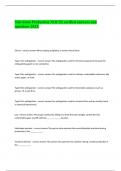
NURS 2539 FLUID AND ELECTROLYTES (QUESTIONS & ANSWERS 100% VERIFIED) FLUID AND ELECTROLYTES Question 1 See full question 1m 36s The physician orders dextrose 5% in water, 1,000 ml to be infused over 8 hours. The I.V. tubing delivers 15 drops/ml. The nurse should run the I.V. infusion at a rate of: You Selected: 32 drops/minute. Correct response: 32 drops/minute. Explanation: Remediation: Question 2 See full question 45s A physician orders a loop diuretic for a client. When administering this drug, the nurse anticipates that the client may develop which electrolyte imbalance? You Selected: Hyperkalemia Correct response: Hypokalemia Explanation: Remediation: Question 3 See full question 16s A nurse must deliver 1,000 ml of normal saline solution over 8 hours. The I.V. tubing has a drop factor of 10 gtt/ml. The nurse should set the flow rate as: You Selected: 21 gtt/minute Correct response: 21 gtt/minute Explanation: Remediation: Question 4 See full question 18s Parents bring their infant to the clinic, seeking treatment for vomiting and diarrhea that has lasted for 2 days. On assessment, the nurse detects dry mucous membranes and lethargy. What other finding suggests a fluid volume deficit? You Selected: A sunken fontanel Correct response: A sunken fontanel Explanation: Remediation: Question 5 See full question 45s For a client with anorexia nervosa, which goal takes the highest priority? You Selected: The client will identify self-perceptions about body size as unrealistic. Correct response: The client will establish adequate daily nutritional intake. Explanation: Remediation: Question 6 See full question 20s A client in the 13th week of pregnancy develops hyperemesis gravidarum. Which laboratory finding indicates the need for intervention? You Selected: Ketones in urine. Correct response: Ketones in urine. Explanation: Remediation: Question 7 See full question 12s Parents who bring a 3-week-old neonate to the hospital report that he's been "throwing up after every feeding." A nurse notes projectile vomiting while assessing the neonate. X-rays confirm: You Selected: pyloric stenosis. Correct response: pyloric stenosis. Explanation: Remediation: Question 8 See full question 56s Which assessment finding would lead a nurse to suspect dehydration in a preterm neonate? You Selected: Urine output below 1 ml/hour Correct response: Urine output below 1 ml/hour Explanation: Remediation: Question 9 See full question 2m 44s A nurse is planning to administer a sodium polystyrene sulfonate enema to a client with a potassium level of 6.2 mEq/L. Correct administration and the effects of this enema should include having the client: You Selected: retain the enema for 30 minutes to allow for sodium exchange; afterward, the client should have diarrhea. Correct response: retain the enema for 30 minutes to allow for sodium exchange; afterward, the client should have diarrhea. Explanation: Remediation: Question 10 See full question 2m 4s After completing discharge instructions for a primiparous client who is bottlefeeding her term neonate, the nurse determines that the mother understands the instructions when the mother says that she should contact the pediatrician if the neonate exhibits which sign or symptom? You Selected: spitting up of a tablespoon of formula after feeding Correct response: passage of a liquid stool with a watery ring Explanation: Remediation: Question 11 See full question 5m 21s A 31-year-old multigravid client at 39 weeks' gestation admitted to the hospital in active labor is receiving intravenous lactated Ringer's solution and a continuous epidural anesthetic. During the first hour after administration of the anesthetic, the nurse should monitor the client for: You Selected: hypotension. Correct response: hypotension. Explanation: Remediation: Question 12 See full question 2m 44s The nurse is evaluating the effectiveness of fluid resuscitation during the emergency period of burn management. Which finding indicates that adequate fluid replacement has been achieved in the client? You Selected: an increase in body weight Correct response: urine output greater than 35 mL/hour Explanation: Remediation: Question 13 See full question 3m 1s A client is admitted with acute pancreatitis. The nurse should monitor which laboratory values? You Selected: increased serum amylase and lipase levels Correct response: increased serum amylase and lipase levels Explanation: Remediation: Question 14 See full question 3m 1s Clients who are receiving total parenteral nutrition (TPN) are at risk for development of which complication? You Selected: pulmonary hypertension Correct response: fluid imbalances Explanation: Remediation: Question 15 See full question 38s A client with a history of renal calculi formation is being discharged after surgery to remove the calculus. What instructions should the nurse include in the client's discharge teaching plan? You Selected: Increase daily fluid intake to at least 2 to 3 L. Correct response: Increase daily fluid intake to at least 2 to 3 L. Explanation: Remediation: Question 16 See full question 6m 18s The client's serum potassium level is elevated in acute renal failure, and the nurse administers sodium polystyrene sulfonate. The mechanism of action for this drug is to: You Selected: exchange sodium for potassium ions in the colon. Correct response: exchange sodium for potassium ions in the colon. Explanation: Remediation: Question 17 See full question 1m 32s What finding should the nurse interpret as indicating that a child is receiving too much IV fluid too rapidly? You Selected: moist crackles in the lung fields Correct response: moist crackles in the lung fields Explanation: Remediation: Question 18 See full question 2m 1s Which symptom is an early indication that the client’s serum potassium level is below normal? You Selected: muscle weakness in the legs Correct response: muscle weakness in the legs Explanation: Remediation: Question 19 See full question 14s The nurse monitors IV replacement therapy for a client with a nasogastric (NG) tube attached to low suction in order to: You Selected: maintain fluid and electrolyte balance. Correct response: maintain fluid and electrolyte balance. Explanation: Remediation: Question 20 See full question 36s The nurse is assessing a client who is restless and agitated, has dry mucous membranes, and has intense thirst. The nurse should assess the client further for which electrolyte imbalance? You Selected: hypernatremia Correct response: hypernatremia Explanation: Remediation: Question 21 See full question 2m 49s A client with Crohn's disease is scheduled for a barium enema. What should the plan of care include today to prepare for the test tomorrow? You Selected: Encourage plenty of fluids. Correct response: Encourage plenty of fluids. Explanation: Remediation: Question 22 See full question 9m 9s During a follow-up visit to the physician, a client with hyperparathyroidism asks the nurse to explain the physiology of the parathyroid glands. The nurse states that these glands produce parathyroid hormone (PTH). PTH maintains the balance between calcium and: You Selected: phosphorus. Correct response: phosphorus. Explanation: Remediation: Question 23 See full question 17s A client has a serum calcium level of 7.2 mg/dl (1.8 mmol/L). During the physical examination, the nurse expects to assess: You Selected: Trousseau's sign. Correct response: Trousseau's sign. Explanation: Remediation: Question 24 See full question 33s A nurse is caring for a client who had a thyroidectomy and is at risk for hypocalcemia. What should the nurse do? You Selected: Observe for muscle twitching and numbness or tingling of the lips, fingers, and toes. Correct response: Observe for muscle twitching and numbness or tingling of the lips, fingers, and toes. Explanation: Remediation: Question 25 See full question 16s For the first 72 hours after thyroidectomy surgery, a nurse should assess a client for Chvostek's sign and Trousseau's sign because they indicate: You Selected: hypocalcemia. Correct response: hypocalcemia. Explanation: Remediation: Question 26 See full question 51s A client is admitted with nausea, vomiting, and diarrhea. His blood pressure on admission is 74/30 mm Hg. The client is oliguric and his blood urea nitrogen (BUN) and creatinine levels are elevated. The physician will most likely write an order for which treatment? You Selected: Start I.V. fluids with a normal saline solution bolus followed by a maintenance dose. Correct response: Start I.V. fluids with a normal saline solution bolus followed by a maintenance dose. Explanation: Remediation: Question 27 See full question 2m 15s A nurse is caring for a 3-year-old client with a neuroblastoma who has been receiving chemotherapy for the last 4 weeks. His laboratory test results indicate a Hgb of 12.5 g/dL (125 g/L), HCT of 36.8% (0.37), WBC of 2000 mm3 (2 X 10⁹/L), and platelet count of 150,000/μL (150 X 109/L). Based on the child's values, what is the highest priority nursing intervention? You Selected: Prepare to give the child a transfusion of platelets. Correct response: Encourage meticulous handwashing by the client and visitors. Explanation: Remediation: Question 28 See full question 42s Which adverse effects occur when there is too rapid an infusion of TPN solution? You Selected: hypoglycemia Correct response: circulatory overload Explanation: Remediation: Question 29 See full question 1m 19s The client is to receive antibiotic intravenous (IV) therapy in the home. The nurse should develop a teaching plan to ensure that the client and family can manage the IV fluid and infusion correctly and avoid complications. What should the nurse instruct the client to do? Select all that apply. You Selected: Report signs of redness or inflammation at the site. Cleanse the port with alcohol wipes. Correct response: Report signs of redness or inflammation at the site. Call the health care provider (HCP) for a temperature above 100° F (37.8° C). Cleanse the port with alcohol wipes. Explanation: Remediation: Question 30 See full question 44s A client is brought to the emergency department with abdominal trauma following an automobile accident. The vital signs are as follows: heart rate, 132 bpm; respirations, 28 breaths/min; blood pressure, 84/58 mm Hg; temperature, 97.0° F (36.1° C); oxygen saturation 89% on room air. Which prescription should the nurse implement first? You Selected: Administer 1 liter 0.9% saline IV. Correct response: Administer 1 liter 0.9% saline IV. Explanation: Remediation: Question 31 See full question 2m 25s A client with Addison’s disease has fluid and electrolyte loss due to inadequate fluid intake and to fluid loss secondary to inadequate adrenal hormone secretion. As the client’s oral intake increases, which fluids would be most appropriate? You Selected: water and eggnog Correct response: chicken broth and juice Explanation: Remediation: Question 32 See full question 26s A client has had an exacerbation of ulcerative colitis with cramping and diarrhea persisting longer than 1 week. The nurse should assess the client for which complication? You Selected: hypokalemia Correct response: hypokalemia Explanation: Remediation: Question 33 See full question 43s A client who is recovering from gastric surgery is receiving IV fluids to be infused at 100 mL/hour. The IV tubing delivers 15 gtt/mL. The nurse should infuse the solution at a flow rate of how many drops per minute to ensure that the client receives 100 mL/hour? Record your answer using a whole number. Your Response: 25 Correct response: 25 Explanation: Remediation: Question 34 See full question 2m 8s The nurse is caring for a client admitted with pyloric stenosis. A nasogastric tube placed upon admission is on low intermittent suction. Upon review of the morning's blood work, the nurse observes that the patient's potassium is below reference range. The nurse should recognize that the patient may be at risk for what imbalance? You Selected: Metabolic alkalosis Correct response: Metabolic alkalosis Explanation: Remediation: Question 35 See full question 5m 1s The nurse is caring for a child with elevated serum potassium. When teaching the parents about dietary restrictions related to this condition, which of the following would be appropriate information? Select all that apply. You Selected: Do not drink orange juice. Asparagus should be avoided. Correct response: Do not drink orange juice. Asparagus should be avoided. Explanation: Remediation: Question 36 See full question 25s A child is brought to the emergency department with a full-thickness burn involving the epidermis, dermis, and underlying subcutaneous tissue, but does not report pain at this time. Which of the following statements by the nurse are correct about this type of burn? Select all that apply. You Selected: Rehabilitation and skin grafting will be necessary. This is a severe burn and nerve endings have been destroyed. The child must be monitored for signs of fluid shift. Correct response: This is a severe burn and nerve endings have been destroyed. The child must be monitored for signs of fluid shift. Rehabilitation and skin grafting will be necessary. Explanation: Remediation: Question 37 See full question 20s A child is admitted with a 5-day history of severe vomiting and diarrhea. Which intervention is the highest priority for the nurse? You Selected: Administering an antiemetic medication Correct response: Administering IV fluids with electrolyte correction Explanation: Remediation: Question 38 See full question 22s A 6-month-old infant is brought to the clinic. The mother reports the infant has been lethargic. The infant's anterior fontanel is sunken. What other assessment data are a priority for the nurse to collect? You Selected: Number of wet diapers the in the last 24 hours Correct response: Number of wet diapers the in the last 24 hours Explanation: Remediation: Question 39 See full question 44s A client who has been taking furosemide has a serum potassium level of 3.2 mEq/L. Which assessment findings by the nurse would confirm an electrolyte imbalance? You Selected: Muscle weakness and a weak, irregular pulse Correct response: Muscle weakness and a weak, irregular pulse Explanation: Remediation: Question 40 See full question 37s When a client returns from a magnetic resonance imaging (MRI) exam with contrast, which of the following actions is appropriate? You Selected: Administering fluids to the client Correct response: Administering fluids to the client Explanation: Remediation: Question 41 See full question 3m 7s Which statement indicates that a client with the medical diagnosis of hypoparathyroidism understands diet instructions? You Selected: “A spinach salad with cucumbers and tomatoes is a good meal.” Correct response: “I will eat green beans, fish, and white bread for a meal.” Explanation: Remediation: Question 42 See full question 18s A client with an IV of normal saline at 150 mL/hour reports dyspnea and restlessness. Which of the following is the priority nursing action? You Selected: Assess lung sounds Correct response: Assess lung sounds Explanation: Remediation: Question 43 See full question 2m 51s A client has an order for a clear liquid diet. The nurse is assisting the client to complete a menu. Which of the following would be appropriate for the client to order? You Selected: Apple juice Broth Tea Correct response: Apple juice Broth Tea Explanation: Question 44 See full question 1m 45s The client receiving furosemide should be monitored for what potential complication? You Selected: Electrolyte imbalance Correct response: Electrolyte imbalance Explanation: Remediation: Question 45 See full question 1m 23s A client prescribed propranolol calls the clinic to report a weight gain of 3 lbs (1.36 kg) within 2 days, shortness of breath, and swollen ankles. What is the nurse’s best action? You Selected: Have the client come to the clinic in order to assess the lungs. Correct response: Have the client come to the clinic in order to assess the lungs. Explanation: Remediation: Question 46 See full question 48s A nurse is caring for a 12-month-old infant with dehydration with resulting metabolic acidosis. The infant exhibits lethargy and poor skin turgor. Which of the following actions by the nurse takes priority? You Selected: Obtaining a urine sample via catheterization Correct response: Obtaining a patent intravenous site Explanation: Question 47 See full question 1m 40s A client is admitted to the psychiatric clinic for treatment of anorexia nervosa. Which actions are most important for the nurse to perform at this time? Select all that apply. You Selected: Assess the client’s serum albumin and electrolyte levels Weigh the client daily after the evening meal Monitor the client's vital signs Correct response: Monitor the client's vital signs Assess the client’s serum albumin and electrolyte levels Explanation: Remediation: Question 48 See full question 50s A client with marked oliguria is ordered a test dose of 0.2 g/kg of 15% mannitol solution intravenously over 5 minutes. The client weighs 132 lb. How many grams would the nurse administer? Record your answer as a whole number. Your Response: 12 Correct response: 12 Explanation: Remediation: Question 49 See full question 23s In caring for a pregnant client with hyperemesis gravidarum, which is the priority nursing intervention? You Selected: correction of fluid-electrolyte imbalance Correct response: correction of fluid-electrolyte imbalance Explanation: Remediation: Question 50 See full question 1m 8s A two-year-old child is showing signs of shock. A 10 ml/kg bolus of normal saline solution is ordered. The child weighs 40 lb (18.18 kg). How many milliliters should be administered? Round your answer using a whole number. Your Response: 182 Correct response: 182 Explanation: Remediation: Question 1 See full question 56s A nurse is reviewing a client's laboratory test results. Which electrolyte is the major cation controlling a client's extracellular fluid (ECF) osmolality? You Selected: Potassium Correct response: Sodium Explanation: Remediation: Question 2 See full question 2m 12s Which type of solution raises serum osmolarity and pulls fluid from the intracellular and intrastitial compartments into the intravascular compartment? You Selected: Hypertonic Correct response: Hypertonic Explanation: Question 3 See full question 25s A preschooler has vomiting, diarrhea, and a potassium level of 3 mEq/L (3 mmol/L). The physician orders an I.V. infusion of 500 ml of dextrose 5% in water and halfnormal saline solution with 20 mEq (20 mmol/L) of potassium chloride. The nurse knows that a child with vomiting and diarrhea needs fluids and potassium chloride to: You Selected: promote normal stool elimination. Correct response: meet physiologic needs. Explanation: Question 4 See full question 1m 46s A 4-year-old child is receiving dextrose 5% in water and half-normal saline solution at 100 ml/hour. The nurse should suspect that the child's I.V. fluid intake is excessive if assessment reveals: You Selected: worsening dyspnea. Correct response: worsening dyspnea. Explanation: Remediation: Question 5 See full question 3h 28m 19s A nurse is caring for a woman receiving a lumbar epidural anesthetic block to control labor pain. What should the nurse do to prevent hypotension? You Selected: Place the woman supine with her legs raised. Correct response: Ensure adequate hydration before the anesthetic is administered. Explanation: Remediation: Question 6 See full question 7s A client with renal insufficiency is admitted to the hospital with pneumonia. He's being treated with gentamicin. Which laboratory value should be closely monitored? You Selected: Blood urea nitrogen (BUN) Correct response: Blood urea nitrogen (BUN) Explanation: Remediation: Question 7 See full question 2s A nurse is reviewing a client's fluid intake and output record. Fluid intake and urine output should relate in which way? You Selected: Fluid intake should be about equal to the urine output. Correct response: Fluid intake should be about equal to the urine output. Explanation: Remediation: Question 8 See full question 4s A client has been diagnosed with right-sided heart failure. The nurse should assess the client further for: You Selected: Dependent edema. Correct response: Dependent edema. Explanation: Remediation: Question 9 See full question 4s The nurse monitors the serum electrolyte levels of a client who is taking digoxin. Which electrolyte imbalance is a common cause of digoxin toxicity? You Selected: hyponatremia Correct response: hypokalemia Explanation: Remediation: Question 10 See full question 6s What is the primary goal of nursing care during the emergent phase after a burn injury? You Selected: Replace lost fluids. Correct response: Replace lost fluids. Explanation: Remediation: Question 11 See full question 20s A newborn admitted with pyloric stenosis is lethargic and has poor skin turgor. The health care provider (HCP) has prescribed IV fluids of dextrose water with sodium and potassium. The baby’s admission potassium level is 3.4 mEq/L (3.4 mmol/L). What should the nurse do first? You Selected: Administer the prescribed fluids. Correct response: Verify that the infant has urinated. Explanation: Remediation: Question 12 See full question 18s During a clinic visit, the mother of an infant with hydrocele states that the infant's scrotum is smaller now than when he was born. After teaching the mother about the infant's condition, which statement by the mother indicates that the teaching has been effective? You Selected: "It seems like the fluid is being reabsorbed." Correct response: "It seems like the fluid is being reabsorbed." Explanation: Remediation: Question 13 See full question 14s After a total laryngectomy, the client
Written for
Document information
- Uploaded on
- November 3, 2021
- Number of pages
- 196
- Written in
- 2021/2022
- Type
- Exam (elaborations)
- Contains
- Questions & answers
Subjects
-
nurs 2539 fluid and electrolytes questions amp answers 100 verified