
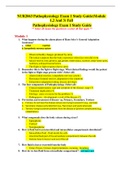
NUR2063 Pathophysiology Exam 1 Study Guide(Module 1,2 And 3) Fall Pathophysiology Exam 1 Study Guide ** Select all means the question is a select all that apply ** Module 1 1. What happens during the alarm phase of Hans Selye’s General Adaptation Syndrome? a. Initial reaction b. Sympathetic nervous system • Observed bodily changes produced by stress • The initial symptom that the body experience when face stressful event • Natural reserve, time, genetics, age, gender, health status, nutrition, sleep–wake cycles, hardiness, and psychosocial factors • The flight or fight response due to stress 2. Remember this is the fight or flight stage. What clinical findings would the patient in the fight or flight stage present with? (Select All) • Alarm (initial reaction, sympathetic nervous system ) • Resistance (limited stressor, adaptation to the situation) • Exhaustion (adaptation failing, disease develops) 3. The four components of Pathophysiology (Select all) • Clinical manifestation: sign and symptom of the disease, stage (3) • Treatment implication (4) • Etiology: cause or reason for the problem (1) • Pathogenesis – development + evol of the disease (2) 4. Prevention and treatment of disease - eg. Primary, Secondary, Tertiary a. Primary: do not have the disease and you are trying to prevent it (e.g., vaccines) b. Secondary: disease early detection (e.g., Pap smears and yearly physicals) c. Tertiary: trying to prevent problems from the disease or (prevent complication) (e.g., rehabilitation) 5. What compounds does the body release during stress? • Epinephrine • Cortisol • Norepinephrine 6. How is fluid between interstitial and intracellular compartments distributed? • Intracellular fluid : fluid inside the cells • Interstitial fluid (part of the extracellular compartment): between the cells • Osmosis how it moves in and out of the cell 7. How fluid is lost or excreted from the body • Urine. Fesses, Gi tract, hyperventilation, sweating , breathing 8. How do we lose fluid from extracellular compartment? ( not sure) not • Urine fesses, gi tract, sweat, 9. What is potential and fatal complication of hyponatremia • Confusion, seizure, coma, death, cerebral edema 10. Priority assessment for a patient with a potassium imbalance. • Do an EKG of the heart? asses the heart 11. Symptoms of dehydration • Fatigue, dry mouth, headache, palpitation, extreme thirst, hypernatremia, cell shrinkage, flush skin, increase in temperature, dry mucous membrane 12. Cause of edema 13. Swelling (too much water, sodium) fluid retention , excess fluid in the interstitial space 14. Wha t hormones assist with potassium distribution (I discussed 2 main hormones in the webex lecture) • Insulin • Epinephrin 15. Extracellular fluid has higher concentration of which electrolytes/substances (I discussed 2) • Sodium • Chloride 16. The energy currency of a cell and role the mitochondrion plays in this currency a. Power plants b. Aerobic metabolism —ATP ( we need oxygen for it to function ) c. Number in a given cell varies depending on the cell’s energy needs d. Contains own DNA and ribosomes 17. Three electrolytes that impact bone • Phosphorus • Magnesium, • calcium • calcium + phosphorus inverse relation • calcium + magnesium synergistic • parathyroid hormone regulates calcium + phosphorus in the blood. Module 2 1. What is active immunity? • Acquired by having the disease (i.e., prior antigen exposure) and by vaccinations • Long lasting but takes a few days to become effective • (flu vaccine takes about 3 days to become active)
Preview 2 out of 11 pages
Other
NUR2063 Pathophysiology Exam 1 Study Guide(Module 1,2 And 3)
Preview 2 out of 11 pages
NUR2063 Pathophysiology Exam 1 Study Guide(Module 1,2 And 3)-1. What happens during the alarm phase of Hans Selye’s General Adaptation Syndrome? a. Initial reaction b. Sympathetic nervous system • Observed bodily changes produced by stress • The initial symptom that the body experience when face stressful event • Natural reserve, time, genetics, age, gender, health status, nutrition, sleep–wake cycles, hardiness, and psychosocial factors • The flight or fight response due to stress 2. Remember this is the fight or flight stage. What clinical findings would the patient in the fight or flight stage present with? (Select All) • Alarm (initial reaction, sympathetic nervous system ) • Resistance (limited stressor, adaptation to the situation) • Exhaustion (adaptation failing, disease develops) 3. The four components of Pathophysiology (Select all) • Clinical manifestation: sign and symptom of the disease, stage (3) • Treatment implication (4) • Etiology: cause or reason for the problem (1) • Pathogenesis – development + evol of the disease (2) 4. Prevention and treatment of disease- eg. Primary, Secondary, Tertiary a. Primary: do not have the disease and you are trying to prevent it (e.g., vaccines) b. Secondary: disease early detection (e.g., Pap smears and yearly physicals) c. Tertiary: trying to prevent problems from the disease or (prevent complication) (e.g., rehabilitation) 5. What compounds does the body release during stress? • Epinephrine • Cortisol • Norepinephrine 6. How is fluid between interstitial and intracellular compartments distributed? • Intracellular fluid : fluid inside the cells • Interstitial fluid (part of the extracellular compartment): between the cells • Osmosis how it moves in and out of the cell 7. How fluid is lost or excreted from the body • Urine. Fesses, Gi tract, hyperventilation, sweating , breathing 8. How do we lose fluid from extracellular compartment? ( not sure) not
Content preview
Document information
- Uploaded on
- October 25, 2021
- Number of pages
- 11
- Written in
- 2021/2022
- Type
- Other
- Person
- Unknown
$14.74
Wrong document? Swap it for free
Within 14 days of purchase and before downloading, you can choose a different document. You can simply spend the amount again.
Written by students who passed
Immediately available after payment
Read online or as PDF

Reputation scores are based on the amount of documents a seller has sold for a fee and the reviews they have received for those documents. There are three levels: Bronze, Silver and Gold. The better the reputation, the more your can rely on the quality of the sellers work.

