European History
2019-2020
Emma Maréchal
Lesson Page number
2. French Revolution 2
3: Conservative backlashes 15
4: Peace and war 28
5: Nationalism 37
6: Industrialisation 48
7: Age of mass migration 61
8: Culture and secularisation 70
9: European expansionism and imperialism 81
10: First world war 89
11: Road to WWII 102
12: Conclusion 115
, 2: French Revolution
Content:
1. Context of the French Revolution (1789-1815)
a. Ancien Régime system
b. Meeting of the Estates-General
2. A series of revolutions: three stages
a. The moderate stage (1789-1792)
b. The radical stage (1793-1794)
c. The directory (1795-1799)
d. + The age of Napoleon (1800-1815)
3. The legacy of the FR
4. Interpreting the FR
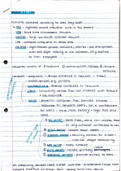
FR - conceived as the beginning of the 19C; seen as marking the beginning of the period in which modernity in Europe/the
‘European modern man’ was created.
After the FR and Napoleonic Empire there is a conservative backlash/tendency to undo part of the workings of the FR.
1. Context of the French Revolution (1789-1815)
● The FR is not the first revolution of its kind.
FR should be placed in a historical continuum with at least 2 other revolutions:
- Glorious Revolution (1688-1689, England)
- Different monarchies, different families in UK
- Different religious origins: Catchilic Church, Protestant Church.
⇒ Abdication (under immense pressures) of Catholic King and replacement by Protestant king.
- American Revolution (1775-1783)
- Different motive, different outcome: settlers in the US were still highly dependent on rule from the UK -
received/had minimal rights in British parliament --> completely governed by foreign rule/body, in which
they had little/no say.
- Meanwhile they were paying taxes: “no taxation without representation” - wanted to have more fair
representation in the UK, but in general also independence.
- Outcome: American independence from the UK.
==> People in the 16-17-18C were rebelling all the time: against authority, Church, politics, etc.
● Impact of these revolutions: (and why they matter to the FR)
- England: sharp breach with tradition of ‘divine right to rule’ of kings.
The switch from a Catholic to a Protestant king is crucial.
In CC - longstanding tradition to conceive the head of the Church - Pope based in Rome - as the representative of God on Earth.
It was the Pope who was invited to anoint the king, sharing his worldly powers, his representation of God with the King and the
Royal family.
--> Both the Pope and the King are seen as spokesmen of God.
As long as they fitted within this Roman Catholic tradition, they were conceived as having a DRTR.
==> If God has granted you the right to rule, you don’t have to account to ordinary people.
Within the Protestant tradition, there’s a much greater emphasis on every individual religious person and their
reading/interpretation of the Bible.
--> Completely different hierarchies within the Protestant Church.
==> Changing the king and his religious beliefs in England meant that the English king could no longer claim to have an absolute
DRTR.
==> This switch also meant the king now had to account to those he was ruling over.
● If no Roman Catholic could be king, then no Kingship could be unconditional.
, ○ There’d always be some sort of account giving for their actions to the people.
Huge ramifications: suddenly there’s a relationship of ‘democratic control’ created with the people.
Happened in the UK partly due to its very complex royal family and constant rivalries over the throne.
==> England, as a result of the Glorious Rev, has its own traditions.
At the time, it was the most democratic country in the sense that there was already the switch that the DRTR of the king is no
longer accepted. This was not the case in Continental Europe - the king is still absolute ruler & his DRTR still uncontested.
The rules and practices of England also circulate on the European continent and add to the dismay of the people - they’d like to
see it copied.
- USA: rights of representation & revolt against ‘unjust’ rule.
Claim for fair representation; American revolutionaries made the case that if government is conceived as illegitimate by the
people, that the people have the right to rebel. -->presents a claim for popular sovereignty, again challenging the authority
coming from above, claiming instead that a ruler should account to the people.
If the people are fed up, they can get rid of the ruler and the system.
Both the Glorious and esp the American Rev were greatly inspired by liberal philosopher John Locke:
John Locke (1689): Two Treatises of Government:
= a case for constitutional monarchy (= non-elected monarch is head of the state within the limits of a constitution. Political
power is shared between the monarch and an organised government (parliament).)
● Two premises - quite controversial at the time
1) No DRTR: No government can be justified by one’s appeal to the divine right of kings
2) Legitimate governments would always be founded on the consent of those governed.
● He was a social contract theorist (justification for the state):
○ State of nature - rational man --> peaceful view on man
Believed in human capability of finding a peaceful cohabitation. (Vastly different to Hobbes - another contract theorist: the state
of nature is constant warfare with no government restraining us. Need for almighty king to deal with constant warfare.)
Locke sees the state of nature as reasonable individuals - even in a position of imperfect security, we’d find a way of negotiating,
deliberating. But there’s never an absolute guarantee that people wouldn’t act irrationally. ==> Why a state is needed: to provide
security to enjoy your properties (including your own life). Reasonable individuals would collectively transfer part of their
sovereignty to a state body. They are capable of self-government, but a government facilitates our cohabitation because it brings
more stability --> does not lead to an absolute tyrant but to a civil government that constantly needs to account for what it does.
⇩
○ Civil government founded on popular sovereignty.
Run-up to the FR
1) Economics: Financial Bankruptcy
Near to financial bankruptcy.
France - was a very big country; but had made a lot of financial investments of different nature:
- Louis XIV (‘Sun King’) mass expenditures: Palace of Versailles
- Seven Years’ War between England-France: loss of many colonies
- Had provided lots of financial support in the American Rev.
- Poor harvests, famine, and already harsh taxes and income inequalities.
2) Politics: struggle with provincial “parlements”
At the beginning of the FR - King Louis XVI inherited the struggle with provincial courts who had the right to appeal to the
king’s edicts. Courts could interfere with the king’s edicts; King had the duty to listen and perhaps tweak his laws - ending in a
battle of negotiation with these courts.
Faced with these 2 factors (bankruptcy + parlements struggle), the king had to do something. - had to get more finances. -->
raising taxes was the obvious answer.
● Dismissal of Jacques Necker (1789)- controller-general of Finance.
- Necker was critical of raising taxes on ordinary people (already high) and tax exemptions for nobility and clergy.
- Much more in favour of borrowing money abroad; or raising taxes to the upper 2 estates.
, - These 2 suggestions and the fact that he made quite a lot of his reports public made him unpopular with the king and
aristocracy.
- --> Borrowing money abroad would weaken the position of France in Europe. Become dependent on its
neighbours rather than ruling over them.
● (Unfortunate) Gamble of Louis XVI (1787-88)
- Proposes a “land tax” on all land-holders (including nobility)
- Would directly affect nobility and clergy - directly attacks aristocracy.
- The king got Necker’s message - couldn’t get more money out of ordinary people.
- Organises an “Assembly of Notables” - assumes they’d accept his authority and approve his proposal - but they reject
it.
- The assembly argues to the king that it’s not something for them to decide upon - it’s a law that’d affect the
totality of France. ==> A Meeting with the legislative body - the Parliament of France.
- King calls a meeting of the Estates-General
- Attempts to bypass them, thinking the clergy and ordinary people will back him, as he has the DRTR.
- E-G hasn’t convened in 150 years - as part of the absolute rule in France
○ Instigates discussions on institutional design (how to organise parliament - who gets rights?) --> leading to
the FR.
1.1. Ancien Régime system
1.1.1. AR Economics of France
● Explosion in terms of demographic growth
Simultaneously:
● Still a very agricultural nation
● Not urbanised
● Not industrialised
- Heavy reliance on agriculture
- But not technically advanced
- Low productivity: labor intensive, out-dated methods.
- Failed to keep up with demographic growth.
● Famine
- 1780s: poor harvests
- 1788: harsh winter
- Almost no food left in France: food shortages in cities.
- Ban on food export. Lot of grain imported to feed people. Rising bread prices.
==> Dire circumstances of ordinary people.
● Geography:
- A jigsaw of land: result of previous conquest. (1664: Saint-Dominique, 1770: Corsica)
==> Conditions (economic circumstances) for a rebellion were there.
1.1.2. AR: Politics
- DRTR
- Parlements
- Estates-General
Political system was also feeding a lot of discontent.
● King ruled by the divine right.
- Decision-making with King’s council (consultative prerogatives).
- King needed to consult council - receive advice;
- But the king was almighty - making it an absolute regime.
● Absolutist rule = no constitution
- Legal pluralism: rules varied across regional courts.
- King ruled by royal edicts - would be implemented throughout France.
2019-2020
Emma Maréchal
Lesson Page number
2. French Revolution 2
3: Conservative backlashes 15
4: Peace and war 28
5: Nationalism 37
6: Industrialisation 48
7: Age of mass migration 61
8: Culture and secularisation 70
9: European expansionism and imperialism 81
10: First world war 89
11: Road to WWII 102
12: Conclusion 115
, 2: French Revolution
Content:
1. Context of the French Revolution (1789-1815)
a. Ancien Régime system
b. Meeting of the Estates-General
2. A series of revolutions: three stages
a. The moderate stage (1789-1792)
b. The radical stage (1793-1794)
c. The directory (1795-1799)
d. + The age of Napoleon (1800-1815)
3. The legacy of the FR
4. Interpreting the FR
FR - conceived as the beginning of the 19C; seen as marking the beginning of the period in which modernity in Europe/the
‘European modern man’ was created.
After the FR and Napoleonic Empire there is a conservative backlash/tendency to undo part of the workings of the FR.
1. Context of the French Revolution (1789-1815)
● The FR is not the first revolution of its kind.
FR should be placed in a historical continuum with at least 2 other revolutions:
- Glorious Revolution (1688-1689, England)
- Different monarchies, different families in UK
- Different religious origins: Catchilic Church, Protestant Church.
⇒ Abdication (under immense pressures) of Catholic King and replacement by Protestant king.
- American Revolution (1775-1783)
- Different motive, different outcome: settlers in the US were still highly dependent on rule from the UK -
received/had minimal rights in British parliament --> completely governed by foreign rule/body, in which
they had little/no say.
- Meanwhile they were paying taxes: “no taxation without representation” - wanted to have more fair
representation in the UK, but in general also independence.
- Outcome: American independence from the UK.
==> People in the 16-17-18C were rebelling all the time: against authority, Church, politics, etc.
● Impact of these revolutions: (and why they matter to the FR)
- England: sharp breach with tradition of ‘divine right to rule’ of kings.
The switch from a Catholic to a Protestant king is crucial.
In CC - longstanding tradition to conceive the head of the Church - Pope based in Rome - as the representative of God on Earth.
It was the Pope who was invited to anoint the king, sharing his worldly powers, his representation of God with the King and the
Royal family.
--> Both the Pope and the King are seen as spokesmen of God.
As long as they fitted within this Roman Catholic tradition, they were conceived as having a DRTR.
==> If God has granted you the right to rule, you don’t have to account to ordinary people.
Within the Protestant tradition, there’s a much greater emphasis on every individual religious person and their
reading/interpretation of the Bible.
--> Completely different hierarchies within the Protestant Church.
==> Changing the king and his religious beliefs in England meant that the English king could no longer claim to have an absolute
DRTR.
==> This switch also meant the king now had to account to those he was ruling over.
● If no Roman Catholic could be king, then no Kingship could be unconditional.
, ○ There’d always be some sort of account giving for their actions to the people.
Huge ramifications: suddenly there’s a relationship of ‘democratic control’ created with the people.
Happened in the UK partly due to its very complex royal family and constant rivalries over the throne.
==> England, as a result of the Glorious Rev, has its own traditions.
At the time, it was the most democratic country in the sense that there was already the switch that the DRTR of the king is no
longer accepted. This was not the case in Continental Europe - the king is still absolute ruler & his DRTR still uncontested.
The rules and practices of England also circulate on the European continent and add to the dismay of the people - they’d like to
see it copied.
- USA: rights of representation & revolt against ‘unjust’ rule.
Claim for fair representation; American revolutionaries made the case that if government is conceived as illegitimate by the
people, that the people have the right to rebel. -->presents a claim for popular sovereignty, again challenging the authority
coming from above, claiming instead that a ruler should account to the people.
If the people are fed up, they can get rid of the ruler and the system.
Both the Glorious and esp the American Rev were greatly inspired by liberal philosopher John Locke:
John Locke (1689): Two Treatises of Government:
= a case for constitutional monarchy (= non-elected monarch is head of the state within the limits of a constitution. Political
power is shared between the monarch and an organised government (parliament).)
● Two premises - quite controversial at the time
1) No DRTR: No government can be justified by one’s appeal to the divine right of kings
2) Legitimate governments would always be founded on the consent of those governed.
● He was a social contract theorist (justification for the state):
○ State of nature - rational man --> peaceful view on man
Believed in human capability of finding a peaceful cohabitation. (Vastly different to Hobbes - another contract theorist: the state
of nature is constant warfare with no government restraining us. Need for almighty king to deal with constant warfare.)
Locke sees the state of nature as reasonable individuals - even in a position of imperfect security, we’d find a way of negotiating,
deliberating. But there’s never an absolute guarantee that people wouldn’t act irrationally. ==> Why a state is needed: to provide
security to enjoy your properties (including your own life). Reasonable individuals would collectively transfer part of their
sovereignty to a state body. They are capable of self-government, but a government facilitates our cohabitation because it brings
more stability --> does not lead to an absolute tyrant but to a civil government that constantly needs to account for what it does.
⇩
○ Civil government founded on popular sovereignty.
Run-up to the FR
1) Economics: Financial Bankruptcy
Near to financial bankruptcy.
France - was a very big country; but had made a lot of financial investments of different nature:
- Louis XIV (‘Sun King’) mass expenditures: Palace of Versailles
- Seven Years’ War between England-France: loss of many colonies
- Had provided lots of financial support in the American Rev.
- Poor harvests, famine, and already harsh taxes and income inequalities.
2) Politics: struggle with provincial “parlements”
At the beginning of the FR - King Louis XVI inherited the struggle with provincial courts who had the right to appeal to the
king’s edicts. Courts could interfere with the king’s edicts; King had the duty to listen and perhaps tweak his laws - ending in a
battle of negotiation with these courts.
Faced with these 2 factors (bankruptcy + parlements struggle), the king had to do something. - had to get more finances. -->
raising taxes was the obvious answer.
● Dismissal of Jacques Necker (1789)- controller-general of Finance.
- Necker was critical of raising taxes on ordinary people (already high) and tax exemptions for nobility and clergy.
- Much more in favour of borrowing money abroad; or raising taxes to the upper 2 estates.
, - These 2 suggestions and the fact that he made quite a lot of his reports public made him unpopular with the king and
aristocracy.
- --> Borrowing money abroad would weaken the position of France in Europe. Become dependent on its
neighbours rather than ruling over them.
● (Unfortunate) Gamble of Louis XVI (1787-88)
- Proposes a “land tax” on all land-holders (including nobility)
- Would directly affect nobility and clergy - directly attacks aristocracy.
- The king got Necker’s message - couldn’t get more money out of ordinary people.
- Organises an “Assembly of Notables” - assumes they’d accept his authority and approve his proposal - but they reject
it.
- The assembly argues to the king that it’s not something for them to decide upon - it’s a law that’d affect the
totality of France. ==> A Meeting with the legislative body - the Parliament of France.
- King calls a meeting of the Estates-General
- Attempts to bypass them, thinking the clergy and ordinary people will back him, as he has the DRTR.
- E-G hasn’t convened in 150 years - as part of the absolute rule in France
○ Instigates discussions on institutional design (how to organise parliament - who gets rights?) --> leading to
the FR.
1.1. Ancien Régime system
1.1.1. AR Economics of France
● Explosion in terms of demographic growth
Simultaneously:
● Still a very agricultural nation
● Not urbanised
● Not industrialised
- Heavy reliance on agriculture
- But not technically advanced
- Low productivity: labor intensive, out-dated methods.
- Failed to keep up with demographic growth.
● Famine
- 1780s: poor harvests
- 1788: harsh winter
- Almost no food left in France: food shortages in cities.
- Ban on food export. Lot of grain imported to feed people. Rising bread prices.
==> Dire circumstances of ordinary people.
● Geography:
- A jigsaw of land: result of previous conquest. (1664: Saint-Dominique, 1770: Corsica)
==> Conditions (economic circumstances) for a rebellion were there.
1.1.2. AR: Politics
- DRTR
- Parlements
- Estates-General
Political system was also feeding a lot of discontent.
● King ruled by the divine right.
- Decision-making with King’s council (consultative prerogatives).
- King needed to consult council - receive advice;
- But the king was almighty - making it an absolute regime.
● Absolutist rule = no constitution
- Legal pluralism: rules varied across regional courts.
- King ruled by royal edicts - would be implemented throughout France.