TDC - Lecture 7
Knowledge Transfer between Domains
Selection psychology in sports:
→ clinical vs actuarial judgment
→ sign vs sample
→ representative design
→ dynamic network model (talent and performance emerge out of dynamic interactions between all
kinds of components and difficult to isolate and separate them)
Selection Psychology
• roots in IO psychology and Psychometrics
◦ Selection Psychology Is all about making selection decisions (how can we determine if
someone will be successful in the future)
• principles affecting the relationship between predictors and a criterion
◦ application across domains
Sample vs Sign
• Sign and samples in Education:
◦ Niessen & Meijer: wanted to predict performance of first year psychology students (gave
them a book which they had to study, then had an exam and predicted from these
specific skills performance later on)
▪ Sign (general mental ability, verbal ability, conscientiousness, procrastination) →
measured in low-stakes context; Sample (trail-studying (book), trial-studying
(lecture), mean grade high school → measured in selection context)
• in sport mostly takes test batteries (dribbling, sprinting etc → see how this later on predict
performance)
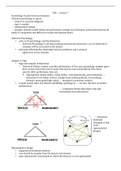
→ component driven (disconnect task and
environment from the person)
→ interaction
dominant
(example of that
is the
representative
design)
Representative design
• organism-environment relations
• cues should be samples from the typical environment
• must represent the environment to which the behavior is to be generalized
, • high in action fidelity (setting/ design should be an optimal simulation of the real world)
• Why samples work from theoretical viewpoint
• Why samples work better fro methodological viewpoint: closer to criterion you want to
predict (the closer you are to criterion (resemble 11 vs 11 game in soccer) the better your
prediction)
• samples closer to criterion you want to test (resembles criterion: 11 vs 11 or small sided
games e.g. 7 vs 7)
• New horizon: 7 vs 7 good resemble 11 vs 11 → found that it is representative (checked
frequencies: 7 vs 7 played faster and more “waving” → excluding them was even same (1)
to 11 vs 11)
◦ typical sign have weak
◦ sampling performance in 7 vs 7 games is more predictive of performance in 11 vs 11
games (sign vs sample)
Clinical vs Actuarial Judgment
• clinical judgment of coaches:
◦ technique, attitude (more difficult to define), the X-factor (how define? Define experts it
in same way? → judges are bias)
◦ body language, skin color, verbal expressions → biases judgment
• actuarial judgment of coaches:
◦ working according to a (non-biased) decision rules → define it before
◦ even when use imperfect judgment still outperform clinical judgment because
standardized
• study: how scouts identify talented players?
◦ Many scouted players under 12 but on the other hand thought that not able to predict
from 12 predict performance in future → scouts realize that but still scout early
Knowledge Transfer between Domains
Selection psychology in sports:
→ clinical vs actuarial judgment
→ sign vs sample
→ representative design
→ dynamic network model (talent and performance emerge out of dynamic interactions between all
kinds of components and difficult to isolate and separate them)
Selection Psychology
• roots in IO psychology and Psychometrics
◦ Selection Psychology Is all about making selection decisions (how can we determine if
someone will be successful in the future)
• principles affecting the relationship between predictors and a criterion
◦ application across domains
Sample vs Sign
• Sign and samples in Education:
◦ Niessen & Meijer: wanted to predict performance of first year psychology students (gave
them a book which they had to study, then had an exam and predicted from these
specific skills performance later on)
▪ Sign (general mental ability, verbal ability, conscientiousness, procrastination) →
measured in low-stakes context; Sample (trail-studying (book), trial-studying
(lecture), mean grade high school → measured in selection context)
• in sport mostly takes test batteries (dribbling, sprinting etc → see how this later on predict
performance)
→ component driven (disconnect task and
environment from the person)
→ interaction
dominant
(example of that
is the
representative
design)
Representative design
• organism-environment relations
• cues should be samples from the typical environment
• must represent the environment to which the behavior is to be generalized
, • high in action fidelity (setting/ design should be an optimal simulation of the real world)
• Why samples work from theoretical viewpoint
• Why samples work better fro methodological viewpoint: closer to criterion you want to
predict (the closer you are to criterion (resemble 11 vs 11 game in soccer) the better your
prediction)
• samples closer to criterion you want to test (resembles criterion: 11 vs 11 or small sided
games e.g. 7 vs 7)
• New horizon: 7 vs 7 good resemble 11 vs 11 → found that it is representative (checked
frequencies: 7 vs 7 played faster and more “waving” → excluding them was even same (1)
to 11 vs 11)
◦ typical sign have weak
◦ sampling performance in 7 vs 7 games is more predictive of performance in 11 vs 11
games (sign vs sample)
Clinical vs Actuarial Judgment
• clinical judgment of coaches:
◦ technique, attitude (more difficult to define), the X-factor (how define? Define experts it
in same way? → judges are bias)
◦ body language, skin color, verbal expressions → biases judgment
• actuarial judgment of coaches:
◦ working according to a (non-biased) decision rules → define it before
◦ even when use imperfect judgment still outperform clinical judgment because
standardized
• study: how scouts identify talented players?
◦ Many scouted players under 12 but on the other hand thought that not able to predict
from 12 predict performance in future → scouts realize that but still scout early