TDC – Week 5 1
Lecture Notes Week 5
21st Century Skills:
• Critical Thinking
• Creativity
• Collaboration
• Communication
Definitions of talent in education
• Retrospective
◦ looking for presence of precursors of talent
◦ hard to find!
◦ not useful for education
• Prospective
◦ early behavior is observes and various trajectories are being followed
Normative approach (Subotnik)
• look at norm population (when look at IQ scale you know how is high normative etc)
• the manifestation of performance that is clearly at the upper end of the distribution in a
talent domain even relative to that of other high-functioning individuals in that domain
◦ “potential”; “achievement”; “environment”
◦ influential cognitive and psychosocial variables are malleable and need to be
deliberately cultivates (e.g. motivation and opportunity)
• current inability to accurately identify who will be gifted in the long run → difference
between potential and actual realization of that in the future
• normative approach because takes distribution as starting point
• Subotnik focused only on high performers
Ipsative approach (more implicit also Subotnik)
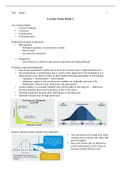
• each person has own range (e.g. when
anxious move to lower end, when feel
good to higher)
• that is the reason why so difficult to
predict performance in the long run
because in them self also vary
,TDC – Week 5 2
Project “Curious Minds”
• observed that young children where really interested in science but as soon as they entered
school this interest seemed to disappear
• 8 universities
• University of Groningen: Developmental Psychology
◦ 9 PhD-projects
◦ fundamental and applied research > intervention in schools
• concept idea: every child is talented!
◦ Partly historic statement in a historical context of education! Because project started
when gifted education was more popular → identify gifted children and offer them
special education
◦ looking at ipsative approach and responsibility of educational context to bring out what
every child has in him → looking for potential
▪ when teach science in particular way very child can become talented
◦ society needed scientists and project stressed idea that every child is talented
◦ also has backlash (“be best you can be”) → lead to achievable society
◦ Example: Video of Wesley and the
air squirt
▪ which “talented” behavior do
you observe? → child discover
himself
▪ What does the teacher do? →
teacher help him to find out:
connected previous knowledge
and continuously asks
questions (verbal); set
boundaries → had to
think before pushing
(guide attention of child)
▪ when manipulate task it
constantly changes
▪ core aspects of triangle
continuously change
each other
▪ mini components
interact with each other
(figure 2)
▪ interaction of time → talent
is a development and
constantly changing
▪ shows how talent evolves
during 1 by 1 interaction
• Video is an example of a co-
constructive process:
◦ child builds insights,
predictions and explanations
◦ the importance of adequate
guidance of teacher
, TDC – Week 5 3
▪ helps child construct predictions and explanations that were not there when the
learning activity started
▪ giving adequate help means that the process is a process of co-construction
• What teachers should do is encouraging upward spirals
◦ co-adaption/self-organization
▪ e.g. child likes dinosaurs > parent buy book about it > knowledge and interest grows
in child > parents take their child to museum → like positive feedback loop, positive
behaviors influence each other and create upper spiral
▪ can also be interrupted e.g. child prefers watch TV show and forgets about dinosaur
◦ many factors positively influence each other → excelling
◦ also in educational processes
▪ NB: it places the burden on education
▪ NB: supportive environment, distributing the cognitive load
• Upward spiral (like positive feedback loop) vs attractors
◦ can be positive but also ngative
◦ recurrent or stable patterns of actions (when time passes on attractor state become
stronger and harder to change) → interaction pattern that has evolved in certain direction
and has required a certain stability over time
▪ patterns are shaped over time (self evolved)
◦ are difficult to break, behavior is being pulled back
◦ teacher (explanations, instructions etc) ↔ student (listening, responses)
• state space grids
◦ suitable for describing interactions between ordinal variables at micro level
◦ attractor detection
◦ have behavior of on person on one axis and the behavior of the other one on another axis
and than put dot down (for everything teacher says→ e.g. no questions, closed or open
questions; same for child → responses given by child) → than see if attractors emerge
over time
• Example: looked at attractor states in second year education in English lesson
◦ Which question and answer patterns
do teachers and student ask
◦ coded questions and responses (5 for
each per question) of both
◦ figure show how interactive lesson
was (red→ low level of response)
• similar pattern observed in other studies:
◦ 16 EFL lessons (left all on top of each other):
▪ the lesson duration varied between 13-41 minutes
▪ mean # evens in complex: 5,8% of the lesson time
▪ students give very few complex answers
→ found attractor in yellow square in the middle
(teacher asked display question e.g. “where do
Lecture Notes Week 5
21st Century Skills:
• Critical Thinking
• Creativity
• Collaboration
• Communication
Definitions of talent in education
• Retrospective
◦ looking for presence of precursors of talent
◦ hard to find!
◦ not useful for education
• Prospective
◦ early behavior is observes and various trajectories are being followed
Normative approach (Subotnik)
• look at norm population (when look at IQ scale you know how is high normative etc)
• the manifestation of performance that is clearly at the upper end of the distribution in a
talent domain even relative to that of other high-functioning individuals in that domain
◦ “potential”; “achievement”; “environment”
◦ influential cognitive and psychosocial variables are malleable and need to be
deliberately cultivates (e.g. motivation and opportunity)
• current inability to accurately identify who will be gifted in the long run → difference
between potential and actual realization of that in the future
• normative approach because takes distribution as starting point
• Subotnik focused only on high performers
Ipsative approach (more implicit also Subotnik)
• each person has own range (e.g. when
anxious move to lower end, when feel
good to higher)
• that is the reason why so difficult to
predict performance in the long run
because in them self also vary
,TDC – Week 5 2
Project “Curious Minds”
• observed that young children where really interested in science but as soon as they entered
school this interest seemed to disappear
• 8 universities
• University of Groningen: Developmental Psychology
◦ 9 PhD-projects
◦ fundamental and applied research > intervention in schools
• concept idea: every child is talented!
◦ Partly historic statement in a historical context of education! Because project started
when gifted education was more popular → identify gifted children and offer them
special education
◦ looking at ipsative approach and responsibility of educational context to bring out what
every child has in him → looking for potential
▪ when teach science in particular way very child can become talented
◦ society needed scientists and project stressed idea that every child is talented
◦ also has backlash (“be best you can be”) → lead to achievable society
◦ Example: Video of Wesley and the
air squirt
▪ which “talented” behavior do
you observe? → child discover
himself
▪ What does the teacher do? →
teacher help him to find out:
connected previous knowledge
and continuously asks
questions (verbal); set
boundaries → had to
think before pushing
(guide attention of child)
▪ when manipulate task it
constantly changes
▪ core aspects of triangle
continuously change
each other
▪ mini components
interact with each other
(figure 2)
▪ interaction of time → talent
is a development and
constantly changing
▪ shows how talent evolves
during 1 by 1 interaction
• Video is an example of a co-
constructive process:
◦ child builds insights,
predictions and explanations
◦ the importance of adequate
guidance of teacher
, TDC – Week 5 3
▪ helps child construct predictions and explanations that were not there when the
learning activity started
▪ giving adequate help means that the process is a process of co-construction
• What teachers should do is encouraging upward spirals
◦ co-adaption/self-organization
▪ e.g. child likes dinosaurs > parent buy book about it > knowledge and interest grows
in child > parents take their child to museum → like positive feedback loop, positive
behaviors influence each other and create upper spiral
▪ can also be interrupted e.g. child prefers watch TV show and forgets about dinosaur
◦ many factors positively influence each other → excelling
◦ also in educational processes
▪ NB: it places the burden on education
▪ NB: supportive environment, distributing the cognitive load
• Upward spiral (like positive feedback loop) vs attractors
◦ can be positive but also ngative
◦ recurrent or stable patterns of actions (when time passes on attractor state become
stronger and harder to change) → interaction pattern that has evolved in certain direction
and has required a certain stability over time
▪ patterns are shaped over time (self evolved)
◦ are difficult to break, behavior is being pulled back
◦ teacher (explanations, instructions etc) ↔ student (listening, responses)
• state space grids
◦ suitable for describing interactions between ordinal variables at micro level
◦ attractor detection
◦ have behavior of on person on one axis and the behavior of the other one on another axis
and than put dot down (for everything teacher says→ e.g. no questions, closed or open
questions; same for child → responses given by child) → than see if attractors emerge
over time
• Example: looked at attractor states in second year education in English lesson
◦ Which question and answer patterns
do teachers and student ask
◦ coded questions and responses (5 for
each per question) of both
◦ figure show how interactive lesson
was (red→ low level of response)
• similar pattern observed in other studies:
◦ 16 EFL lessons (left all on top of each other):
▪ the lesson duration varied between 13-41 minutes
▪ mean # evens in complex: 5,8% of the lesson time
▪ students give very few complex answers
→ found attractor in yellow square in the middle
(teacher asked display question e.g. “where do