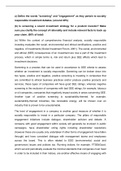
a) Define the words "screening" and "engagement" as they pertain to socially
responsible investment debates. (around 40%)
(b) Is screening a sound investment strategy for a prudent investor? Make
sure you clarify the concept of rationality and include relevant facts to back up
your claim. (60% of total)
(a) Within the context of comprehensive financial analysis, socially responsible
investing evaluates the social, environmental and ethical ramifications, positive and
negative, of investments (Social Investment Forum, 2001). The social, environmental
and ethical (SEE) consequences of an investment are now a part of the investment
process, which in simple terms is, risk and return plus SEE effects which lead to
investment decisions.
Screening is a process that can be used in accordance to SEE criteria to assess
whether an investment is socially responsible. Screening can be broken down into
two types, positive and negative, positive screening is investing in companies that
are committed to ethical business practices and/or produce positive products and
services, these types of companies will have good SEE ratings, whereas negative
screening is the exclusion of companies with bad SEE ratings, for example, tobacco
or oil companies, companies that negatively impact society in areas concerning SEE.
Another type of positive screening is sustainability-themed, for example,
sustainability-themed industries, like renewable energy, will be chosen over an
industry that is proven to be unsustainable.
The level of engagement in a company is another good measure of whether it is
socially responsible to invest in a particular company. The pillars of responsible
engagement initiatives include dialogue, shareholder activism and debate. A
company with good engagement within society will generally be involved in public
campaigns, have shareholder voting rights including shareholder resolutions
(however these are usually only undertaken if other forms of engagement have fallen
through) and have consistent dialogue with management teams and employees
across the board. This is often related to ESG (environmental, social and
governance) issues and policies too. Running indices, for example, FTSE4Good,
which set and periodically evaluate the minimal standards that companies must meet
in order to be included in their indices, are another effective means of engaging with
, companies to push them to improve their practices. An example of social
engagement from a company is Yahoo! Inc. in 2006, following the company’s
exposure in the public after it handed over user information to Chinese security
officials, who then imprisoned this user. In 2007 the founder of Yahoo! Inc. stated the
company’s dedication to human rights and freedom of speech online. This change in
policy from Yahoo! Inc. shows how engagement by a company can positively impact
its customers and thus the whole community (Dimson, Karakas & Li, 2015).
Both screening and engagement play a part in socially responsible investments, one
allows companies to examine whether a company or industry is worth investing in
(when the worth is compared to SEE criteria), and the other shows to the public how
a company reacts to and with SEE, or ESG issues.
(b) The dictionary definition of rationality is “the quality of being based on or in
accordance with reason or logic”. As rationality is essentially having and using
reason, it would be suitable to refer to Kantian ethics when discussing whether or not
screening is a good strategy for a rational investor. A Kantian would first need to
determine what the investor’s desired outcomes are. For sake of time, I have chosen
to define a rational investor as an investor who is seeking the most return with the
smallest amount of risk (although a whole other argument could be had into whether
this is the correct approach to take). As described before, screening uses information
analysis to determine whether an investment is suitable and in accordance with SEE
criteria. I would suggest the argument is not whether screening is a rational process,
instead, whether screening produces financial results that a rational investor would
be satisfied with.
There are both arguments for and against SRI screening and the empirical research
into the relationship between screening and financial performance is inconclusive.
Supporters of SRI screening say that this approach generates comparatively high
returns and generally lowers the investment’s risk, this is argued because chosen
companies are less likely to face law suits, are more likely to encourage brand
loyalty (from both customers and employees, increasing profits and decreasing turn
over) and are less susceptible to negative media attention and regulatory risk. Some
responsible investment debates. (around 40%)
(b) Is screening a sound investment strategy for a prudent investor? Make
sure you clarify the concept of rationality and include relevant facts to back up
your claim. (60% of total)
(a) Within the context of comprehensive financial analysis, socially responsible
investing evaluates the social, environmental and ethical ramifications, positive and
negative, of investments (Social Investment Forum, 2001). The social, environmental
and ethical (SEE) consequences of an investment are now a part of the investment
process, which in simple terms is, risk and return plus SEE effects which lead to
investment decisions.
Screening is a process that can be used in accordance to SEE criteria to assess
whether an investment is socially responsible. Screening can be broken down into
two types, positive and negative, positive screening is investing in companies that
are committed to ethical business practices and/or produce positive products and
services, these types of companies will have good SEE ratings, whereas negative
screening is the exclusion of companies with bad SEE ratings, for example, tobacco
or oil companies, companies that negatively impact society in areas concerning SEE.
Another type of positive screening is sustainability-themed, for example,
sustainability-themed industries, like renewable energy, will be chosen over an
industry that is proven to be unsustainable.
The level of engagement in a company is another good measure of whether it is
socially responsible to invest in a particular company. The pillars of responsible
engagement initiatives include dialogue, shareholder activism and debate. A
company with good engagement within society will generally be involved in public
campaigns, have shareholder voting rights including shareholder resolutions
(however these are usually only undertaken if other forms of engagement have fallen
through) and have consistent dialogue with management teams and employees
across the board. This is often related to ESG (environmental, social and
governance) issues and policies too. Running indices, for example, FTSE4Good,
which set and periodically evaluate the minimal standards that companies must meet
in order to be included in their indices, are another effective means of engaging with
, companies to push them to improve their practices. An example of social
engagement from a company is Yahoo! Inc. in 2006, following the company’s
exposure in the public after it handed over user information to Chinese security
officials, who then imprisoned this user. In 2007 the founder of Yahoo! Inc. stated the
company’s dedication to human rights and freedom of speech online. This change in
policy from Yahoo! Inc. shows how engagement by a company can positively impact
its customers and thus the whole community (Dimson, Karakas & Li, 2015).
Both screening and engagement play a part in socially responsible investments, one
allows companies to examine whether a company or industry is worth investing in
(when the worth is compared to SEE criteria), and the other shows to the public how
a company reacts to and with SEE, or ESG issues.
(b) The dictionary definition of rationality is “the quality of being based on or in
accordance with reason or logic”. As rationality is essentially having and using
reason, it would be suitable to refer to Kantian ethics when discussing whether or not
screening is a good strategy for a rational investor. A Kantian would first need to
determine what the investor’s desired outcomes are. For sake of time, I have chosen
to define a rational investor as an investor who is seeking the most return with the
smallest amount of risk (although a whole other argument could be had into whether
this is the correct approach to take). As described before, screening uses information
analysis to determine whether an investment is suitable and in accordance with SEE
criteria. I would suggest the argument is not whether screening is a rational process,
instead, whether screening produces financial results that a rational investor would
be satisfied with.
There are both arguments for and against SRI screening and the empirical research
into the relationship between screening and financial performance is inconclusive.
Supporters of SRI screening say that this approach generates comparatively high
returns and generally lowers the investment’s risk, this is argued because chosen
companies are less likely to face law suits, are more likely to encourage brand
loyalty (from both customers and employees, increasing profits and decreasing turn
over) and are less susceptible to negative media attention and regulatory risk. Some