Inhoud
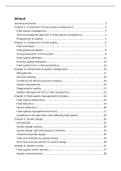
Learning outcomes................................................................................................. 3
Chapter 1: Introduction to food quality management............................................3
Food quality management................................................................................... 3
Techno-managerial approach in food quality management................................4
Perspectives on quality....................................................................................... 5
Chapter 2: Introduction to food quality...................................................................6
Food processes.................................................................................................... 7
Food quality perception....................................................................................... 8
Conceptualisation of food quality........................................................................9
Food quality attributes...................................................................................... 11
Extrinsic quality attributes................................................................................ 13
Food quality from a chain perspective..............................................................13
Chapter 3: Introduction to quality management..................................................14
Management..................................................................................................... 15
Decision-making................................................................................................ 16
Conditions for effective decision-making...........................................................18
Quality management......................................................................................... 19
Organising for quality........................................................................................ 21
Quality management from a chain perspective................................................22
Chapter 4: Food quality management principles..................................................24
Food quality relationship................................................................................... 24
Food behaviour.................................................................................................. 25
Human behaviour.............................................................................................. 26
Food quality management functions.................................................................27
Conditions in the agri-food chain affecting food quality....................................29
Chapter 5: Quality design..................................................................................... 30
Introduction....................................................................................................... 30
Quality design process...................................................................................... 30
Quality design and technological conditions.....................................................32
Customer-oriented design................................................................................. 33
Tools and methods for quality design...............................................................34
Structures and procedures for quality design...................................................36
Chapter 6: Quality control.................................................................................... 37
Food quality control function............................................................................. 37
Quality control process...................................................................................... 38
, Quality control and technological conditions.....................................................39
Product-process and resource control in food production.................................40
Tools and methods for quality control...............................................................41
Structures and procedures for quality control...................................................43
Chapter 7: Quality improvement..........................................................................44
Quality improvement process........................................................................... 45
Quality gurus on improvement..........................................................................46
Tools and methods for quality improvement.....................................................47
Structures and procedures for quality improvement.........................................49
Commitment and competencies for quality improvement................................50
Chapter 8: Quality assurance............................................................................... 51
Quality assurance process................................................................................. 51
Quality assurance and technological conditions................................................53
Quality assurance standards and guidelines.....................................................53
Tools and methods for quality assurance..........................................................56
Structures and procedures for quality assurance..............................................57
Commitment and competencies for quality assurance.....................................60
Chapter 9: Quality policy and strategy.................................................................60
The quality policy and strategy process............................................................61
Quality policy and technological conditions......................................................62
Total quality management................................................................................ 62
Tools and methods for quality strategy and policy............................................63
Value chain concept.......................................................................................... 64
Structures and procedures for quality policy and strategy................................65
,Learning outcomes
Describe different concepts of food quality and quality management and
the relation to food quality
o Chapters 1 - 3
Describe the food quality management principles, and apply them in
problem analysis
o Chapter 4
Explain every food quality management function, its elements and the
relation to food quality
o Chapters 4 - 9
Chapter 1: Introduction to food quality management
Our general view is that food quality management is a necessary activity in
realising food quality in food production processes. We consider various
challenges confronting today’s food quality managers. To understand food quality
management, it is important to see food quality management as a set of
activities as well as challenges to be dealt with.
Food quality management
Food quality (FQ) and quality management (QM) are the two basic components of
food quality management. It deals with the physical aspects of quality as well as
managing the people who have to realise it and applies to all stages in the agri-
food production chain.
Characterisation of the agri-food production chain
The agri-food production chain refers to the chain in which people transform
agricultural products into food products for use and consumption. Agri-food
production chains differ from other product manufacturing chains as agriculture
and food products are living systems. They usually have a restricted shelf life, are
harvested seasonally, are mostly heterogeneous, and have large variability.
Moreover, they may contain hidden safety risks, such as chemical contaminants
or pathogens, which usually cannot be visually detected. These characteristics
have consequences for activities, such as storage technology and conditions,
packaging, tracking and tracing systems, and quality control and assurance
systems.
Importance of food quality
In the last few decades, awareness of the importance of food quality has
increased in agri- and food businesses worldwide, as they have had to cope with
multiple serious food scandals with a major impact on human and animal health,
which in turn have led to considerable consequences for control and assurance of
food safety.
Food quality and obviously food safety
issues are commonly due to a combination
of multiple causes, and these causes are
often embedded in different systems.
Luning and Marcelis (2006) discussed the
complexity of food quality management
from the perspective of ambiguity and
uncertainty inherent to the dynamic and
complex character of the food and human
, (social) systems involved in producing food quality. Ambiguity commonly
describes ‘a fact of something having more than one possible meaning and
therefore possibly causing confusing’; ‘open to more than one interpretation’;
‘lack of understanding of mechanism’. The term uncertainty usually describes ‘a
situation involving insecurity and/or unknown information’; ‘lack of knowledge of
obtainable facts’. Ambiguity and uncertainty in FQM are inherent to the dynamic
character of the food and people (social) systems involved in the realisation of
food quality.
The outcome of food quality management is not fully predictable because of the
complexity of both food and human (social) systems. However, at the same time,
food businesses must reach predictive and guaranteed quality levels. What often
happens in practice, when having to deal with complex systems, is that there is a
tendency to reduce it to a more simple system. A simple system, which one can
understand, enables a straightforward choice of solutions. Likewise, despite its
complexity, people usually consider good quality a rather controllable process.
Consequently, people introduce straightforward mechanisms of control to
manage the variation in outcome. Quality/safety management systems
commonly use procedures and control circles as mechanism to control and
assure food quality. After implementation, however, it often appears in practice
that food businesses do not achieve the intended results and that there is a lack
of understanding of the reasons why. One should, therefore, acknowledge that
complex systems are not fully predictable.
As described by Van Mil et al., complex systems are systems that are part of
continuously changing, self-organising, interdependent, and adaptive systems in
our world. Multiple factors determine their behaviour and they are in a
continuous state of flus. One cannot infer the response of a combination of
factors from the response of each factor. Factors exist on different time and
length scales ad refer to various disciplines, and a reductionistic analysis is,
therefore, incomplete. Likewise, one cannot just approach FQM issues from one
discipline because of the dynamic and complex characteristics of both food
production systems and the people involved in the production of agri-materials
and food products.
Techno-managerial approach in food quality management
Based on the characteristics of food and human systems and the character of
food quality management, we developed a techno-managerial approach to food
quality management research. Within this approach, we described the food
system as the whole range of product properties and dynamic food processes.
Food behaviour is the result of the outcomes of the food system over time, a food
system is subject to a food production system, which is the whole range of
product activities and technological conditions that are necessary to realise the
desired product properties. The complexity and variability of these food
production systems encompass:
Heterogeneity of food products due to their complex structure,
heterogenous distribution of constituents, and compartments;
Variation in composition and concentrations due to cultivar and breeding
differences, seasonal influences, weather and harvesting conditions;
Continuous decay of quality attributes due to a wide range of food
processes, like microbial, physical, biochemical, chemical and physiological
processes;
Interactions between food processes;
Learning outcomes................................................................................................. 3
Chapter 1: Introduction to food quality management............................................3
Food quality management................................................................................... 3
Techno-managerial approach in food quality management................................4
Perspectives on quality....................................................................................... 5
Chapter 2: Introduction to food quality...................................................................6
Food processes.................................................................................................... 7
Food quality perception....................................................................................... 8
Conceptualisation of food quality........................................................................9
Food quality attributes...................................................................................... 11
Extrinsic quality attributes................................................................................ 13
Food quality from a chain perspective..............................................................13
Chapter 3: Introduction to quality management..................................................14
Management..................................................................................................... 15
Decision-making................................................................................................ 16
Conditions for effective decision-making...........................................................18
Quality management......................................................................................... 19
Organising for quality........................................................................................ 21
Quality management from a chain perspective................................................22
Chapter 4: Food quality management principles..................................................24
Food quality relationship................................................................................... 24
Food behaviour.................................................................................................. 25
Human behaviour.............................................................................................. 26
Food quality management functions.................................................................27
Conditions in the agri-food chain affecting food quality....................................29
Chapter 5: Quality design..................................................................................... 30
Introduction....................................................................................................... 30
Quality design process...................................................................................... 30
Quality design and technological conditions.....................................................32
Customer-oriented design................................................................................. 33
Tools and methods for quality design...............................................................34
Structures and procedures for quality design...................................................36
Chapter 6: Quality control.................................................................................... 37
Food quality control function............................................................................. 37
Quality control process...................................................................................... 38
, Quality control and technological conditions.....................................................39
Product-process and resource control in food production.................................40
Tools and methods for quality control...............................................................41
Structures and procedures for quality control...................................................43
Chapter 7: Quality improvement..........................................................................44
Quality improvement process........................................................................... 45
Quality gurus on improvement..........................................................................46
Tools and methods for quality improvement.....................................................47
Structures and procedures for quality improvement.........................................49
Commitment and competencies for quality improvement................................50
Chapter 8: Quality assurance............................................................................... 51
Quality assurance process................................................................................. 51
Quality assurance and technological conditions................................................53
Quality assurance standards and guidelines.....................................................53
Tools and methods for quality assurance..........................................................56
Structures and procedures for quality assurance..............................................57
Commitment and competencies for quality assurance.....................................60
Chapter 9: Quality policy and strategy.................................................................60
The quality policy and strategy process............................................................61
Quality policy and technological conditions......................................................62
Total quality management................................................................................ 62
Tools and methods for quality strategy and policy............................................63
Value chain concept.......................................................................................... 64
Structures and procedures for quality policy and strategy................................65
,Learning outcomes
Describe different concepts of food quality and quality management and
the relation to food quality
o Chapters 1 - 3
Describe the food quality management principles, and apply them in
problem analysis
o Chapter 4
Explain every food quality management function, its elements and the
relation to food quality
o Chapters 4 - 9
Chapter 1: Introduction to food quality management
Our general view is that food quality management is a necessary activity in
realising food quality in food production processes. We consider various
challenges confronting today’s food quality managers. To understand food quality
management, it is important to see food quality management as a set of
activities as well as challenges to be dealt with.
Food quality management
Food quality (FQ) and quality management (QM) are the two basic components of
food quality management. It deals with the physical aspects of quality as well as
managing the people who have to realise it and applies to all stages in the agri-
food production chain.
Characterisation of the agri-food production chain
The agri-food production chain refers to the chain in which people transform
agricultural products into food products for use and consumption. Agri-food
production chains differ from other product manufacturing chains as agriculture
and food products are living systems. They usually have a restricted shelf life, are
harvested seasonally, are mostly heterogeneous, and have large variability.
Moreover, they may contain hidden safety risks, such as chemical contaminants
or pathogens, which usually cannot be visually detected. These characteristics
have consequences for activities, such as storage technology and conditions,
packaging, tracking and tracing systems, and quality control and assurance
systems.
Importance of food quality
In the last few decades, awareness of the importance of food quality has
increased in agri- and food businesses worldwide, as they have had to cope with
multiple serious food scandals with a major impact on human and animal health,
which in turn have led to considerable consequences for control and assurance of
food safety.
Food quality and obviously food safety
issues are commonly due to a combination
of multiple causes, and these causes are
often embedded in different systems.
Luning and Marcelis (2006) discussed the
complexity of food quality management
from the perspective of ambiguity and
uncertainty inherent to the dynamic and
complex character of the food and human
, (social) systems involved in producing food quality. Ambiguity commonly
describes ‘a fact of something having more than one possible meaning and
therefore possibly causing confusing’; ‘open to more than one interpretation’;
‘lack of understanding of mechanism’. The term uncertainty usually describes ‘a
situation involving insecurity and/or unknown information’; ‘lack of knowledge of
obtainable facts’. Ambiguity and uncertainty in FQM are inherent to the dynamic
character of the food and people (social) systems involved in the realisation of
food quality.
The outcome of food quality management is not fully predictable because of the
complexity of both food and human (social) systems. However, at the same time,
food businesses must reach predictive and guaranteed quality levels. What often
happens in practice, when having to deal with complex systems, is that there is a
tendency to reduce it to a more simple system. A simple system, which one can
understand, enables a straightforward choice of solutions. Likewise, despite its
complexity, people usually consider good quality a rather controllable process.
Consequently, people introduce straightforward mechanisms of control to
manage the variation in outcome. Quality/safety management systems
commonly use procedures and control circles as mechanism to control and
assure food quality. After implementation, however, it often appears in practice
that food businesses do not achieve the intended results and that there is a lack
of understanding of the reasons why. One should, therefore, acknowledge that
complex systems are not fully predictable.
As described by Van Mil et al., complex systems are systems that are part of
continuously changing, self-organising, interdependent, and adaptive systems in
our world. Multiple factors determine their behaviour and they are in a
continuous state of flus. One cannot infer the response of a combination of
factors from the response of each factor. Factors exist on different time and
length scales ad refer to various disciplines, and a reductionistic analysis is,
therefore, incomplete. Likewise, one cannot just approach FQM issues from one
discipline because of the dynamic and complex characteristics of both food
production systems and the people involved in the production of agri-materials
and food products.
Techno-managerial approach in food quality management
Based on the characteristics of food and human systems and the character of
food quality management, we developed a techno-managerial approach to food
quality management research. Within this approach, we described the food
system as the whole range of product properties and dynamic food processes.
Food behaviour is the result of the outcomes of the food system over time, a food
system is subject to a food production system, which is the whole range of
product activities and technological conditions that are necessary to realise the
desired product properties. The complexity and variability of these food
production systems encompass:
Heterogeneity of food products due to their complex structure,
heterogenous distribution of constituents, and compartments;
Variation in composition and concentrations due to cultivar and breeding
differences, seasonal influences, weather and harvesting conditions;
Continuous decay of quality attributes due to a wide range of food
processes, like microbial, physical, biochemical, chemical and physiological
processes;
Interactions between food processes;