Nursing Theories And Nursing Practice 4th Edition By Smith Parker Test Bank
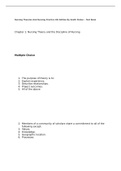
Nursing Theories And Nursing Practice 4th Edition By Smith Parker Test Bank Nursing Theories And Nursing Practice 4th Edition By Smith Parker – Test Bank Chapter 1: Nursing Theory and the Discipline of Nursing Multiple Choice 1. The purpose of theory is to: 2. Explain experience. 3. Describe relationships. 4. Project outcomes. 5. All of the above 2. Members of a community of scholars share a commitment to all of the following except: 3. Values. 4. Knowledge. 5. Geographic location. 6. Processes. 3. ____________________ and ____________________ structures are essential to any discipline and are inherent in nursing theories. 4. Paradigm and metaparadigm 5. Syntactical and conceptual 6. Middle and grand 7. Language and symbol 4. Books and periodicals are examples of: 5. Communication networks. 6. Heritage of literature. 7. Nursing organizations. 8. Nursing discipline. 5. The basic building blocks of theories are: 6. Concepts and their definitions. 7. Statements of relationships. 8. Concepts and statements of relationships. 9. Empirical indicators. 6. Nursing theories: 7. Are discovered in nature. 8. Serve as exact representations of reality. 9. Are invented by humans. 10. Cannot be modified. 7. A paradigm is defined as a: 8. Worldview. 9. General framework. 10. Set of shared perspectives held by members of a discipline. 11. All of the above 8. The dependence of nursing theory development on human imagination is an attribute of nursing as a(n): 9. Occupation. 10. Discipline. 11. Vocation. 12. Profession. 9. The primary purpose of nursing theory is to: 10. Structure nursing knowledge. 11. Demonstrate creativity in nursing. 12. Guide the thinking about, being, and doing of nursing. 13. Organize nursing curricula. 10. The first nursing theorist who identified the importance of theory in nursing was: 11. Virginia Henderson. 12. Hildegard Peplau. 13. Lydia Hall. 14. Florence Nightingale. 11. The most abstract level of knowledge is the: 12. Paradigm. 13. Metaparadigm. 14. Theory. 15. Concept. 12. Statements of enduring values or beliefs are considered: 13. Conceptual models. 14. Philosophies. 15. Grand theories. 16. Practice theories. 13. Theories that include specific concepts, are broad enough to be useful in complex situations, and can be empirically tested are called: 14. Grand theories. 15. Middle-range theories. 16. Practice-level theories. 17. Nursing theories. 14. Theories that have the most limited scope and level of abstraction that are useful in within a specific range of nursing situations are called: 15. Grand theories. 16. Middle-range theories. 17. Practice-level theories. 18. Nursing theories. 15. The name for the boundaries or focus of a discipline is: 16. Imagination. 17. Domain. 18. Tradition. 19. Value. True/False 1. Every discipline has a unique focus that directs inquiry and distinguishes it from other fields of study. 2. Theories are not discovered in nature but are human inventions 3. Science generally evolves as a smooth, regular, continuing path of knowledge development over time
Written for
Document information
- Uploaded on
- October 15, 2021
- Number of pages
- 133
- Written in
- 2021/2022
- Type
- Exam (elaborations)
- Contains
- Questions & answers
Subjects
-
nursing theories and nursing practice 4th edition by smith parker test bank

Also available in package deal