Accounting II summary
Financial accounting
Users of financial statements:
- Shareholders main focus of IFRS on these capital providers
- Banks/ creditors
- Customers/ suppliers
- Employees
- Government (regulators, tax authorities)
- ‘Society’ (e.g. NGOs)
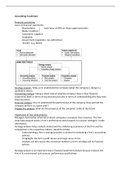
Strategy analysis: helps us to understand the company (what the company is doing in a
qualitative sense).
Accounting analysis: taking a closer look at what the company does in their financial
statements. Both in terms of key decisions but also in terms of understanding why they took
these decisions.
Financial analysis: tries to understand the performance of the company. How well did the
company perform in a given year?
Prospective analysis: what are the prospects of the company? Looks at the future.
Importance of four-step analysis:
Managers have better information about companies’ prospects than investors. The four
steps help analysts assess a firm’s performance and prospects to uncover managers’ inside
information.
Strategy analysis helps analysts understand the underlying economics of the firm and the
competition in the respective industry. Benefits include:
- Understanding a firm’s strategy provides a context for evaluating a firm’s accounting
policies.
- It highlights the firm’s profit drivers and major areas of risk.
- Analysts can also assess the connection between a firm’s strategy and its financial
policies.
Strategy analysis is an important step in financial statement analysis because it places the
firm in its environment and assesses performance qualitatively.
, Accounting analysis helps the analyst to reverse accounting distortions by adjusting the
reported figures. Financial analysis uses financial data to evaluate a firm’s performance.
Prospective analysis synthesizes the insights from the previous steps to make predictions
about a firm’s future and estimate the value of the firm.
Accounting distortions arise because
- There is a mismatch between accounting standards and underlying economics
- Analysts disagree with management’s discretionary decisions.
Financial reporting and capital markets
Accrual accounting: transactions are recorded in the period in which they occur rather than
when we have the cashflow.
à Revenue is recognized when it is earned.
Factors that affect financial reporting:
- Accounting conventions and standards (“local dialects”)
o European listed firms are required to apply IFRS.
- Auditing and the regulatory framework
IFRS – International Financial Reporting Standards
à Set of accounting rules for the financial statements of public companies that are
intended to make them consistent, transparent and easily comparable around the world.
Financial accounting
Users of financial statements:
- Shareholders main focus of IFRS on these capital providers
- Banks/ creditors
- Customers/ suppliers
- Employees
- Government (regulators, tax authorities)
- ‘Society’ (e.g. NGOs)
Strategy analysis: helps us to understand the company (what the company is doing in a
qualitative sense).
Accounting analysis: taking a closer look at what the company does in their financial
statements. Both in terms of key decisions but also in terms of understanding why they took
these decisions.
Financial analysis: tries to understand the performance of the company. How well did the
company perform in a given year?
Prospective analysis: what are the prospects of the company? Looks at the future.
Importance of four-step analysis:
Managers have better information about companies’ prospects than investors. The four
steps help analysts assess a firm’s performance and prospects to uncover managers’ inside
information.
Strategy analysis helps analysts understand the underlying economics of the firm and the
competition in the respective industry. Benefits include:
- Understanding a firm’s strategy provides a context for evaluating a firm’s accounting
policies.
- It highlights the firm’s profit drivers and major areas of risk.
- Analysts can also assess the connection between a firm’s strategy and its financial
policies.
Strategy analysis is an important step in financial statement analysis because it places the
firm in its environment and assesses performance qualitatively.
, Accounting analysis helps the analyst to reverse accounting distortions by adjusting the
reported figures. Financial analysis uses financial data to evaluate a firm’s performance.
Prospective analysis synthesizes the insights from the previous steps to make predictions
about a firm’s future and estimate the value of the firm.
Accounting distortions arise because
- There is a mismatch between accounting standards and underlying economics
- Analysts disagree with management’s discretionary decisions.
Financial reporting and capital markets
Accrual accounting: transactions are recorded in the period in which they occur rather than
when we have the cashflow.
à Revenue is recognized when it is earned.
Factors that affect financial reporting:
- Accounting conventions and standards (“local dialects”)
o European listed firms are required to apply IFRS.
- Auditing and the regulatory framework
IFRS – International Financial Reporting Standards
à Set of accounting rules for the financial statements of public companies that are
intended to make them consistent, transparent and easily comparable around the world.