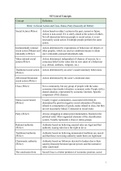
ST3 List of Concepts
Concept Definition
Week 1A Social Action and Class, Status, Party (basically all Weber)
Social Action (Weber) Action based on other’s action in the past, current or future.
Action is non-social if it is solely aimed at the action of others.
Not all interaction between people is social action, it is not
necessarily social action if multiple people perform the same
action.
Instrumentally rational Action determined by expectations of behaviour (of objects or
social action (Means-end other people), which are used as conditions/means to attain
rationality) (Weber) one’s (rationally pursued/calculated) ends.
Value-rational social Action determined, independent of chances of success, by a
action (Weber) conscious belief in the value (for its own sake) of a behaviour
(e.g. ethical, aesthetic, religious, etc.).
Traditional social action Action determined by an actor’s usual/customary behaviours.
(Weber)
Affectional/Emotional Action determined by the actor’s emotional state.
social action (Weber)
Class (Weber) Not a community, but any group of people with the same,
economic/class/market situation: economic order. People with a
shared situation, represented by economic interests. Specific
component of life chances.
Status (social honor) Usually (vague) communities, associated with lifestyle,
(Weber) determined by positive/negative social estimation of honour,
related to consumption of goods; status related to class, but they
are not necessarily linked. Connected to social order.
Party (Weber) Always struggling to attain power/domination. Rooted in the
political order. Most organized elements of the classification
system. Usually represents a class or status groups.
Rational authority Authority based on believing enacted rules are legal and that
(Weber) authority issuing rules have the right to do so
Traditional authority Authority based on believing immemorial traditions are sacred
(Weber) and that those exercising authority under them are legitimate
Charismatic authority Authority based on followers devoted to leaders due to their
(Weber) sanctity/character/heroism/special powers and the normative
order sanctioned
The conclusion from Social Class is a better predictor of economic position, social
1
, Chan and Goldthorpe (in status is a better predictor of lifestyle preferences (e.g. cultural
lecture 1) tastes)
The elephant graph by The poorest and European groups experience very little income
Branco Milanovic (as growth. Middle class has stagnated/decreased. The extremely
mentioned in lecture 1) rich have become much richer.
The Great Gatsby Curve More inequality is associated with less mobility across the
by Miles Cook (as generations. Social mobility tells us about the openness of a
mentioned in lecture 1) society, so is it easy/possible to move between [SE] groups?
Week 1B Inequality according to structural functionalism
Structural Functionalism Social phenomena are explained from the functions they have
according to Parsons to create continuity and stability of society. Society guided by a
shared set of norms & values. To maintain stability & order →
Social continuity.
Who was Talcott 1902-1979, connected to Harvard, translated Weber and took
Parsons? European sociology to the U.S. He was Merton’s mentor. He
connected Durkheim (internalization of norms to maintain
social order), Weber (social action, rationalization) and Pareto
(equilibrium).
AGIL system (Parsons - Adaptation (A); a system must adapt to its environment
influenced by Weber’s Goal attainment (G); a system must define and achieve its
ideas) primary goal
Integration (I); a system must regulate the interrelationship of
its component parts as well as the relationships between the
A-G-L societal community (the law)
Latency (L); pattern maintenance, a system must maintain and
renew both the motivation of individuals and the cultural
patterns that create and sustain that motivation, fiduciary
system (i.e. school, family)
Social system (Parsons) A social system consists of a plurality of individual actors
interacting with each other in a situation which has at least a
physical or environmental aspect, actors who are motivated in
terms of a tendency of the “optimization of gratification” and
those whose relation to their situations, including each other, is
defined and mediated in terms of a system of culturally
structured and shared symbols”
Cultural system Major force binding the action system. Culture = patterned,
(Parsons) ordered system of symbols that are objects of orientation to
actors, internalized aspects of the personality system, and
institutionalized patterns in the social system
Personality system Controlled by cultural and social systems. Personality = the
(Parsons) organized system of orientation and motivation of action of the
2
Concept Definition
Week 1A Social Action and Class, Status, Party (basically all Weber)
Social Action (Weber) Action based on other’s action in the past, current or future.
Action is non-social if it is solely aimed at the action of others.
Not all interaction between people is social action, it is not
necessarily social action if multiple people perform the same
action.
Instrumentally rational Action determined by expectations of behaviour (of objects or
social action (Means-end other people), which are used as conditions/means to attain
rationality) (Weber) one’s (rationally pursued/calculated) ends.
Value-rational social Action determined, independent of chances of success, by a
action (Weber) conscious belief in the value (for its own sake) of a behaviour
(e.g. ethical, aesthetic, religious, etc.).
Traditional social action Action determined by an actor’s usual/customary behaviours.
(Weber)
Affectional/Emotional Action determined by the actor’s emotional state.
social action (Weber)
Class (Weber) Not a community, but any group of people with the same,
economic/class/market situation: economic order. People with a
shared situation, represented by economic interests. Specific
component of life chances.
Status (social honor) Usually (vague) communities, associated with lifestyle,
(Weber) determined by positive/negative social estimation of honour,
related to consumption of goods; status related to class, but they
are not necessarily linked. Connected to social order.
Party (Weber) Always struggling to attain power/domination. Rooted in the
political order. Most organized elements of the classification
system. Usually represents a class or status groups.
Rational authority Authority based on believing enacted rules are legal and that
(Weber) authority issuing rules have the right to do so
Traditional authority Authority based on believing immemorial traditions are sacred
(Weber) and that those exercising authority under them are legitimate
Charismatic authority Authority based on followers devoted to leaders due to their
(Weber) sanctity/character/heroism/special powers and the normative
order sanctioned
The conclusion from Social Class is a better predictor of economic position, social
1
, Chan and Goldthorpe (in status is a better predictor of lifestyle preferences (e.g. cultural
lecture 1) tastes)
The elephant graph by The poorest and European groups experience very little income
Branco Milanovic (as growth. Middle class has stagnated/decreased. The extremely
mentioned in lecture 1) rich have become much richer.
The Great Gatsby Curve More inequality is associated with less mobility across the
by Miles Cook (as generations. Social mobility tells us about the openness of a
mentioned in lecture 1) society, so is it easy/possible to move between [SE] groups?
Week 1B Inequality according to structural functionalism
Structural Functionalism Social phenomena are explained from the functions they have
according to Parsons to create continuity and stability of society. Society guided by a
shared set of norms & values. To maintain stability & order →
Social continuity.
Who was Talcott 1902-1979, connected to Harvard, translated Weber and took
Parsons? European sociology to the U.S. He was Merton’s mentor. He
connected Durkheim (internalization of norms to maintain
social order), Weber (social action, rationalization) and Pareto
(equilibrium).
AGIL system (Parsons - Adaptation (A); a system must adapt to its environment
influenced by Weber’s Goal attainment (G); a system must define and achieve its
ideas) primary goal
Integration (I); a system must regulate the interrelationship of
its component parts as well as the relationships between the
A-G-L societal community (the law)
Latency (L); pattern maintenance, a system must maintain and
renew both the motivation of individuals and the cultural
patterns that create and sustain that motivation, fiduciary
system (i.e. school, family)
Social system (Parsons) A social system consists of a plurality of individual actors
interacting with each other in a situation which has at least a
physical or environmental aspect, actors who are motivated in
terms of a tendency of the “optimization of gratification” and
those whose relation to their situations, including each other, is
defined and mediated in terms of a system of culturally
structured and shared symbols”
Cultural system Major force binding the action system. Culture = patterned,
(Parsons) ordered system of symbols that are objects of orientation to
actors, internalized aspects of the personality system, and
institutionalized patterns in the social system
Personality system Controlled by cultural and social systems. Personality = the
(Parsons) organized system of orientation and motivation of action of the
2