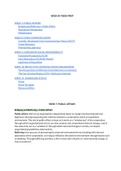
WEEK BY WEEK PREP
WEEK 7: PUBLIC AFFAIRS
Bridging and Buffering + Public Affairs
Reputation Management
Mediatization
WEEK 8: CRISIS COMMUNICATION
Coombs’ Situational Crisis Communication Theory (SCCT)
Frame Alignment
Maintaining Legitimacy
WEEK 9: CORPORATE SOCIAL RESPONSIBILITY
Functional Perspective of CSR
Four Dimensions of CSR [4Is Model]
Legitimacy & Reputation
WEEK 10: REFLECTIVE COMMUNICATION MANAGEMENT
Two Perspectives on PR/Corp Com [Habermas vs. Luhmann]
The Four Existing Models of CM + Reflective Umbrella
WEEK 11: POWER AND ETHICS
Power
Power Struggles
Discourse Ethics
WEEK 7: PUBLIC AFFAIRS
Bridging and Buffering + Public Affairs
Public affairs refers to an organisation’s department that is in charge of preserving external
legitimacy through organizing the interface between a corporation and its sociopolitical
environment. The role of public affairs is dual, as it works as a “window out” of the corporation
through which organizational actors can view, analyse and comprehend external changes, and at
the same time, act as a “window in” through which external changes in society can impact
organizational guidelines and practices.
Buffering is the process of preventing the external environment from intruding with internal
operations of the corporation, or trying to influence the external environment through means such
as lobbying. Through buffering activities, a firm resists and is hostile to environmental change, or
tries to control it.
, Bridging occurs when firms try to adapt organisational activities so that they comply with external
expectations. The firm takes active measures in order to meet regulations imposed by the
industry. Through bridging, firms try to adapt to the changes in its external environment.
Reputation Management
Organisational reputation is the established impression that stakeholders have of an organization
over time. It is an abstract interpretation of an organization, often referred to as an “intangible
asset”. The organisational recipe for reputation management consists of three steps; the
formulation of strategy, self-presentation and measurement. In the first stage, the current
identity of the organisation should be examined so that a clear idealised vision of how the
company should be perceived in the future can be determined. In order to do this, the organisation
must focus on its internal identity, by understanding what lies at the heart of the company. When
the company’s organisation identity is examined, it can then establish who and what it wants to be,
and work towards closing the gap between the actual identity and its desired identity.
Two problems arise here, and that is the politics problem and the consistency problem. This is
because this step does not consider the degree to which some organizational actors (employees)
are free to choose the strategy or the identity of the corporation. Circumstances regarding the
political nature of public organisations enact restrictions on the extent to which employees are
free in making strategic decisions. The second issue is the consistency problem, as difficulties
arising in creating consistency in the reputation platform are seldom discussed. Oftentimes, there
are contradictions between different policies as well as between the policies and implementation.
The second step in the reputation management process is self-presentation. In this step, the
organisation should present a unified voice to both internal and external members. This step
should close the gap between organisational identity and reputation. This can be done through
verbal descriptions or graphical profiles, and should be consistent, authentic and transparent. If
successful, the organisational identity and brand image will be aligned and will ultimately result in
an emotional bond between the company and the external audience.
The problems that may arise here are the charisma problem and the uniqueness problem. This
occurs because not all organisations are capable of developing emotional appeal, as they are
unable to speak freely and are limited in the ways that they can represent themselves. In addition,
legitimacy, which is assisted by similarity also causes problems. This highlights the uniqueness
problem, as in order to be legitimate, organisations often strive for similarity.
The third stage is the measurement stage. In this stage, organisations measure audience
perceptions using a variety of measurement tools so that they can monitor and evaluate their
reputation. The idea behind this is to use the results to further close the gap between identity and
image in the future. Thus, reputation surveys can aid in the process of evaluating the current
situation and be used to readjust the strategy.
The problem that arises in this stage is the excellence strategy. This is because public organisations
are more limited in the way that they operate and hence will score poorly on reputation rankings
WEEK 7: PUBLIC AFFAIRS
Bridging and Buffering + Public Affairs
Reputation Management
Mediatization
WEEK 8: CRISIS COMMUNICATION
Coombs’ Situational Crisis Communication Theory (SCCT)
Frame Alignment
Maintaining Legitimacy
WEEK 9: CORPORATE SOCIAL RESPONSIBILITY
Functional Perspective of CSR
Four Dimensions of CSR [4Is Model]
Legitimacy & Reputation
WEEK 10: REFLECTIVE COMMUNICATION MANAGEMENT
Two Perspectives on PR/Corp Com [Habermas vs. Luhmann]
The Four Existing Models of CM + Reflective Umbrella
WEEK 11: POWER AND ETHICS
Power
Power Struggles
Discourse Ethics
WEEK 7: PUBLIC AFFAIRS
Bridging and Buffering + Public Affairs
Public affairs refers to an organisation’s department that is in charge of preserving external
legitimacy through organizing the interface between a corporation and its sociopolitical
environment. The role of public affairs is dual, as it works as a “window out” of the corporation
through which organizational actors can view, analyse and comprehend external changes, and at
the same time, act as a “window in” through which external changes in society can impact
organizational guidelines and practices.
Buffering is the process of preventing the external environment from intruding with internal
operations of the corporation, or trying to influence the external environment through means such
as lobbying. Through buffering activities, a firm resists and is hostile to environmental change, or
tries to control it.
, Bridging occurs when firms try to adapt organisational activities so that they comply with external
expectations. The firm takes active measures in order to meet regulations imposed by the
industry. Through bridging, firms try to adapt to the changes in its external environment.
Reputation Management
Organisational reputation is the established impression that stakeholders have of an organization
over time. It is an abstract interpretation of an organization, often referred to as an “intangible
asset”. The organisational recipe for reputation management consists of three steps; the
formulation of strategy, self-presentation and measurement. In the first stage, the current
identity of the organisation should be examined so that a clear idealised vision of how the
company should be perceived in the future can be determined. In order to do this, the organisation
must focus on its internal identity, by understanding what lies at the heart of the company. When
the company’s organisation identity is examined, it can then establish who and what it wants to be,
and work towards closing the gap between the actual identity and its desired identity.
Two problems arise here, and that is the politics problem and the consistency problem. This is
because this step does not consider the degree to which some organizational actors (employees)
are free to choose the strategy or the identity of the corporation. Circumstances regarding the
political nature of public organisations enact restrictions on the extent to which employees are
free in making strategic decisions. The second issue is the consistency problem, as difficulties
arising in creating consistency in the reputation platform are seldom discussed. Oftentimes, there
are contradictions between different policies as well as between the policies and implementation.
The second step in the reputation management process is self-presentation. In this step, the
organisation should present a unified voice to both internal and external members. This step
should close the gap between organisational identity and reputation. This can be done through
verbal descriptions or graphical profiles, and should be consistent, authentic and transparent. If
successful, the organisational identity and brand image will be aligned and will ultimately result in
an emotional bond between the company and the external audience.
The problems that may arise here are the charisma problem and the uniqueness problem. This
occurs because not all organisations are capable of developing emotional appeal, as they are
unable to speak freely and are limited in the ways that they can represent themselves. In addition,
legitimacy, which is assisted by similarity also causes problems. This highlights the uniqueness
problem, as in order to be legitimate, organisations often strive for similarity.
The third stage is the measurement stage. In this stage, organisations measure audience
perceptions using a variety of measurement tools so that they can monitor and evaluate their
reputation. The idea behind this is to use the results to further close the gap between identity and
image in the future. Thus, reputation surveys can aid in the process of evaluating the current
situation and be used to readjust the strategy.
The problem that arises in this stage is the excellence strategy. This is because public organisations
are more limited in the way that they operate and hence will score poorly on reputation rankings