BIOS-242 Week 2 Quiz – Questions Answers (GRADED A) Solutions | Already Graded A.
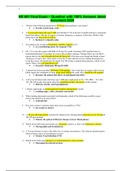
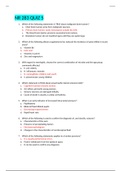
BIOS 242 WEEK 2 QUIZ (TCO 3) Which of the following is a magnifying lens? Objective Ocular Condenser Dark-field stop Both the objective and the ocular Chapter 4: Microscopy, Staining, and Classification (TCO 3) The microscope preferred for viewing living specimens is the microscope. bright-field Correct Answer phase-contrast scanning electron scanning tunneling transmission electron Chapter 4: Microscopy, Staining, and Classification (TCO 3) If a microbiology lab technician left the safranin out of the Gram stain procedure, what would be the result? All cells would be purple. Gram-positive cells would be purple, and Gram-negative cells would be colorless. All cells would be pink. Gram-positive cells would be pink, and Gram-negative cells would be purple. Gram-positive cells would be colorless, and Gram-negative cells would be pink. Chapter 4: Microscopy, Staining, and Classification Question 4 2 / 2 pts (TCO 3) The rules of naming organisms are called . taxonomy nomenclature classification binomials identification Chapter 4: Microscopy, Staining, and Classification (TCO 3) All of the following are associated with smear preparation except . agglutination of the specimen spreading the specimen onto a slide fixation using heat killing the microbes in the specimen fixation using methanol or formalin Chapter 4: Microscopy, Staining, and Classification (TCO 4) A(n) organism is one that requires oxygen for growth. anaerobic facultative anaerobic aerotolerant Correct Answer obligate aerobic Both aerotolerant and anaerobic Chapter 6: Microbial Growth and Nutrition (TCO 4) A microbe that grows only at the bottom of a tube of thioglycollate medium is probably a(n) . obligate aerobe facultative anaerobe aerotolerant anaerobe microaerophile obligate anaerobe Chapter 6: Microbial Growth and Nutrition (TCO 4) A fastidious organism might be grown on which of the following types of media? Transport media Reducing media Enriched media Differential media Selective media Chapter 6: Microbial Growth and Nutrition (TCO 4) Another term for the logarithmic growth of bacterial cells is . generation time exponential growth arithmetic growth absorbance binary fission Chapter 6: Microbial Growth and Nutrition (TCO 4) are complex communities of various types of microbes that adhere to surfaces. Aggregates Colonies Isolates Biofilms Media Chapter 6: Microbial Growth and Nutrition (TCO 4) Explain how temperature and pH levels can influence microbial infections in the human body. Your Answer: In the body there are areas that have different pH levels and different temperatures. Microbial infections require the perfect environment to grow. So if the microbe you are trying to grow likes low temperature and a low pH it would not grow well in the stomach or the vagina. The temperature and the pH can be the cause of life or death of a microbe. In the stomach a common infection is H.pylori because it like the acidic environment. Chapter 6: Microbial Growth and Nutrition All microbes have particular ranges of temperature and pH within which they exist. When the temperature or pH of their environment falls outside this range, their growth is inhibited, and they may even die as a result of the adverse conditions. Therefore, only those microbes whose pH and temperature requirements match those conditions found in the human body will be able to grow and reproduce there. For example, because the temperature of the human body is 37° C, only mesophiles can reproduce there. In addition, the pH of most tissues and fluids in the body is 6.5–7.5, which matches the pH requirements of neutrophiles. Therefore, it is not surprising that most human pathogens are mesophiles and neutrophiles. But this is not always the case. Some microbes have adapted to environments that would otherwise be extremely hostile to most microbes. A good example is the bacterium Helicobacter pylori, which is able to live in the extremely acidic conditions of the stomach by secreting substances that help to neutralize the acid. The result is an infection that can lead to stomach ulcers. Quiz Score: 26 out of 30 Submission Details: Show Less
Written for
- Institution
-
Chamberlain College Of Nursing
- Course
-
BIOS 242
Document information
- Uploaded on
- October 7, 2021
- Number of pages
- 8
- Written in
- 2021/2022
- Type
- Exam (elaborations)
- Contains
- Questions & answers
Subjects
-
another term for the logarithmic growth of bacterial cells is
-
a fastidious organism might be grown on which of the following types of media
-
a microbe that grows only at the bottom of a tube of thio

Also available in package deal