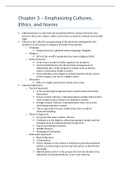
Chapter 3 – Emphasizing Cultures,
Ethics, and Norms
Ethnocentrism is a self-centered mentality held by a group of people who
perceive their own culture, ethics, and norms, as natural, rational and morally
right
Culture is the collective programming of the mind that distinguishes the
members of one group or category of people from another
o Language
Lingua franca is a global business language (English)
o Religion
85% of the world’s population has some religious belief
o Social Structure
Is the way a society broadly organizes its members
Social stratification is the hierarchical arrangement of
individuals into social categories (strata) such as classes,
castes, or divisions within a society
Social mobility is the degree to which members from a lower
social category can rise to a higher status
o Education
Kids are taught mainstream values and norms
Cultural Differences
o Context Approach
Is the underlying background upon which social interaction
takes place
In low-context cultures, communication is usually taken at face
value without much reliance on unspoken context
In high-context cultures, communication relies a lot on the
underlying unspoken context
This is important because without this there could be
misunderstanding
o Clusters Approach
Countries that share similar cultures
Civilization is the highest cultural grouping of people and the
broadest level of cultural identity people have
Ronen and Shenkar Clusters
GLOBE Clusters
Huntington Civilization
o Dimension Approach
More influential
5 dimensions
Power distance is the extent to which less powerful members
within a country expect and accept that power is distributed
unequally
Individualism refers to the perspective that the identity of an
individual is fundamentally his or her own whereas
Ethics, and Norms
Ethnocentrism is a self-centered mentality held by a group of people who
perceive their own culture, ethics, and norms, as natural, rational and morally
right
Culture is the collective programming of the mind that distinguishes the
members of one group or category of people from another
o Language
Lingua franca is a global business language (English)
o Religion
85% of the world’s population has some religious belief
o Social Structure
Is the way a society broadly organizes its members
Social stratification is the hierarchical arrangement of
individuals into social categories (strata) such as classes,
castes, or divisions within a society
Social mobility is the degree to which members from a lower
social category can rise to a higher status
o Education
Kids are taught mainstream values and norms
Cultural Differences
o Context Approach
Is the underlying background upon which social interaction
takes place
In low-context cultures, communication is usually taken at face
value without much reliance on unspoken context
In high-context cultures, communication relies a lot on the
underlying unspoken context
This is important because without this there could be
misunderstanding
o Clusters Approach
Countries that share similar cultures
Civilization is the highest cultural grouping of people and the
broadest level of cultural identity people have
Ronen and Shenkar Clusters
GLOBE Clusters
Huntington Civilization
o Dimension Approach
More influential
5 dimensions
Power distance is the extent to which less powerful members
within a country expect and accept that power is distributed
unequally
Individualism refers to the perspective that the identity of an
individual is fundamentally his or her own whereas