Chapter 8: Interfaces
Introduction
Static description of internal pressure and surface tension of a liquid
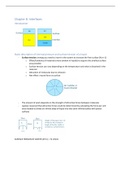
- Surface tension: energy you need to insert in the system to increase the free surface [N.m-1]
o Effect/tendency of materials (more evident in liquids) to acquire the smallest surface
area possible
o Surface tension can vary depending on the temperature and what is dissolved in the
material
o Attraction of molecules due to cohesion
o Net effect: inward force at surface
- The amount of work depends on the strength of attractive forces between molecules
- Laplace reasoned that attractive forces could be determined by calculating the force per unit
area needed to divide an infinite body of liquid into two semi-infinite bodies with planar
surfaces
SURFACE TENSION OF WATER (25°C) = 72 mN/m
, Measurement of interfacial tension
Wilhelmy-plate method
- Plate is placed on top of a liquid surface and then because of the existence of a surface
tension, the force F, needed to keep the plate in position just on top of the liquid surface is
given by;
- Measuring the force needed to keep the plate in position and substituting the other
experimentally accessible variables = surface tension
Du Nouy-ring method
- A ring is placed on top of a liquid surface. The force needed to keep the ring on top of a
liquid surface is given by;
Surface active molecules
Surfactants, amphiphiles and emulsifiers
- Usually the main ingredients of an emulsion or foam do not mix spontaneously
- Shaking and stirring can help the missing process but will eventually lead to phase
separation after a while (oil and water)
- Addition of surface-active molecules leads to a situation where this phases separation does
not occur so readily anymore
o The surface-active molecules reside mostly in the interface of the water droplet
dispersed in the oil, thereby stabilizing the interface of the water droplets against
coalescence
- SURFace-ACTive molecules are also called surfactants
o Other terms; amphiphiles (have affinity for both liquids because they have a
hydrophobic and hydrophilic part)
o Emulsifiers, help to form emulsions
o Also called soaps
- The surfactants are not only in the interface but divides themselves over the water phase, oil
phase and interface so that the chemical potential is equal in all phases
Introduction
Static description of internal pressure and surface tension of a liquid
- Surface tension: energy you need to insert in the system to increase the free surface [N.m-1]
o Effect/tendency of materials (more evident in liquids) to acquire the smallest surface
area possible
o Surface tension can vary depending on the temperature and what is dissolved in the
material
o Attraction of molecules due to cohesion
o Net effect: inward force at surface
- The amount of work depends on the strength of attractive forces between molecules
- Laplace reasoned that attractive forces could be determined by calculating the force per unit
area needed to divide an infinite body of liquid into two semi-infinite bodies with planar
surfaces
SURFACE TENSION OF WATER (25°C) = 72 mN/m
, Measurement of interfacial tension
Wilhelmy-plate method
- Plate is placed on top of a liquid surface and then because of the existence of a surface
tension, the force F, needed to keep the plate in position just on top of the liquid surface is
given by;
- Measuring the force needed to keep the plate in position and substituting the other
experimentally accessible variables = surface tension
Du Nouy-ring method
- A ring is placed on top of a liquid surface. The force needed to keep the ring on top of a
liquid surface is given by;
Surface active molecules
Surfactants, amphiphiles and emulsifiers
- Usually the main ingredients of an emulsion or foam do not mix spontaneously
- Shaking and stirring can help the missing process but will eventually lead to phase
separation after a while (oil and water)
- Addition of surface-active molecules leads to a situation where this phases separation does
not occur so readily anymore
o The surface-active molecules reside mostly in the interface of the water droplet
dispersed in the oil, thereby stabilizing the interface of the water droplets against
coalescence
- SURFace-ACTive molecules are also called surfactants
o Other terms; amphiphiles (have affinity for both liquids because they have a
hydrophobic and hydrophilic part)
o Emulsifiers, help to form emulsions
o Also called soaps
- The surfactants are not only in the interface but divides themselves over the water phase, oil
phase and interface so that the chemical potential is equal in all phases