Property Law: Introduction to Modern Land Law.
What is Property Law?
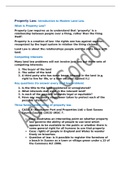
Property Law requires us to understand that ‘property’ is a
relationship between people over a thing, rather than the thing
itself.
Property is a creation of law- the rights one has against another,
recognized by the legal system in relation the thing claimed.
Land Law is about the relationships people and the state have with
land.
Competing Interests
Many land law problems will not involve just two but three sets of
competing interests:
1. The buyer of the land
2. The seller of the land
3. A third party who has some lesser interest in the land (e.g.
right to live for life, or a loan secured against it.)
Key questions (to answer every land law problem)
1. Is the title to the land registered or unregistered?
2. What interests may exist in the relevant land?
3. Is each of the possible interests legal or equitable?
4. Have any necessary steps been taken to protect each of the
possible interests?
Three fundamental ideas of property law.
CASE: R (Newhaven Port and Properties Ltd) v East Sussex
County Council (2015) UKSC 7.
Case illustrates an interesting point on whether property
law governs the ability of people to use land which
appears to be available to the public or whether there is
some general right for all humans to use that property
Case: rights of people in England and Wales to wander
freely on breaches.
Question of law: is it possible to register the foreshow of
a beach in Sussex as a town or village green under s.15 of
the Commons Act 2006.
, The beach at Newhaven had become available for the
public for purposes of bathing after the area had been
developed as a new harbor mouth.
The area could not be registered under the Commons Act
2006.
This case shows that property law protects the ownership and
other rights of people in property.
The fact that someone has the ability to exert power to create
rules over the use of land makes it more likely that any use of
the land is only permitted because the landowner grants the
right to do so.
Two axioms of English Property law
1. Legal property interest: ‘Legal rights bind the world’
2. Equitable property interest: ‘Equity rights bind the world
with the exception of the bona fide purchaser of the legal
estate for value without notice’
What is Property Law?
Property Law requires us to understand that ‘property’ is a
relationship between people over a thing, rather than the thing
itself.
Property is a creation of law- the rights one has against another,
recognized by the legal system in relation the thing claimed.
Land Law is about the relationships people and the state have with
land.
Competing Interests
Many land law problems will not involve just two but three sets of
competing interests:
1. The buyer of the land
2. The seller of the land
3. A third party who has some lesser interest in the land (e.g.
right to live for life, or a loan secured against it.)
Key questions (to answer every land law problem)
1. Is the title to the land registered or unregistered?
2. What interests may exist in the relevant land?
3. Is each of the possible interests legal or equitable?
4. Have any necessary steps been taken to protect each of the
possible interests?
Three fundamental ideas of property law.
CASE: R (Newhaven Port and Properties Ltd) v East Sussex
County Council (2015) UKSC 7.
Case illustrates an interesting point on whether property
law governs the ability of people to use land which
appears to be available to the public or whether there is
some general right for all humans to use that property
Case: rights of people in England and Wales to wander
freely on breaches.
Question of law: is it possible to register the foreshow of
a beach in Sussex as a town or village green under s.15 of
the Commons Act 2006.
, The beach at Newhaven had become available for the
public for purposes of bathing after the area had been
developed as a new harbor mouth.
The area could not be registered under the Commons Act
2006.
This case shows that property law protects the ownership and
other rights of people in property.
The fact that someone has the ability to exert power to create
rules over the use of land makes it more likely that any use of
the land is only permitted because the landowner grants the
right to do so.
Two axioms of English Property law
1. Legal property interest: ‘Legal rights bind the world’
2. Equitable property interest: ‘Equity rights bind the world
with the exception of the bona fide purchaser of the legal
estate for value without notice’