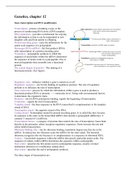
Genetics, chapter 12
Gene transcription and RNA modification
Transcription - process of making a copy or the
process of synthesizing RNA from a DNA template.
DNA replication - provides a mechanism for copying
the information so that it can be transmitted to new
daughter cells and from parent to offspring.
Protein-encoding genes - carry the information for the
amino acid sequence of a polypeptide.
Messenger RNA (mRNA) - the first product (RNA)
after transcription of a protein-encoding gene.
Translation - polypeptide synthesis in which the
sequence of nucleotides within the mRNA determines
the sequence of amino acids in a polypeptide. One or
more polypeptides then assemble into a functional
protein.
The central dogma of genetics - The making of a
functional protein. (See figure)
Regulatory sites - influence whether a gene is turned on or off.
Regulatory sequence - site for the binding of regulatory proteins. The role of regulatory
proteins is to influence the rate of transcription.
Gene expression - process by which the information within a gene is used to produce a
functional product (RNA or protein). —> molecular level. Along with environmental factors,
it determines the organism's traits.
Promoter - site for RNA polymerase binding; signals the beginning of transcription.
Terminator - signals the end of transcription.
Template strand - the base sequence in the RNA transcribed is complementary to the template
strand of DNA.
Nontemplate strand - the opposite strand of the DNA.
Coding strand - Nontemplate strand for protein-encoding genes. It is called like this, because
its sequence is the same as the transcribed mRNA that encodes a polypeptide (difference: it
contains T instead of U (mRNA)).
Transcription factors - a category of proteins that controls the rate of transcription. Some bind
directly to the promotor, others recognize regulatory sequences. Some increase the rate and
others inhibit transcription.
Ribosome-binding sites - site for ribosome binding; translation begins near this site in the
mRNA. In eukaryotes, the ribosome scans the mRNA for the start codon. The bacterial
ribosome recognizes this site because it is complementary to a sequence in ribosomal RNA.
Codons - 3 nucleotide sequences within the mRNA that specify particular amino acids. The
sequence of codons within mRNA determines the sequence within a polypeptide.
Start codon - specifies the first amino acid in a polypeptide sequence, usually a formyl
methionine (bacteria) or a methionine (eukaryotes).
Stop codon - specifies the end of polypeptide synthesis.
The three stages of transcription are:
, Initiation - the promoter functions as a recognition site for transcription factors. The
transcription factors enable RNA polymerase to bind to the promotor. Following
binding, the DNA is denatured into a bubble known as the open complex.
Elongation - RNA polymerase slides along the DNA in an open complex to synthesize
RNA.
Termination - A terminator is reached that causes RNA polymerase and the RNA
transcript to dissociate from the DNA.
RNA polymerase - enzyme that synthesizes RNA. For transcription to occur, the DNA strand
must be separated.
Question 12.1
1. Which of the following base sequences is used during transcription?
A. promoter and terminator
B. start and stop codons
C. ribosome-binding site
D. both A and B.
2. The three stages of transcription are:
A. Initiation, ribosome binding, and termination
B. elongation, ribosome binding, and termination
C. initiation, elongation, and termination
D. Initiation, regulation, and termination.
3. What is the function of a promoter?
4. What is the difference between transcription and translation?
(Find the answers at the end of this document)
mRNA - RNA that is transcribed from the base sequence within DNA and then directs the
synthesis in particular polypeptides. It acts as a genetic messenger (From DNA to ribosome)
to provide the information for protein synthesis. When a virus infects a bacterial cell, a virus-
specific RNA is made and rapidly associates with preexisting ribosomes in the cell.
A promoter is a short sequence of DNA that is necessary to initiate transcription. It directs the
exact location for the initiation of transcription. By convention, the bases in a promoter
sequence are numbered in relation to the transcriptional start site - This site is the first
nucleotide used as a template for transcription and is denoted +1. Most of the promoter is
labeled with negative numbers that identify the number of bases preceding the beginning of
transcription.
Pribnow box - the sequence 5'-TATAAT-3', that is important for the promotor to function. It
is at the -10 site. The other sequence, also on the top DNA strand, is the on the -35 site: 5'-
TTGACA-3'.
Consensus sequence - The most commonly occurring bases within a specific type of
sequence. This sequence is efficiently recognized by proteins that initiate transcription. For
many bacterial genes, a strong correlation is found between the maximal rate of transcription
and the degree to which the -35 and -10 sequences agree with their consensus sequence.
Mutations in the -35 or -10 sequences that lessen their similarity to the consensus sequences
typically slow down the rate of transcription.
Gene transcription and RNA modification
Transcription - process of making a copy or the
process of synthesizing RNA from a DNA template.
DNA replication - provides a mechanism for copying
the information so that it can be transmitted to new
daughter cells and from parent to offspring.
Protein-encoding genes - carry the information for the
amino acid sequence of a polypeptide.
Messenger RNA (mRNA) - the first product (RNA)
after transcription of a protein-encoding gene.
Translation - polypeptide synthesis in which the
sequence of nucleotides within the mRNA determines
the sequence of amino acids in a polypeptide. One or
more polypeptides then assemble into a functional
protein.
The central dogma of genetics - The making of a
functional protein. (See figure)
Regulatory sites - influence whether a gene is turned on or off.
Regulatory sequence - site for the binding of regulatory proteins. The role of regulatory
proteins is to influence the rate of transcription.
Gene expression - process by which the information within a gene is used to produce a
functional product (RNA or protein). —> molecular level. Along with environmental factors,
it determines the organism's traits.
Promoter - site for RNA polymerase binding; signals the beginning of transcription.
Terminator - signals the end of transcription.
Template strand - the base sequence in the RNA transcribed is complementary to the template
strand of DNA.
Nontemplate strand - the opposite strand of the DNA.
Coding strand - Nontemplate strand for protein-encoding genes. It is called like this, because
its sequence is the same as the transcribed mRNA that encodes a polypeptide (difference: it
contains T instead of U (mRNA)).
Transcription factors - a category of proteins that controls the rate of transcription. Some bind
directly to the promotor, others recognize regulatory sequences. Some increase the rate and
others inhibit transcription.
Ribosome-binding sites - site for ribosome binding; translation begins near this site in the
mRNA. In eukaryotes, the ribosome scans the mRNA for the start codon. The bacterial
ribosome recognizes this site because it is complementary to a sequence in ribosomal RNA.
Codons - 3 nucleotide sequences within the mRNA that specify particular amino acids. The
sequence of codons within mRNA determines the sequence within a polypeptide.
Start codon - specifies the first amino acid in a polypeptide sequence, usually a formyl
methionine (bacteria) or a methionine (eukaryotes).
Stop codon - specifies the end of polypeptide synthesis.
The three stages of transcription are:
, Initiation - the promoter functions as a recognition site for transcription factors. The
transcription factors enable RNA polymerase to bind to the promotor. Following
binding, the DNA is denatured into a bubble known as the open complex.
Elongation - RNA polymerase slides along the DNA in an open complex to synthesize
RNA.
Termination - A terminator is reached that causes RNA polymerase and the RNA
transcript to dissociate from the DNA.
RNA polymerase - enzyme that synthesizes RNA. For transcription to occur, the DNA strand
must be separated.
Question 12.1
1. Which of the following base sequences is used during transcription?
A. promoter and terminator
B. start and stop codons
C. ribosome-binding site
D. both A and B.
2. The three stages of transcription are:
A. Initiation, ribosome binding, and termination
B. elongation, ribosome binding, and termination
C. initiation, elongation, and termination
D. Initiation, regulation, and termination.
3. What is the function of a promoter?
4. What is the difference between transcription and translation?
(Find the answers at the end of this document)
mRNA - RNA that is transcribed from the base sequence within DNA and then directs the
synthesis in particular polypeptides. It acts as a genetic messenger (From DNA to ribosome)
to provide the information for protein synthesis. When a virus infects a bacterial cell, a virus-
specific RNA is made and rapidly associates with preexisting ribosomes in the cell.
A promoter is a short sequence of DNA that is necessary to initiate transcription. It directs the
exact location for the initiation of transcription. By convention, the bases in a promoter
sequence are numbered in relation to the transcriptional start site - This site is the first
nucleotide used as a template for transcription and is denoted +1. Most of the promoter is
labeled with negative numbers that identify the number of bases preceding the beginning of
transcription.
Pribnow box - the sequence 5'-TATAAT-3', that is important for the promotor to function. It
is at the -10 site. The other sequence, also on the top DNA strand, is the on the -35 site: 5'-
TTGACA-3'.
Consensus sequence - The most commonly occurring bases within a specific type of
sequence. This sequence is efficiently recognized by proteins that initiate transcription. For
many bacterial genes, a strong correlation is found between the maximal rate of transcription
and the degree to which the -35 and -10 sequences agree with their consensus sequence.
Mutations in the -35 or -10 sequences that lessen their similarity to the consensus sequences
typically slow down the rate of transcription.