Mid Term Study Guide NR 507 ALL ANSWERS SOLUTION 99.9% CORRECT AID GRADE A+
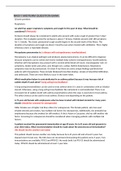
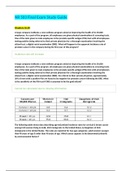
1. Concepts of anticholinergic drug and asthma: Anticholinergic drugs: block acetylcholine binding (primarily in the lungs) -promotes bronchiole dilation through decrease in the parasympathetic response (tiotropium & ipratropium) is fast acting 2. Bronchitis & associated pathogenesis: Begins with an exposure to an irritant (tobacco smoke) – activates bronchiole smooth muscle constriction- mucus secretion- release of inflammatory mediators(histamine, prostaglandins & leukotrienes) normal response to occasional airborne site irritants- over bronchitis is over long term 3 months for over 2 consecutive years- = smooth muscle hypertrophy = increase bronchoconstriction, hypertrophy and hyperplasia of goblet cells= mucus hypersecretion, epithelia cell metaplasia = non-ciliated squamous cells, migration of more WBCs to site = inflammation and fibrosis in bronchial wall, thickening and rigidity of bronchial basement membrane= narrowing of bronchial passageways : Increased mucus production- inflammation process = weight loss, loss of appetite, muscle weakness (interleukin controls appetite) increases protease activity= breakdown of elastin in the connective tissues of the lung= destruction of the wall between the alveoli and lungs = large ineffective air sacs develop-elastic recoil of bronchial wall -destroys bronchi and cant dilate and they stay constricted =air trapping : Chronic bronchitis =Dyspnea- air trapping increased mucus, increase WOB r/t chronic bronchoconstriction Cough- irritated and inflamed bronchial epithelia membrane Hypoxia & Hypercapnia -from impaired gas exchange 3. Chronic bronchitis and related acid/base disturbance: Hypercapnia (CO2 retention) = Respiratory acidosis r/t anatomical changes ventilation is compromised esp. exhalation = alveolar hyperinflation) expanded thorax) hypercapnia CO2 retention = respiratory acidosis 4. Perfusion: the actual exchange of O2 and CO2 in the bloodstream occurs via the alveoli and pulmonary capillaries: the passage of fluid to an organ or a tissue usually referring to delivery of blood to an area 5. Blood flow between the heart and lungs in chronic bronchitis: Poor ventilation leads to r to l shunting to occur= deoxygenated blood passes from r ventricle to the lungs to the l ventricle without adequate perfusion (gas exchange) the kidneys respond by secreting erythropoietin increasing RBC production the increase in RBC increase O2 carrying capacity -the increase blood volume increases the workload of the pulmonary and cardiovascular systems increasing blood volume and vasoconstriction = pulmonary HTN= increase workload on the R ventricle =cardiac hypertrophy= R side HF or Cor Pulmonale 6. Asthma signs and symptoms: Coughing esp. at night, chest tightness, shortness of breath, wheezing on exhalation, and rapid breathing: Characteristics: airway inflammation, bronchial hyperactivity, smooth muscle spasms, = excessive mucus production, hypertrophy of bronchial smooth muscle -obstruction and decrease alveolar ventilation 7. Bronchioles in asthma: There are 3 layers of the bronchiole which is a tube-like structure surrounding the lumen or airway passageway: innermost layer is composed of columnar epithelial cells and goblet cells- The outermost layer is composed of smooth muscle cells responsible for the ability of the airway to constrict and dilate – the middle layer is the laminar propria and it is embedded with connective tissue and immune cells: in asthma these protective features go overactive =inflammation response= damage to host tissue=hypertrophy of the bronchioles smooth muscle and excessive mucus production: bronchioles spasm-mucus production-obstruction 8. Alveolar hyperinflation with asthma: Increase mucus production from the goblet cells in the inflammation process forms plugs of mucus and pus and block alveolar passageways leading to air trapping and hyperinflation = erosion of airway tissue 9. Polycythemia Vera: a rare blood disease in which the body makes too many RBCs making the blood thicker than normal causing blood clots; is often a result of chronic low levels of O2 in the blood, the kidney compensates by increase secretion of erythropoetin, the primary hormone responsible for stimulating RBC production= as a result patients with chronic bronchitis will often exhibit increased HCT levels and can develop a condition called secondary polycythemia vera. 10. Mechanism of action of anticholinergic drugs to treat asthma: Anticholinergic drugs bind to muscarine receptors and block the action of acetylcholine They reduce Broncho motor tone =bronchodilation: block acetylcholine binding, bronchodilation, decrease parasympathetic response Cardiovascular: 11. Review concepts of Cardiac Output: Cardiac Output= Heart rate x Stroke volume Cardiac output: is the volume of blood ejected by each ventricle per minute (75 bpm x 70ml = 5.25 L/min) 5 L of blood in the body= every drop of blood circulates the body -per heartbeat per minute Cardiac output decrease with age at a rate of 1% per year after the age of 30 (other factors can accelerate the rate of decline) Cardiac output is a key component of HF and is important to understand the connection b/t HR & SV: DECRESE in HR (longer filling time) INCREASE in SV INCREASE in HR (shorter fill time) DECREASE in SV 12. Concepts of cardiac contractility: Contractility (ionotropic state) Contractility is determined by Calcium availability and its interaction with actin and myosin Contractility INCREASES by sympathetic stimulation (fever, anxiety, increased thyroxine levels; factors that increase the cellular metabolic rate will increase strength of muscle cell at least temporarily) Contractility DECREASES by low levels of ATP (ischemia, hypoxia, acidosis; Factors that decrease the amount of energy available to the muscle cell will decrease strength of contraction) 13. Preload and Afterload Concepts: PRELOAD: is the degree of myocardial fiber length stretch before contraction; the degree of stretch will be influenced by the end diastolic ventricular volume (EDV) [edv= is the amount of blood entering each ventricle during diastoles {approx. 120- 130 ml}] PRELOAD IS LOADING THE HEART WITH BLOOD Preload can be INCREASED by CHF, hypervolemia, (increased BV) Preload can be DECREASED by cardiac tamponade, hypovolemia (hemorrhage or dehydration) AFTERLOAD is the amount of tension the ventricle must develop during systole to open the semilunar valves and eject blood into circulation: Afterload is influenced by: Ventricular wall thickness= muscle strength Arterial pressure= resistance to ejection Ventricle chamber size= blood volume capacity Ventricular wall thickness: muscle strength (increase thickness the more muscle mass decrease tension force required for ejection) Arterial pressure: resistance to ejection (increase pressure within the pulmonary or systemic vessels = increase tension required for ejection) Ventricle chamber size: increased blood volume (increase tension required for ejection) AFTERLOAD INCREASED by systemic HTN, valve disease, COPD = pulmonary HTN AFTERLOAD DECREASED by hypotension or vasodilation, such as SHOCK LAPELACE LAW: THE HEART MUST WORK HARDER (INCREASE TENSION) WHEN HEART MUSCLE IS WEAK: VENTRICLES ARE HYPERTROPHIED (HOLD MORE VOLUME) AND OR PULMONARY OR SYSTEMIC BP IS ELEVATED 14. Systole and Diastole: Systole and Diastole are two phases of the cardiac cycle: they occur as the heart beats, pumping blood through the body. Systole: occurs when the heart contracts to pump blood OUT Diastole: occurs when the heart RELAXES after contraction Systole causes the ejection of blood into the aorta and pulmonary trunk. Systole, period of contraction of the ventricles of the heart that occurs between the first and the second heart sound Diastole period of relaxation of the heart muscle accompanied by the filing of the chambers with blood
Written for
Document information
- Uploaded on
- September 25, 2021
- Number of pages
- 13
- Written in
- 2021/2022
- Type
- Other
- Person
- Unknown
Subjects
-
1 concepts of anticholinergic drug and asthma
-
2 bronchitis amp associated pathogenesis
-
3 chronic bronchitis and related acidbase disturbance
-
4 perfusion
-
5 blood flow between the heart and l