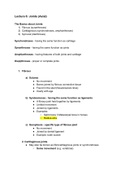
Lecture 6: Joints (Axial)
The Basics about Joints
1) Fibrous (synarthroses)
2) Cartilaginous (synchondroses, amphiarthroses)
3) Synovial (diarthroses)
Synchondroses - having the same function as cartilage
Synarthroses - having the same function as joints
Amphiarthroses - having features of both joints and cartilage
Dia(a)throses - proper or complete joints
1. Fibrous
a) Sutures
● No movement
● Bones joined by fibrous connective tissue
● Found in the skull (fissure/suture lines)
● Ossify with age
b) Syndesmoses - having the same function as ligaments
● A fibrous joint held together by ligaments
● Limited movement
● Joined by ligaments
● Examples:
○ Splint bone 3 Metacarpal bone in horses
○ Radius-ulna
c) Gomphosis - specific type of fibrous joint
● No movement
● Joined by dental ligament
● Example: tooth socket
2. Cartilaginous joints
● May also be known as fibrocartilaginous joints or synchondroses
○ Some movement (e.g. vertebrae)
, ○ Little to no movement (e.g. pubic and mandibular symphyses,
first sternocostal joint) - symphysis
○ Temporary (long bones - fusing and ossifying eventually) -
synchondroses
3. Synovial joints
● Found throughout the body
● Highly mobile, termed diarthrosis
● Specialized structures provide support to these joints
Components of Synovial Joints
1. Joint cavity enclosed by a joint capsule
(filled with synovial fluid)
● Lubricates joint and facilitates
movement
2. Synovial membrane (inner part of the
capsule)
● Responsible for producing
synovial fluid
3. Articular cartilage (bone surface, hyaline)
● Very soft compared to periosteum
4. Fibrous layer of joint capsule
5. Periosteum (outside of bone)
6. Compact bone
Stabilisers: ligaments - fibrous connective
tissue and menisci
● Can take the form of simple fibrous tissues = ligaments or tendons (rarer)
● Have these in all synovial joints
● Meniscus = structure to help synovial joints
7 Types of Synovial Joints
Joint type Movement Examples
Plane (almost flat) Translation (sliding) Intervertebral
Hinge (ginglymus) Pendular Metacarpophalangeal,
elbow
Pivot (peg in a ring) Rotation Alantoaxial
, Condylar (condyles in the Flexion-extension and Stifle (femorotibial),
concave adjacent rotation temporomandibular
surfaces)
Ellipsoidal (ovoid in a Flexion-extension, Radiocarpal joint
cavity) abduction-adduction
Saddle (mix of Flexion-extension, Distal interphalangeal
convex-concave surfaces) Abduction-adduction, joint
Rotation
Spheroidal Almost all types of Coxofemoral joint,
(ball-and-socket) movement scapulohumeral joint
Synovial Connections Pained Her Brain Guaranteed
Synovial Condylar Pivot Hinge Ball and Socket Gliding
Summary
1. Fibrous
a) Sutures (skull bones)
b) Syndesmoses (radius-ulna)
c) Gomphosis (tooth socket)
2. Cartilaginous
a) Synchondroses (epiphyseal plates and hyoid apparatus)
b) Symphysis (mandible, pubic bone, intervertebral)
3. Synovial
● The rest of the body (almost)
● Seven types according to movement
Joints associated with the axial skeleton (9)
1. Sutures
2. Mandibular symphysis
3. Synchondroses hyoid apparatus - skull
4. Synovial temporomandibular joints (TMTJ)
5. Synovial occipital bone and C1
6. Cartilaginous intervertebral
7. Vertebra to rib
8. Rib to rib
9. Rib to sternum (sternocostal)
The Basics about Joints
1) Fibrous (synarthroses)
2) Cartilaginous (synchondroses, amphiarthroses)
3) Synovial (diarthroses)
Synchondroses - having the same function as cartilage
Synarthroses - having the same function as joints
Amphiarthroses - having features of both joints and cartilage
Dia(a)throses - proper or complete joints
1. Fibrous
a) Sutures
● No movement
● Bones joined by fibrous connective tissue
● Found in the skull (fissure/suture lines)
● Ossify with age
b) Syndesmoses - having the same function as ligaments
● A fibrous joint held together by ligaments
● Limited movement
● Joined by ligaments
● Examples:
○ Splint bone 3 Metacarpal bone in horses
○ Radius-ulna
c) Gomphosis - specific type of fibrous joint
● No movement
● Joined by dental ligament
● Example: tooth socket
2. Cartilaginous joints
● May also be known as fibrocartilaginous joints or synchondroses
○ Some movement (e.g. vertebrae)
, ○ Little to no movement (e.g. pubic and mandibular symphyses,
first sternocostal joint) - symphysis
○ Temporary (long bones - fusing and ossifying eventually) -
synchondroses
3. Synovial joints
● Found throughout the body
● Highly mobile, termed diarthrosis
● Specialized structures provide support to these joints
Components of Synovial Joints
1. Joint cavity enclosed by a joint capsule
(filled with synovial fluid)
● Lubricates joint and facilitates
movement
2. Synovial membrane (inner part of the
capsule)
● Responsible for producing
synovial fluid
3. Articular cartilage (bone surface, hyaline)
● Very soft compared to periosteum
4. Fibrous layer of joint capsule
5. Periosteum (outside of bone)
6. Compact bone
Stabilisers: ligaments - fibrous connective
tissue and menisci
● Can take the form of simple fibrous tissues = ligaments or tendons (rarer)
● Have these in all synovial joints
● Meniscus = structure to help synovial joints
7 Types of Synovial Joints
Joint type Movement Examples
Plane (almost flat) Translation (sliding) Intervertebral
Hinge (ginglymus) Pendular Metacarpophalangeal,
elbow
Pivot (peg in a ring) Rotation Alantoaxial
, Condylar (condyles in the Flexion-extension and Stifle (femorotibial),
concave adjacent rotation temporomandibular
surfaces)
Ellipsoidal (ovoid in a Flexion-extension, Radiocarpal joint
cavity) abduction-adduction
Saddle (mix of Flexion-extension, Distal interphalangeal
convex-concave surfaces) Abduction-adduction, joint
Rotation
Spheroidal Almost all types of Coxofemoral joint,
(ball-and-socket) movement scapulohumeral joint
Synovial Connections Pained Her Brain Guaranteed
Synovial Condylar Pivot Hinge Ball and Socket Gliding
Summary
1. Fibrous
a) Sutures (skull bones)
b) Syndesmoses (radius-ulna)
c) Gomphosis (tooth socket)
2. Cartilaginous
a) Synchondroses (epiphyseal plates and hyoid apparatus)
b) Symphysis (mandible, pubic bone, intervertebral)
3. Synovial
● The rest of the body (almost)
● Seven types according to movement
Joints associated with the axial skeleton (9)
1. Sutures
2. Mandibular symphysis
3. Synchondroses hyoid apparatus - skull
4. Synovial temporomandibular joints (TMTJ)
5. Synovial occipital bone and C1
6. Cartilaginous intervertebral
7. Vertebra to rib
8. Rib to rib
9. Rib to sternum (sternocostal)