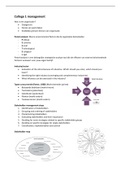
College 1 management
Wat is een organisatie?
• Doelgericht
• Divisie van werk/taken
• Duidelijke grenzen binnen een organisatie
Pestel-analysis: Macro-environmental factors die de organisatie beïnvloeden
- P olitical
- E conomic
- S ocial
- T echnological
- E cological
- L egal
Pestel-analysis is een belangrijke strategische analyse tool die de effecten van externe beïnvloedende
factoren evalueert voor jouw eigen bedrijf.
Industry/sector
• Evaluation of the attractiveness of industries. Which should you enter, which should you
leave?
• Identifying the right industry (converging and complementary industries)
• What influence can be exercised in the industry?
Typen concurrentie (Porter, 1980) (Markt betreden ja/nee)
• Bestaande bedrijven (markt-intern)
• Toetreders (potentieel)
• Substituten (potentieel)
• Klanten (markt-extern)
• Toeleveranciers (markt-extern)
Stakeholder-management steps
1. Identification of stakeholders
2. Grouping and ordering of stakeholders
3. Characterizing stakeholders
4. Evaluating stakeholders and their importance
5. Deciding for norm strategies related to specific stakeholder groups
6. Deciding on specific strategies for single stakeholders
7. Coordination, implementation and control
Stakeholder map
,Management 2 (Jasmina Rueger)
Probleem: Verschil tussen bestaande en gewenste situatie.
Problem identification: Comparison between current reality and some standard
o Past performance Decision making proces
o Previously set goals
o Other organisations
Common decision-making errors and bias
• Overconfidence
Thinking you know more than you do.
Unrealistically positive views of yourself
• Availability bias
Remembering events that are most
recent in your memory
• Immediate Gratification
Wanting immediate rewards, quick payoff
• Representation bias
Likelihood of an event based on how closely it resembles other events
• Anchoring effect
Fixate on initial information. Fail to adjust to new information later
• Selective perception
Seeing what you want to see, ignoring the opposing view
• Confirmation bias
Interpret information in a way that confirms your own assumptions
• Framing bias
Selecting and highlighting certain aspects while disregarding others
• Randomness bias
Trying to find meaning in random events
• Sunk costs error
Forgetting that current choices cannot correct the past, accept losses
• Self-serving bias
Taking credit for successes but blaming failures on outside factors
• Hindsight
Falsely believing that you would have accurately predicted the outcome after it is known
Rational Model Bounded rationality
MUST act Rationally Rational decisions but limited by ability
“perfect world” to process information
Logical and consistent choices Accept solutions are good enough rather than
to maximise value try to perfect (waste resources and time)
Benaderingen voor het nemen van beslissingen: Intuitie
• Experience based decisions
Managers make decisions based on their past experiences
• Affect-initiated decisions
Managers make decisions based on their feelings or emotions
• Cognitive based decisions
, Managers make decisions based on skills, knowledge and training
• Value or ethics-based decisions
Managers make decisions based on ethical values or culture
• Subconscious mental processing
Managers use date from their subconscious mind
Structured Problem Unstructured Problem
Straightforward and simple New and unusual
o Clear goal o Unclear goal
o Familiar Problem o Unfamiliar Problem
o Information is well defined and o Information is ambiguous and incomplete
complete Non-programmed decision
Programmed decision Unique and non-recurring decision requires a
Repetitive decision that can be handled using a custom-made approach
routine approach o At the top level, most problems managers
o Relies on previous solutions face are non-programmed
o Decision-making process is much
shorter
Solving structured problems
1. Procedures
Series of interrelated, sequential steps
> clear problem clear procedure
2. Rules
Explicit statement that tells what can
and cannot be done > simply to follow,
ensuring consistency
3. Policies
Guidelines for making decisions > often
open to personal interpretation
Advantages group decision-making Disadvantages group decision-making
More complete information Time-consuming
Diverse experiences and perspectives Minority domination
More alternatives generated Ambiguous responsibility
Increased acceptance (involvement) Pressure to conform → Groupthink
Increased legitimacy
Groupthink: Een vorm van aanpassen waarbij betrokkenen hun afwijkende, impopulair en
minderheidsstandpunt achterhouden om de indruk van overeenstemming te geven.
Why plan?
o Coordinated efforts
o Reduced uncertainty
o Reduced overlap
o Goals and standards
Types of plans
Wat is een organisatie?
• Doelgericht
• Divisie van werk/taken
• Duidelijke grenzen binnen een organisatie
Pestel-analysis: Macro-environmental factors die de organisatie beïnvloeden
- P olitical
- E conomic
- S ocial
- T echnological
- E cological
- L egal
Pestel-analysis is een belangrijke strategische analyse tool die de effecten van externe beïnvloedende
factoren evalueert voor jouw eigen bedrijf.
Industry/sector
• Evaluation of the attractiveness of industries. Which should you enter, which should you
leave?
• Identifying the right industry (converging and complementary industries)
• What influence can be exercised in the industry?
Typen concurrentie (Porter, 1980) (Markt betreden ja/nee)
• Bestaande bedrijven (markt-intern)
• Toetreders (potentieel)
• Substituten (potentieel)
• Klanten (markt-extern)
• Toeleveranciers (markt-extern)
Stakeholder-management steps
1. Identification of stakeholders
2. Grouping and ordering of stakeholders
3. Characterizing stakeholders
4. Evaluating stakeholders and their importance
5. Deciding for norm strategies related to specific stakeholder groups
6. Deciding on specific strategies for single stakeholders
7. Coordination, implementation and control
Stakeholder map
,Management 2 (Jasmina Rueger)
Probleem: Verschil tussen bestaande en gewenste situatie.
Problem identification: Comparison between current reality and some standard
o Past performance Decision making proces
o Previously set goals
o Other organisations
Common decision-making errors and bias
• Overconfidence
Thinking you know more than you do.
Unrealistically positive views of yourself
• Availability bias
Remembering events that are most
recent in your memory
• Immediate Gratification
Wanting immediate rewards, quick payoff
• Representation bias
Likelihood of an event based on how closely it resembles other events
• Anchoring effect
Fixate on initial information. Fail to adjust to new information later
• Selective perception
Seeing what you want to see, ignoring the opposing view
• Confirmation bias
Interpret information in a way that confirms your own assumptions
• Framing bias
Selecting and highlighting certain aspects while disregarding others
• Randomness bias
Trying to find meaning in random events
• Sunk costs error
Forgetting that current choices cannot correct the past, accept losses
• Self-serving bias
Taking credit for successes but blaming failures on outside factors
• Hindsight
Falsely believing that you would have accurately predicted the outcome after it is known
Rational Model Bounded rationality
MUST act Rationally Rational decisions but limited by ability
“perfect world” to process information
Logical and consistent choices Accept solutions are good enough rather than
to maximise value try to perfect (waste resources and time)
Benaderingen voor het nemen van beslissingen: Intuitie
• Experience based decisions
Managers make decisions based on their past experiences
• Affect-initiated decisions
Managers make decisions based on their feelings or emotions
• Cognitive based decisions
, Managers make decisions based on skills, knowledge and training
• Value or ethics-based decisions
Managers make decisions based on ethical values or culture
• Subconscious mental processing
Managers use date from their subconscious mind
Structured Problem Unstructured Problem
Straightforward and simple New and unusual
o Clear goal o Unclear goal
o Familiar Problem o Unfamiliar Problem
o Information is well defined and o Information is ambiguous and incomplete
complete Non-programmed decision
Programmed decision Unique and non-recurring decision requires a
Repetitive decision that can be handled using a custom-made approach
routine approach o At the top level, most problems managers
o Relies on previous solutions face are non-programmed
o Decision-making process is much
shorter
Solving structured problems
1. Procedures
Series of interrelated, sequential steps
> clear problem clear procedure
2. Rules
Explicit statement that tells what can
and cannot be done > simply to follow,
ensuring consistency
3. Policies
Guidelines for making decisions > often
open to personal interpretation
Advantages group decision-making Disadvantages group decision-making
More complete information Time-consuming
Diverse experiences and perspectives Minority domination
More alternatives generated Ambiguous responsibility
Increased acceptance (involvement) Pressure to conform → Groupthink
Increased legitimacy
Groupthink: Een vorm van aanpassen waarbij betrokkenen hun afwijkende, impopulair en
minderheidsstandpunt achterhouden om de indruk van overeenstemming te geven.
Why plan?
o Coordinated efforts
o Reduced uncertainty
o Reduced overlap
o Goals and standards
Types of plans